







Preparation and Storage


Product Notices
- This reagent has been pre-diluted for use at the recommended Volume per Test. We typically use 1 × 10^6 cells in a 100-µl experimental sample (a test).
- An isotype control should be used at the same concentration as the antibody of interest.
- Caution: Sodium azide yields highly toxic hydrazoic acid under acidic conditions. Dilute azide compounds in running water before discarding to avoid accumulation of potentially explosive deposits in plumbing.
- Source of all serum proteins is from USDA inspected abattoirs located in the United States.
- Species cross-reactivity detected in product development may not have been confirmed on every format and/or application.
- Pacific Blue™ is a trademark of Molecular Probes, Inc., Eugene, OR.
- Brilliant Violet™ 421 is a trademark of Sirigen.
- For fluorochrome spectra and suitable instrument settings, please refer to our Multicolor Flow Cytometry web page at www.bdbiosciences.com/colors.
- Please refer to www.bdbiosciences.com/us/s/resources for technical protocols.
関連製品

The TRAP1 monoclonal antibody specifically binds to CD154. CD154 is a 39 kDa type II membrane glycoprotein that is a member of the tumor necrosis factor superfamily, Tumor necrosis factor ligand superfamily member 5 (TNFSF5). CD154 is expressed on a variety of cell types including activated CD4+ T cells and some CD8+ T cells, NK cells, mast cells and basophils. CD154 is also known as CD40 ligand (CD40L); it serves as a ligand for CD40 that is expressed on B cells, macrophages, and dendritic cells. The expression of CD154 by activated T-helper cells costimulates B-cell activation and proliferation through binding to CD40 expressed on B cells. In response to T-dependent antigens, the CD154 and CD40 interaction is required for B-lymphocyte differentiation, including immunoglobulin production and isotype switching and memory B cell generation. The TRAP1 antibody can partially block T cell-B cell interaction and inhibit the subsequent proliferation, differentiation, and memory formation of B cells. It has been reported that patients with X-linked hyper-IgM syndrome have defective expression of functional CD154 due to mutations in the CD40LG gene that encodes CD154.
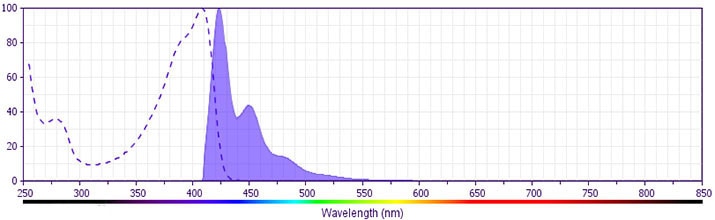
The antibody was conjugated to BD Horizon™ BV421 which is part of the BD Horizon™ Brilliant Violet™ family of dyes. With an Ex Max of 407-nm and Em Max at 421-nm, BD Horizon™ BV421 can be excited by the violet laser and detected in the standard Pacific Blue™ filter set (eg, 450/50-nm filter). BD Horizon™ BV421 conjugates are very bright, often exhibiting a 10 fold improvement in brightness compared to Pacific Blue™ conjugates.
Development References (10)
-
Altenburg A, Baldus SE, Smola H, Pfister H, Hess S. CD40 ligand-CD40 interaction induces chemokines in cervical carcinoma cells in synergism with IFN-gamma. J Immunol. 1999; 162(7):4140-4147. (Clone-specific: Immunohistochemistry). View Reference
-
Fuleihan R, Ramesh N, Horner A, et al. Cyclosporin A inhibits CD40 ligand expression in T lymphocytes. J Clin Invest. 1994; 93(3):1315-1320. (Biology). View Reference
-
Gray D, Dullforce P, Jainandunsing S. Memory B cell development but not germinal center formation is impaired by in vivo blockade of CD40-CD40 ligand interaction. J Exp Med. 1994; 180(1):141-155. (Biology). View Reference
-
Kishimoto T. Tadamitsu Kishimoto .. et al., ed. Leucocyte typing VI : white cell differentiation antigens : proceedings of the sixth international workshop and conference held in Kobe, Japan, 10-14 November 1996. New York: Garland Pub.; 1997.
-
Kroczek RA, Graf D, Brugnoni D, et al. Defective expression of CD40 ligand on T cells causes "X-linked immunodeficiency with hyper-IgM (HIGM1)". Immunol Rev. 1994; 138:39-59. (Clone-specific: Flow cytometry). View Reference
-
MacDonald KP, Nishioka Y, Lipsky PE, Thomas R. Functional CD40 ligand is expressed by T cells in rheumatoid arthritis. J Clin Invest. 1997; 100(9):2404-2414. (Clone-specific: Flow cytometry). View Reference
-
Mason D. David Mason .. et al., ed. Leucocyte typing VII : white cell differentiation antigens : proceedings of the Seventh International Workshop and Conference held in Harrogate, United Kingdom. Oxford: Oxford University Press; 2002.
-
Nishioka Y, Lipsky PE. The role of CD40-CD40 ligand interaction in human T cell-B cell collaboration. J Immunol. 1994; 153(3):1027-1036. (Biology). View Reference
-
O'Gorman MR, Zaas D, Paniagua M, Corrochano V, Scholl PR, Pachman LM. Development of a rapid whole blood flow cytometry procedure for the diagnosis of X-linked hyper-IgM syndrome patients and carriers. Clin Immunol Immunopathol. 1997; 85(2):172-181. (Biology: Flow cytometry). View Reference
-
van Kooten C, Gaillard C, Galizzi JP, et al. B cells regulate expression of CD40 ligand on activated T cells by lowering the mRNA level and through the release of soluble CD40. Eur J Immunol. 1994; 24(4):787-792. (Biology). View Reference
Please refer to Support Documents for Quality Certificates
Global - Refer to manufacturer's instructions for use and related User Manuals and Technical data sheets before using this products as described
Comparisons, where applicable, are made against older BD Technology, manual methods or are general performance claims. Comparisons are not made against non-BD technologies, unless otherwise noted.
For Research Use Only. Not for use in diagnostic or therapeutic procedures.
