







Preparation and Storage


推奨アッセイ手順
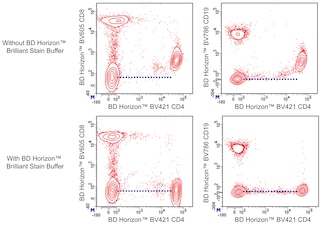
For optimal and reproducible results, BD Horizon Brilliant Stain Buffer should be used anytime two or more BD Horizon Brilliant dyes (including BD OptiBuild Brilliant reagents) are used in the same experiment. Fluorescent dye interactions may cause staining artifacts which may affect data interpretation. The BD Horizon Brilliant Stain Buffer was designed to minimize these interactions. More information can be found in the Technical Data Sheet of the BD Horizon Brilliant Stain Buffer (Cat. No. 563794).
Product Notices
- This antibody was developed for use in flow cytometry.
- The production process underwent stringent testing and validation to assure that it generates a high-quality conjugate with consistent performance and specific binding activity. However, verification testing has not been performed on all conjugate lots.
- Researchers should determine the optimal concentration of this reagent for their individual applications.
- An isotype control should be used at the same concentration as the antibody of interest.
- Caution: Sodium azide yields highly toxic hydrazoic acid under acidic conditions. Dilute azide compounds in running water before discarding to avoid accumulation of potentially explosive deposits in plumbing.
- For fluorochrome spectra and suitable instrument settings, please refer to our Multicolor Flow Cytometry web page at www.bdbiosciences.com/colors.
- Please refer to www.bdbiosciences.com/us/s/resources for technical protocols.
- BD Horizon Brilliant Stain Buffer is covered by one or more of the following US patents: 8,110,673; 8,158,444; 8,575,303; 8,354,239.
- BD Horizon Brilliant Ultraviolet 661 is covered by one or more of the following US patents: 8,110,673; 8,158,444; 8,227,187; 8,575,303; 8,354,239.
関連製品
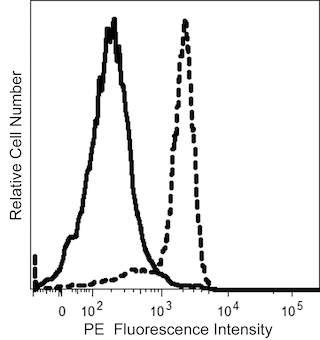
The 1C6/CXCR3 monoclonal antibody specifically binds to human CD183, also known as the CXCR3 chemokine receptor. CD183 is a 40-41 kDa seven-transmembrane protein and member of the G protein-coupled receptor family. CD183 is expressed primarily on activated T cells that infiltrate inflammatory sites. It has also been detected on some circulating T cells, B cells, and NK cells. Reports show that some CXCR3-positive T cells also express CCR5 and are mostly CD45RO-positive cells. Three ligands for CXCR3 have been identified. They are CXCL9 (Mig/monokine induced by interferon-γ), CXCL10 (IP-10/interferon-γ inducible 10-kD protein), and CXCL11 (I-TAC/interferon-inducible T-cell alpha chemoattractant). These chemokines are produced by a variety of cells upon stimulation by IFN-γ and interact with CXCR3 to mediate T-cell chemotaxis. This reagent has been reported to be suitable for immunohistochemical staining of acetone-fixed, frozen sections and/or formalin-fixed, paraffin-embedded tissue sections with citrate pretreatment. Clone 1C6/CXCR3 also cross reacts with a subset of peripheral blood lymphocytes of baboon, and both rhesus and cynomolgus macaque monkeys. The distribution of lymphocytes is similar to that observed with CD183-positive peripheral blood lymphocytes from normal human donors. CXCR3 has been clustered as CD183 in the VIIth HLDA workshop.
The antibody was conjugated to BD Horizon™ BUV661 which is part of the BD Horizon Brilliant™ Ultraviolet family of dyes. This dye is a tandem fluorochrome of BD Horizon BUV395 with an Ex Max of 348-nm and an acceptor dye with an Em Max at 661-nm. BD Horizon Brilliant BUV661 can be excited by the ultraviolet laser (355 nm) and detected with a 670/25 filter and a 630 nm LP. Due to cross laser excitation of this dye, there may be significant spillover into channels detecting APC-like emissions (eg, 670/25-nm filter).
Due to spectral differences between labeled cells and beads, using BD™ CompBeads can result in incorrect spillover values when used with BD Horizon BUV661 reagents. Therefore, the use of BD CompBeads or BD CompBeads Plus to determine spillover values for these reagents is not recommended. Different BUV661 reagents (eg, CD4 vs. CD45) can have slightly different fluorescence spillover therefore, it may also be necessary to use clone-specific compensation controls when using these reagents.
Development References (5)
-
Loetscher M, Gerber B, Loetscher P, et al. Chemokine receptor specific for IP10 and mig: structure, function, and expression in activated T-lymphocytes. J Exp Med. 1996; 184(3):963-969. (Biology). View Reference
-
Marcher C, Moller BK, Lillevang ST, Kristensen T. CXCR4 and IL17R are downregulated on cord-blood CD34-positive cells during short-term culture. In: Mason D. David Mason .. et al., ed. Leucocyte typing VII : white cell differentiation antigens : proceedings of the Seventh International Workshop and Conference held in Harrogate, United Kingdom. Oxford: Oxford University Press; 2002:629-632.
-
Piali L, Weber C, LaRosa G, et al. The chemokine receptor CXCR3 mediates rapid and shear-resistant adhesion-induction of effector T lymphocytes by the chemokines IP10 and Mig. Eur J Immunol. 1998; 28(3):961-972. (Biology). View Reference
-
Qin S, Rottman JB, Myers P, et al. The chemokine receptors CXCR3 and CCR5 mark subsets of T cells associated with certain inflammatory reactions. J Clin Invest. 1998; 101(4):746-754. (Immunogen: Blocking, Flow cytometry, Immunohistochemistry, Inhibition). View Reference
-
Uguccioni M, Willimann K. Cytokine/Chemokine Receptors: Section report. In: Mason D. David Mason .. et al., ed. Leucocyte typing VII : white cell differentiation antigens : proceedings of the Seventh International Workshop and Conference held in Harrogate, United Kingdom. Oxford: Oxford University Press; 2002:237-243.
Please refer to Support Documents for Quality Certificates
Global - Refer to manufacturer's instructions for use and related User Manuals and Technical data sheets before using this products as described
Comparisons, where applicable, are made against older BD Technology, manual methods or are general performance claims. Comparisons are not made against non-BD technologies, unless otherwise noted.
For Research Use Only. Not for use in diagnostic or therapeutic procedures.
