





BD Pharmingen™ Purified Mouse Anti-Human CD44
克隆 G44-26 (also known as C26) (RUO)


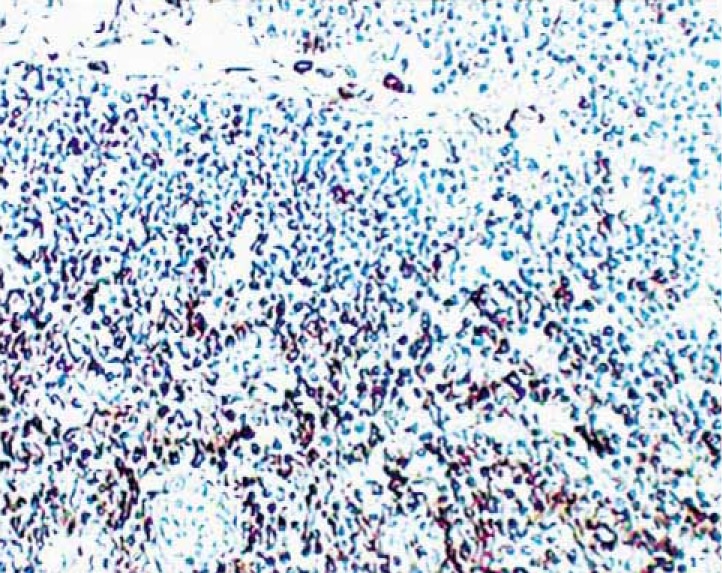
Immunohistochemical staining of CD44+ cells. Paraffin sections of normal human thymus were reacted with Purified Mouse Anti-Human CD44 G44-26 (Cat. No. 550392) antibody. Thymocytes can be identified by the brown labeling of their cell surface membranes. Amplification 20X.
Immunohistochemical staining of CD44+ cells. Paraffin sections of normal human thymus were reacted with Purified Mouse Anti-Human CD44 G44-26 (Cat. No. 550392) antibody. Thymocytes can be identified by the brown labeling of their cell surface membranes. Amplification 20X.


准备和存储


推荐的实验流程
Immunohistochemistry: The G44-26 antibody is recommended to test for immunohistochemical staining of acetone-fixed frozen sections and formalin-fixed paraffin sections with citrate pre-treatment. Tissues tested were human spleen, thymus and tonsil. The antibody stains thymocytes, leukocytes, erythrocytes and weakly on platelets. The isotype control recommended for use with this antibody is purified mouse IgG2b (Cat. No. 557351). For optimal indirect immunohistochemical staining, the G44-26 antibody should be titrated (1:10 to 1:50 dilution) and visualized via a three-step staining procedure in combination with polyclonal, biotin conjugated anti-mouse Igs (multiple adsorbed) (Cat. No. 550337) as the secondary antibody and Streptavidin-HRP (Cat. No. 550946) together with the DAB detection system (Cat. No. 550880). A detailed protocol of the immunohistochemical procedure is available on our website at http://www.bdbiosciences.com/us/s/resources.
商品通知
- Since applications vary, each investigator should titrate the reagent to obtain optimal results.
- An isotype control should be used at the same concentration as the antibody of interest.
- Source of all serum proteins is from USDA inspected abattoirs located in the United States.
- Caution: Sodium azide yields highly toxic hydrazoic acid under acidic conditions. Dilute azide compounds in running water before discarding to avoid accumulation of potentially explosive deposits in plumbing.
- This antibody has been developed for the immunohistochemistry application. However, a routine immunohistochemistry test is not performed on every lot. Researchers are encouraged to titrate the reagent for optimal performance.
- Sodium azide is a reversible inhibitor of oxidative metabolism; therefore, antibody preparations containing this preservative agent must not be used in cell cultures nor injected into animals. Sodium azide may be removed by washing stained cells or plate-bound antibody or dialyzing soluble antibody in sodium azide-free buffer. Since endotoxin may also affect the results of functional studies, we recommend the NA/LE (No Azide/Low Endotoxin) antibody format, if available, for in vitro and in vivo use.
- Please refer to www.bdbiosciences.com/us/s/resources for technical protocols.
配套商品




The G44-26 monoclonal antibody specifically binds to the 80-95 kDa glycosylated type I transmembrane protein, CD44, also known as phagocytic glycoprotein-1 (Pgp-1). CD44 is the receptor for hyaluronic acid. CD44 is expressed on leucocytes, erythrocytes, epithelial cells and weakly on platelets. CD44 is also called extracellular matrix receptor type III and has functional roles in cell migration, lymphocyte homing and adhesion during hematopoiesis and lymphocyte activation. This antibody recognizes epitope 1 of CD44 antigen according to the HLDA workshop studies.
研发参考 (5)
-
Galandrini R, Galluzzo E, Albi N, Grossi CE, Velardi A. Hyaluronate is costimulatory for human T cell effector functions and binds to CD44 on activated T cells. J Immunol. 1994; 153(1):21-31. (Biology). 查看参考
-
Günthert U. CD44: a multitude of isoforms with diverse functions. Curr Top Microbiol Immunol. 1993; 184:47-63. (Biology). 查看参考
-
Patel DD, Liao HX, Haynes BF. CD44 workshop panel report. In: Kishimoto T. Tadamitsu Kishimoto .. et al., ed. Leucocyte typing VI : white cell differentiation antigens : proceedings of the sixth international workshop and conference held in Kobe, Japan, 10-14 November 1996. New York: Garland Pub.; 1997:373-375.
-
Schlossman SF. Stuart F. Schlossman .. et al., ed. Leucocyte typing V : white cell differentiation antigens : proceedings of the fifth international workshop and conference held in Boston, USA, 3-7 November, 1993. Oxford: Oxford University Press; 1995.
-
Stamenkovic I, Amiot M, Pesando JM, Seed B. A lymphocyte molecule implicated in lymph node homing is a member of the cartilage link protein family. Cell. 1989; 56(6):1057-1062. (Biology). 查看参考
Please refer to Support Documents for Quality Certificates
Global - Refer to manufacturer's instructions for use and related User Manuals and Technical data sheets before using this products as described
Comparisons, where applicable, are made against older BD Technology, manual methods or are general performance claims. Comparisons are not made against non-BD technologies, unless otherwise noted.
For Research Use Only. Not for use in diagnostic or therapeutic procedures.