Dear Customer, If you experience any text readability or display issues on our website, please update your web browser to the latest version
.
See More
Dear Customer, If you experience any text readability or display issues on our website, please update your web browser to the latest version
.
See MoreDear Customer, If you experience any text readability or display issues on our website, please update your web browser to the latest version
.
Looks like you're visiting us from {countryName}.
Would you like to stay on the current location or be switched to your location?
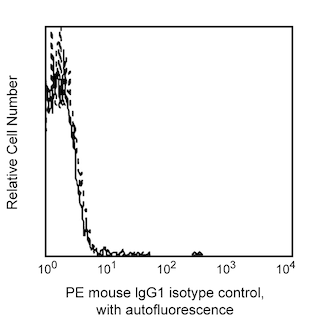
Flow cytometric detection of CD194 (CCR4) on human peripheral lymphocytes. Human peripheral blood mononuclear cells (PBMC) were stained with the PE Mouse Anti-Human CD194 antibody in conjunction with either a FITC Mouse Anti-Human CD4 antibody (Cat. No. 555346 , left panel) or with a FITC Mouse Anti-Human CD8 antibody (Cat. No. 555366, right panel). The cells were gated on lymphocytes and quadrant markers for the bivariate dot plots were set based on staining with a PE Mouse IgG1 κ Isotype Control (Cat. No. 555749).
未经BD明确书面授权,严禁使用未经许可的任何商品。
The 1G1 monoclonal antibody specifically binds to CD194, also known as the human CC Chemokine Receptor type 4 (CCR4). CCR4 is expressed on activated Th2 cells, regulatory T cells, activated NK cells, basophils, monocytes and platelets. CCR4 is a seven-transmembrane, G-protein-coupled receptor, and is the specific receptor for CC chemokines, CCL22/MDC/Macrophage-Derived Chemokine and CCL17/TARC/Thymus and Activation-Regulated Chemokine. It has been reported that CCR4 mRNA is expressed mainly in the thymus and spleen. The human CCR4 gene has been mapped to chromosome 3p24. The purified form of this antibody has been reported not to be a neutralizing antibody. The immunogen used to generate the 1G1 hybridoma has been reported to be human CCR4 transfected L1.2 mouse lymphoma cells.
Please refer to Support Documents for Quality Certificates
Global - Refer to manufacturer's instructions for use and related User Manuals and Technical data sheets before using this products as described
Comparisons, where applicable, are made against older BD Technology, manual methods or are general performance claims. Comparisons are not made against non-BD technologies, unless otherwise noted.
For Research Use Only. Not for use in diagnostic or therapeutic procedures.