







准备和存储


推荐的实验流程
BD® CompBeads can be used as surrogates to assess fluorescence spillover (compensation). When fluorochrome conjugated antibodies are bound to BD® CompBeads, they have spectral properties very similar to cells. However, for some fluorochromes there can be small differences in spectral emissions compared to cells, resulting in spillover values that differ when compared to biological controls. It is strongly recommended that when using a reagent for the first time, users compare the spillover on cells and BD® CompBeads to ensure that BD® CompBeads are appropriate for your specific cellular application.
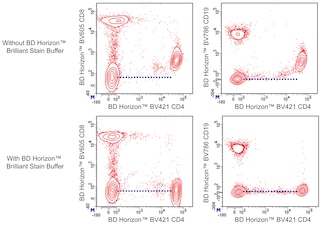
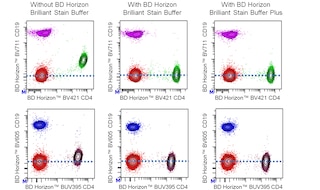
For optimal and reproducible results, BD Horizon Brilliant Stain Buffer should be used anytime BD Horizon Brilliant dyes are used in a multicolor flow cytometry panel. Fluorescent dye interactions may cause staining artifacts which may affect data interpretation. The BD Horizon Brilliant Stain Buffer was designed to minimize these interactions. When BD Horizon Brilliant Stain Buffer is used in in the multicolor panel, it should also be used in the corresponding compensation controls for all dyes to achieve the most accurate compensation. For the most accurate compensation, compensation controls created with either cells or beads should be exposed to BD Horizon Brilliant Stain Buffer for the same length of time as the corresponding multicolor panel. More information can be found in the Technical Data Sheet of the BD Horizon Brilliant Stain Buffer (Cat. No. 563794/566349) or the BD Horizon Brilliant Stain Buffer Plus (Cat. No. 566385).
商品通知
- Please refer to www.bdbiosciences.com/us/s/resources for technical protocols.
- Since applications vary, each investigator should titrate the reagent to obtain optimal results.
- An isotype control should be used at the same concentration as the antibody of interest.
- Caution: Sodium azide yields highly toxic hydrazoic acid under acidic conditions. Dilute azide compounds in running water before discarding to avoid accumulation of potentially explosive deposits in plumbing.
- For fluorochrome spectra and suitable instrument settings, please refer to our Multicolor Flow Cytometry web page at www.bdbiosciences.com/colors.
- The production process underwent stringent testing and validation to assure that it generates a high-quality conjugate with consistent performance and specific binding activity. However, verification testing has not been performed on all conjugate lots.
- Researchers should determine the optimal concentration of this reagent for their individual applications.
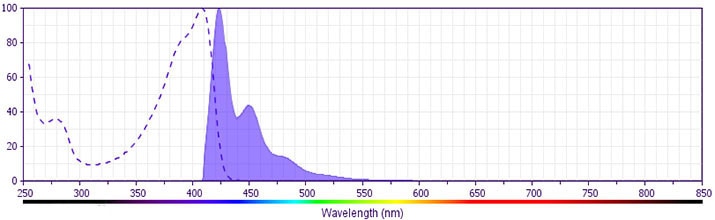
- BD Horizon Brilliant Violet 421 is covered by one or more of the following US patents: 8,158,444; 8,362,193; 8,575,303; 8,354,239.
- BD Horizon Brilliant Stain Buffer is covered by one or more of the following US patents: 8,110,673; 8,158,444; 8,575,303; 8,354,239.
- Human donor specific background has been observed in relation to the presence of anti-polyethylene glycol (PEG) antibodies, developed as a result of certain vaccines containing PEG, including some COVID-19 vaccines. We recommend use of BD Horizon Brilliant™ Stain Buffer in your experiments to help mitigate potential background. For more information visit https://www.bdbiosciences.com/en-us/support/product-notices.
- Please refer to http://regdocs.bd.com to access safety data sheets (SDS).
- Pacific Blue™ is a trademark of Life Technologies Corporation.
配套商品

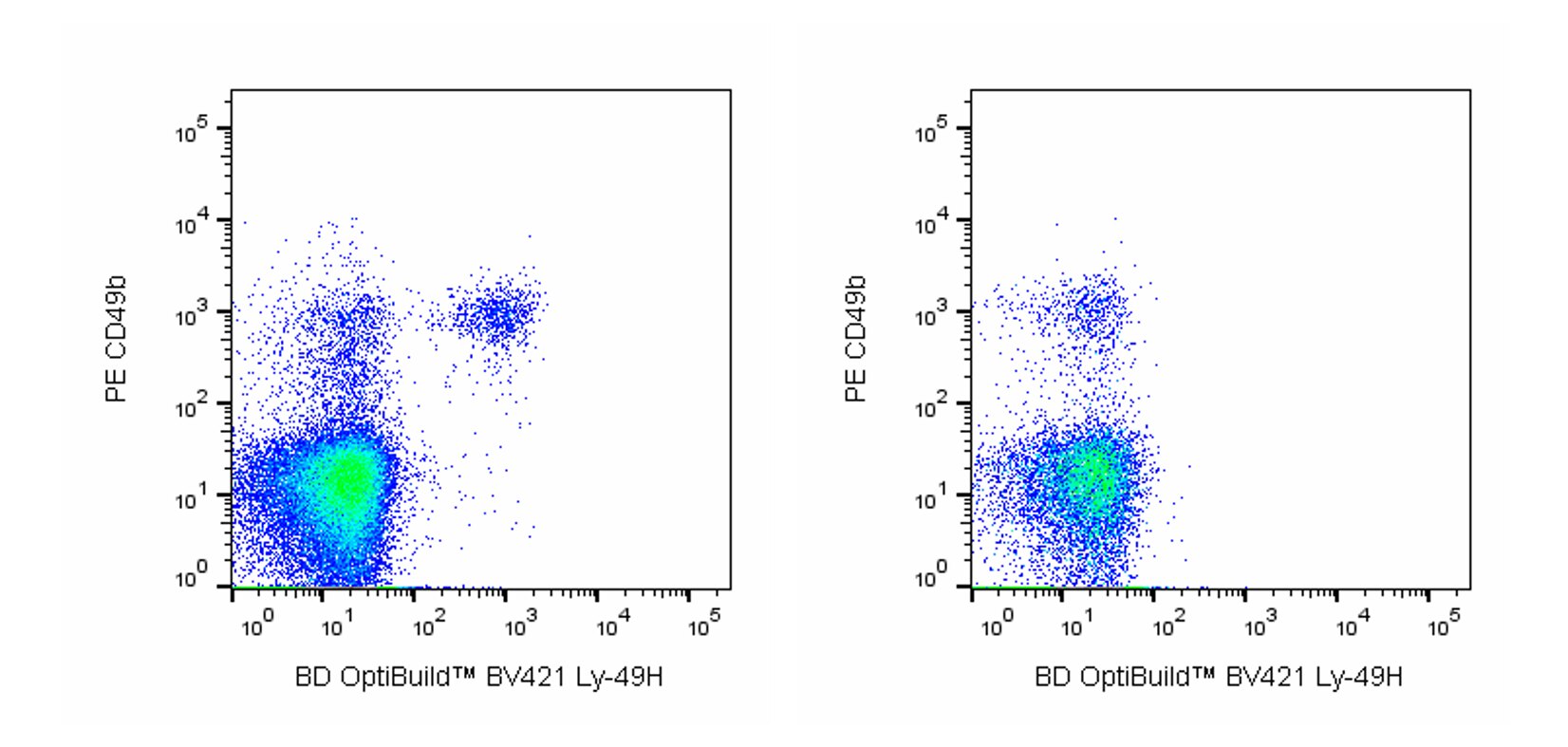
The 3D10 monoclonal antibody specifically binds to mouse Lymphocyte antigen 49H (Ly-49H; also known as Klra8 or Killer cell lectin-like receptor 8). The 3D10 antibody does not crossreact with related molecules such as Ly-49A, C, D or G2. Ly-49H is a type II transmembrane protein and a member of the Ly-49 C-type lectin multigene family of receptors expressed by NK cells. Cell surface Ly-49H is expressed by a subset of NK cells but not by NKT cells. Ly-49H is expressed by C57BL/6 and NWNA but not by BALB/c or DBA/2 mouse NK cells. Cell surface Ly-49H presents as a ~110 kDa disfulfide-linked homodimer and associates with signaling subunits such as DAP10 and DAP12 for optimal transduction of intracellular activation signals. Crosslinking of Ly-49H with the 3D10 antibody reportedly induces NK cell cytotoxicity and cytokine production. Ly-49H recognizes the mouse cytomegalovirus m157 glycoprotein that is expressed by infected cells and is required for protection against cytomegalovirus infection.
研发参考 (5)
-
Brennan J, Mager D, Jefferies W, Takei F. Expression of different members of the Ly-49 gene family defines distinct natural killer cell subsets and cell adhesion properties. J Exp Med. 1994; 180(6):2287-2295. (Biology). 查看参考
-
Brown MG, Dokun AO, Heusel JW, et al. Vital involvement of a natural cell activation receptor in resistance to viral infection. Science. 2001; 292(5518):934-937. (Clone-specific: Activation, Bioassay, Blocking, Cytotoxicity, Flow cytometry). 查看参考
-
Orr MT, Sun JC, Hesslein DG, et al. Ly49H signaling through DAP10 is essential for optimal natural killer cell responses to mouse cytomegalovirus infection. J Exp Med. 2009; 206(4):807-817. (Clone-specific: Blocking, Flow cytometry). 查看参考
-
Silver ET, Elliott JF, Kane KP. Alternatively spliced Ly-49D and H transcripts are found in IL-2-activated NK cells. Immunogenetics. 1996; 44(6):478-482. (Biology). 查看参考
-
Smith HR, Chuang HH, Wang LL, Salcedo M, Heusel JW, Yokoyama WM. Nonstochastic Coexpression of activation receptors on murine Natural Killer cells. J Exp Med. 2000; 191(8):1341-1354. (Immunogen: Activation, Cytotoxicity, Flow cytometry, Immunoprecipitation). 查看参考
Please refer to Support Documents for Quality Certificates
Global - Refer to manufacturer's instructions for use and related User Manuals and Technical data sheets before using this products as described
Comparisons, where applicable, are made against older BD Technology, manual methods or are general performance claims. Comparisons are not made against non-BD technologies, unless otherwise noted.
For Research Use Only. Not for use in diagnostic or therapeutic procedures.
