







准备和存储


商品通知
- This reagent has been pre-diluted for use at the recommended Volume per Test. We typically use 1 × 10^6 cells in a 100-µl experimental sample (a test).
- Since applications vary, each investigator should titrate the reagent to obtain optimal results.
- Please refer to www.bdbiosciences.com/us/s/resources for technical protocols.
- Caution: Sodium azide yields highly toxic hydrazoic acid under acidic conditions. Dilute azide compounds in running water before discarding to avoid accumulation of potentially explosive deposits in plumbing.
- Source of all serum proteins is from USDA inspected abattoirs located in the United States.
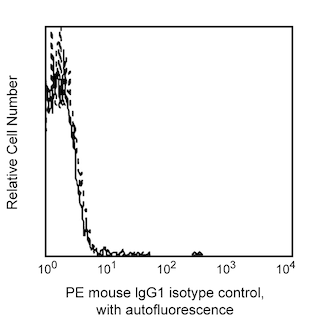
The 4G8 monoclonal antibody specifically binds to CD135 which is also known as FMS-like tyrosine kinase 3 (FLT3), Fetal liver kinase 2 (FLK2) and Stem cell tyrosine kinase 1 (STK1). CD135 is a 155-160 kDa type I transmembrane glycoprotein. It belongs to subclass III of the receptor tyrosine kinase (RTK) family which includes receptors for M-CSF (CD115), SCF/c-Kit Ligand (CD117), and PDGF (CD140a and CD140b). CD135 is expressed on multipotential, myelomonocytic and primitive B-cell progenitors. The most primitive hematopoietic progenitor cells express low levels of CD135. CD135 plays the role of growth factor receptor for early hematopoietic progenitors. Reports from studies with knockout mice have shown that targeted CD135 disruption impaired the development of primitive progenitor cells of all hematopoietic lineages with significant impact on lymphopoietic precursors.
This antibody is routinely tested by flow cytometric analysis. Other applications were tested at BD Biosciences Pharmingen during antibody development only reported in the literature.
研发参考 (6)
-
Kishimoto T. Tadamitsu Kishimoto .. et al., ed. Leucocyte typing VI : white cell differentiation antigens : proceedings of the sixth international workshop and conference held in Kobe, Japan, 10-14 November 1996. New York: Garland Pub.; 1997.
-
Lyman SD, James L, Johnson L. Cloning of the human homologue of the murine flt3 ligand: a growth factor for early hematopoietic progenitor cells. Blood. 1994; 83(10):2795-27801. (Biology). 查看参考
-
Mackarehtschian K, Hardin JD, Moore KA, Boast S, Goff SP, Lemischka IR. Targeted disruption of the flk2/flt3 gene leads to deficiencies in primitive hematopoietic progenitors. Immunity. 1995; 3(1):147-161. (Biology). 查看参考
-
Rappold I, Ziegler BL, Kohler I, et al. Functional and phenotypic characterization of cord blood and bone marrow subsets expressing FLT3 (CD135) receptor tyrosine kinase. Blood. 1997; 90(1):111-125. (Biology). 查看参考
-
Rosnet O, Schiff C, Pébusque MJ. Human FLT3/FLK2 gene: cDNA cloning and expression in hematopoietic cells. Blood. 1993; 82(4):1110-1119. (Biology). 查看参考
-
Rusten LS, Lyman SD, Veiby OP, Jacobsen SE. The FLT3 ligand is a direct and potent stimulator of the growth of primitive and committed human CD34+ bone marrow progenitor cells in vitro. Blood. 1996; 87(4):1317-1325. (Biology). 查看参考
Please refer to Support Documents for Quality Certificates
Global - Refer to manufacturer's instructions for use and related User Manuals and Technical data sheets before using this products as described
Comparisons, where applicable, are made against older BD Technology, manual methods or are general performance claims. Comparisons are not made against non-BD technologies, unless otherwise noted.
For Research Use Only. Not for use in diagnostic or therapeutic procedures.
