





.png)


준비 및 보관


권장 분석 절차
Either BD Cytofix™ fixation buffer or BD Phosflow™ Fix Buffer I may be used for cell fixation. Any of the three BD Phosflow™ permeabilization buffers may be used.
제품 고시
- This reagent has been pre-diluted for use at the recommended Volume per Test. We typically use 1 × 10^6 cells in a 100-µl experimental sample (a test).
- Source of all serum proteins is from USDA inspected abattoirs located in the United States.
- Caution: Sodium azide yields highly toxic hydrazoic acid under acidic conditions. Dilute azide compounds in running water before discarding to avoid accumulation of potentially explosive deposits in plumbing.
- Alexa Fluor® 488 fluorochrome emission is collected at the same instrument settings as for fluorescein isothiocyanate (FITC).
- For fluorochrome spectra and suitable instrument settings, please refer to our Multicolor Flow Cytometry web page at www.bdbiosciences.com/colors.
- The Alexa Fluor®, Pacific Blue™, and Cascade Blue® dye antibody conjugates in this product are sold under license from Molecular Probes, Inc. for research use only, excluding use in combination with microarrays, or as analyte specific reagents. The Alexa Fluor® dyes (except for Alexa Fluor® 430), Pacific Blue™ dye, and Cascade Blue® dye are covered by pending and issued patents.
- Alexa Fluor® is a registered trademark of Molecular Probes, Inc., Eugene, OR.
- Please refer to www.bdbiosciences.com/us/s/resources for technical protocols.
관련 제품


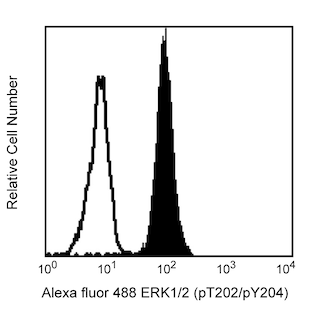
The eukaryotic translation initiation factor 4E-Binding Protein 1 (4EBP1) is a phosphorylated heat- and acid-stable protein (PHAS-I or PHAS-1), and it is regulated by insulin. It is a member of the eIF4E-Binding Protein Family, which also includes the proteins 4EBP2 and 4EBP3. 4EBP1 binds with eukaryotic translation Initiation Factor 4E (eIF4E), which prevents its assembly into the eIF4E complex and inhibits cap-dependent translation. When 4EBP1 is phosphorylated, this binding is disrupted, allowing cap-dependent translation to be activated. Phosphorylation of 4EBP1 is required for protein synthesis, and it mediates the regulation of protein translation by stimuli that signal through the phosphoinositide 3 (PI3) kinase pathway. We found that threonine 69 (T69) is phosphorylated in resting human peripheral blood monocytes, but it is almost undetectable in resting lymphocytes. PI3 kinase inhibitors, such as LY294002 down-regulate the phosphorylation level of 4EBP1 (pT69) in monocytes.
The M34-273 monoclonal antibody recognizes the phosphorylated T69 of activated human 4EBP1.
개발 참고 자료 (2)
-
Gingras AC, Raught B, Gygi SP, et al. Hierarchical phosphorylation of the translation inhibitor 4E-BP1. Genes Dev. 2001; 15(21):2852-2864. (Biology). 참조 보기
-
Hay N, Sonenberg N. Upstream and downstream of mTOR. Genes Dev. 2004; 18:1926-1945. (Biology).
Please refer to Support Documents for Quality Certificates
Global - Refer to manufacturer's instructions for use and related User Manuals and Technical data sheets before using this products as described
Comparisons, where applicable, are made against older BD Technology, manual methods or are general performance claims. Comparisons are not made against non-BD technologies, unless otherwise noted.
For Research Use Only. Not for use in diagnostic or therapeutic procedures.
