






Waters Biosciences Makes Splashes with its Latest Innovations, Integrated Solutions and a New era of Standardization in Flow Cytometry at CYTO 2026
July 06, 2026
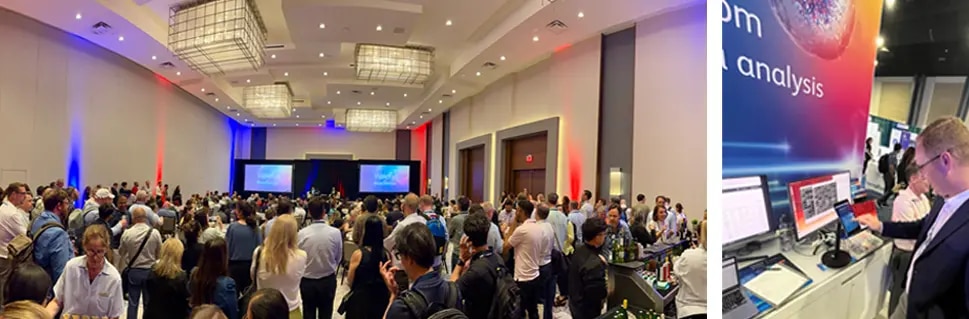
The sunny shores of West Palm Beach, Florida, welcomed the cytometry community this year for the annual CYTO2026 meeting aptly themed “Cytometry: The Next Wave”. From a packed exhibition booth and energetic poster sessions to insightful scientific discussions, the event was defined by innovation, collaboration and forward-looking conversations. It also marked an ideal platform for Waters Biosciences to demonstrate the combined strength following the merger with BD Biosciences.
Advancing Flow Cytometry – A Continued Commitment to Innovation
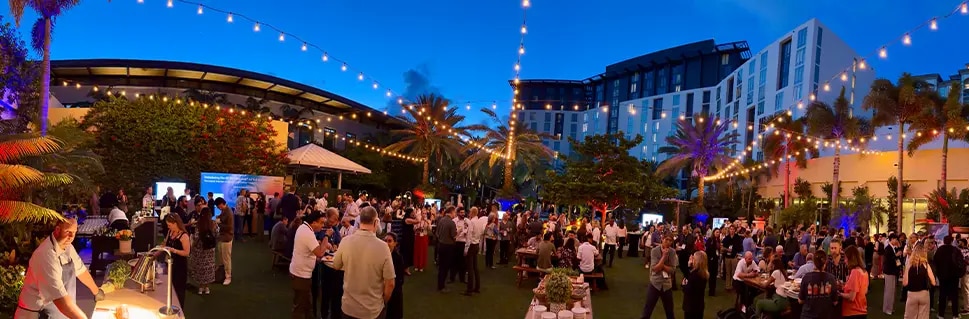
This year, being the first CYTO meeting after the merger of BD Biosciences with Waters Corporation, the event provided a timely opportunity for CEO Udit Batra to reinforce the company’s commitment to flow cytometry innovation. During a special customer event, he highlighted the organization’s vision for the future. The evening blended high-impact scientific exchange with a fun and memorable experience for both the Waters Biosciences team as well as the attendees. The opportunity to interact directly with the scientists who developed the cutting-edge technologies from Waters Biosciences was unique for the attendees and their enthusiasm was evident in their lively participation.
Defining the Future Standard of Spectral Flow Cytometry with the Reveal of the BD FACSDiscover™ A7 Cell Analyzer
The reveal of the latest advancement in spectral flow cytometry by Ranga Partha, VP/GM Marketing and Single-Cell Multiomics at Waters Biosciences and Shawn Austin, VP/GM Sales, and Eric Diebold, VP/GM Instruments & Informatics, was a momentous occasion, marking a significant leap forward in the world of cytometry and setting the tone for the event with a signal toward a new standard. The BD FACSDiscover™ A7 Cell Analyzer, which will launch this year, wasn’t just another instrument, it marked a shift toward a more standardized, streamlined future for flow cytometry. The attendees were captivated by its cutting-edge spectral technology, sophisticated hardware and integrated features designed to simplify their workflows and enhance reproducibility.
Attendees were curious to learn about the system-level standardization design using the FACSTruQ™ Technology and how it optimizes repeatability and reproducibility of spectral performance both across and within instruments. Another feature that caught their attention was the specialized detector setting independent (DIS) scaling that enhances consistency by minimizing variability associated with detector settings, allowing them to focus on biological insights rather than instrument performance.
The two oral presentations from the Waters Biosciences team drew the attention of the audience. The talk entitled “Spectral flow cytometry beyond 60 colors” by Peter Mage et al., unveiled results from the world's first 60-color spectral cytometry panel, developed on the BD FACSDiscover A8 Cell Analyzer in a collaboration between Waters Biosciences and ETH Zurich. The talk introduced novel approaches to panel design for ultra-high parameter panels, showing how to account for fluorochrome collinearity and unmixing-dependent spreading in order to preserve biological resolution.
The presentation by Ioannis Panetas in collaboration with Jochen Behrends showed how image-enabled spectral flow cytometry can achieve accurate, label-free identification and sorting of Mycobacterium tuberculosis–infected macrophages. By leveraging intrinsic autofluorescence and morphological features rather than fluorescent labels, this approach not only enables downstream high dimensional analysis but also opens new possibilities for applying flow cytometric sorting in infectious disease research.
What really stood out in demos and conversations was how approachable the BD FACSDiscover A7 Cell Analyzer felt. With simplified workflows and robust performance showcased in demos, the promise of reproducible spectral data resonated strongly with attendees looking to scale and standardize their research. It was no wonder that attendees were captivated by the promise of this new instrument.

A Packed Agenda of Science and Storytelling
Beyond the reveal, Waters Biosciences kept the momentum going with a strong lineup of talks, tutorials, and scientific sessions throughout the week.
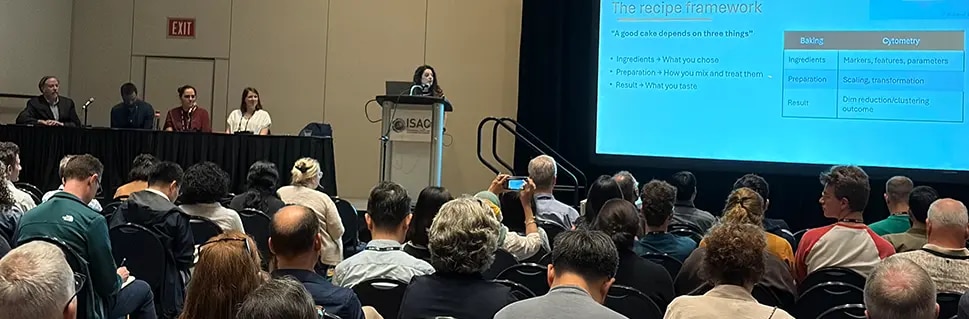
Remarkable among them was the exhibitor tutorial, “Discover the Future Standard of Spectral Flow Cytometry,” which brought together experts like Eric Diebold, Aaron Tyznik, and Aaron Middlebrook. The session explored how spectral flow cytometry has evolved and where it’s headed next and delved into the fundamental challenges and opportunities of spectral standardization, illustrating how Waters Biosciences is advancing technology to unlock the next phase of flow cytometry. The discussion went beyond standardization, highlighting how researchers worldwide are exploring new scientific applications, such as advanced CRISPR screening and sorting cell populations that were not possible to be sorted before, using the BD FACSDiscover™ Platform and its underlying technologies such as the BD CellView™ Image Technology and BD SpectralFX™ Technology.
A real-world application where the technology was used was highlighted by Adam Liang, PhD, CEO/CSO from IMU Biosciences. He presented their remarkable work on correlating immunological signatures to health outcomes using the BD FACSDiscover™ Platform and the BD Rhapsody™ Single Cell Multiomics System for high-parameter flow cytometry and single-cell analysis. Workshops and tutorials on standardization, best practices, and practical workflows were particularly well received, reflecting strong audience interest in improving reproducibility and experimental rigor.
A Connected Ecosystem and a Total Solution for Biological Resolution
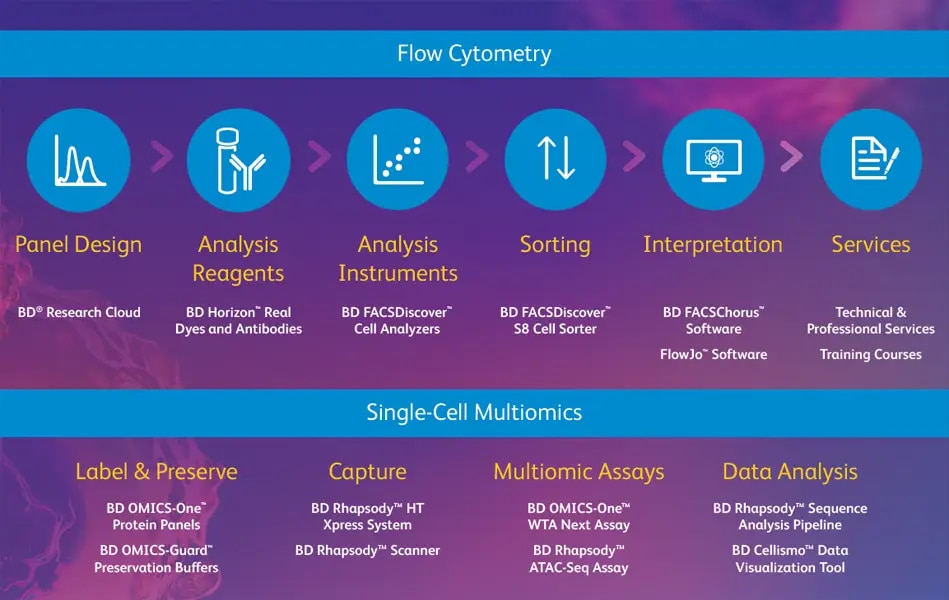
Waters Biosciences also showcased an integrated solution for flow cytometry workflow and single cell multiomics analysis. Starting with flow cytometry panel design to cell analysis, cell sorting and data interpretation, a complete solution of products across the discovery workflow was presented by the team. Along with high parameter flow cytometry, a suite of products for single-cell analysis – from sample preparation to single-cell capture, multiomic assays and data analysis tools – designed to work together to enable fewer handoffs and confidence in results was also showcased at CYTO by the Waters team. One of the popular demonstrations showcased a seamless analysis workflow by taking imaging data into FlowJo™ Software, clustering the data and creating a 2-D plot and generating a gating strategy on the BD FACSDiscover™ S8 Cell Sorter. The approach of delivering an integrated experience from sample to insight that maximizes biological resolution across the entire workflow was of particular interest to the audience.
A Flow Personality Test that Added a New Dimension to Flow Cytometry Analysis
Can your preferences while conducting flow cytometry analysis determine your personality type? It sure can! That’s what scientists who took the flow personality test at CYTO2026 found out. They participated in this fun exercise that categorized them into one of the four personality types: “Quality Guardian”, “Practical Mapper”, “System Organizer” and “Visual Explorer”. They got to display their personality types with the pin that they earned at the end of the test. It was interesting to see that the majority of test takers earned the “Quality Guardian” personality type pin and most of them happened to be flow core facility managers! Our VP of Instruments, Eric Diebold, also participated in the test and was thrilled to learn that he was a tSNE, a “Visual Explorer”! The event added a personal dimension to the scientific exchange.
Posters Demonstrated How to Fully Utilize Blue and Yellow-Green Lasers and Go Even Beyond into Near Infra-Red Detection!
Posters from Waters Biosciences featuring the development of new BD Horizon RealBlue™ and Horizon RealYellow™ Dyes and fluorochromes that leverage the spectrum beyond 800 nm were received well by the audience. A poster by Jacob Rabenstein discussed how the use of commonly available fluorochromes such as PE and PE tandems that are excited by both the blue (488nm) and yellow-green(YG)/green (561nm/532nm) lasers led to the underutilization of the blue laser line in most modern flow cytometers and how the BD Horizon™ RealBlue™ and RealYellow™ family comprising 14 fluorochromes makes it possible to fully utilize the blue and YG lasers. Data showing improvements in resolution, spillover, photostability, buffer compatibility, intracellular compatibility, and nonspecific background binding when compared to legacy and other commonly used dye families was presented in the poster.
Another poster from Jacob Rabenstein showcased two new fluorochromes - RB824 and RV828 that show emission in the near infra-red (NIR) range, where autofluorescence is lower and fewer dyes reside. Traditional fluorochromes show emission between 600–750 nm, which creates spectral overlap and making panel design more complicated. The poster presented data showing how RB824 and RV828 fluorochromes can be used with the BD FACSDiscover™ Flow Cytometers, which have the capacity to detect signals up to 860 nm.
You can download the CYTO posters from our CYTO2026 event page.
As CYTO 2026 concluded, the excitement surrounding the advancements in flow cytometry was palpable. Waters Biosciences has set a new standard for reproducible spectral data, enabling laboratories worldwide to obtain high-quality flow cytometry results with ease. The conference was a testament to the collaborative spirit and innovative drive that defines the field of cytometry.
Here’s a glimpse of what Waters Biosciences leaders summarized as the highlights of our offerings at CYTO2026.
Watch the video.


