





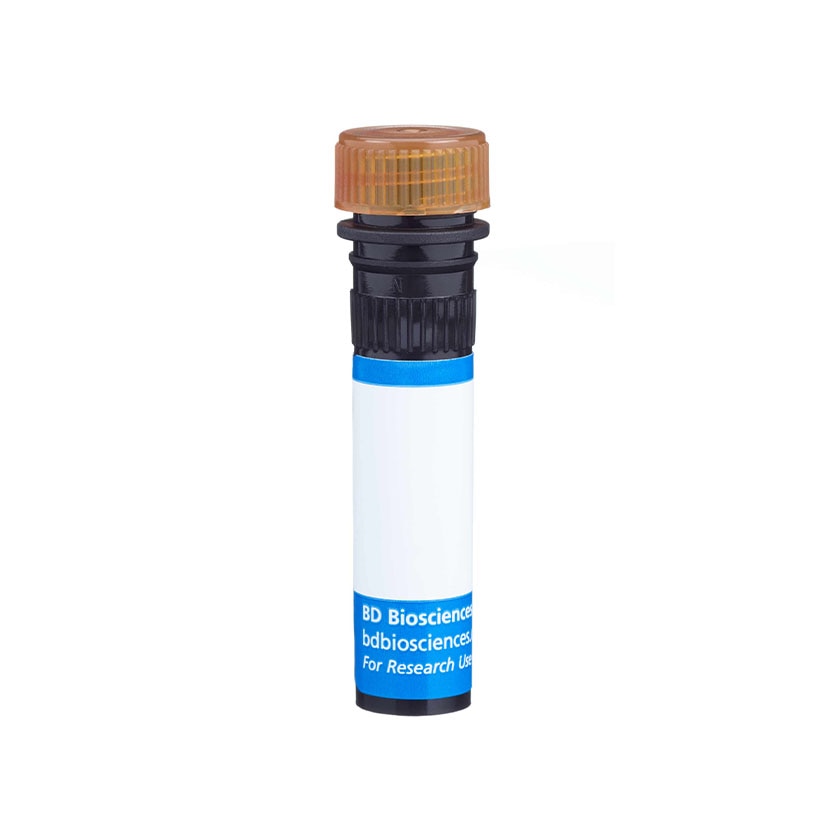


준비 및 보관


권장 분석 절차
This antibody conjugate is suitable for intracellular staining of human whole blood (using BD Phosflow™ Lyse/Fix Buffer) and peripheral blood mononuclear cells (using BD Cytofix™ Fixation Buffer or BD Phosflow™ Fix Buffer I). Any of the three BD Phosflow™ permeabilization buffers may be used.
제품 고시
- This reagent has been pre-diluted for use at the recommended Volume per Test. We typically use 1 × 10^6 cells in a 100-µl experimental sample (a test).
- Please refer to www.bdbiosciences.com/us/s/resources for technical protocols.
- For fluorochrome spectra and suitable instrument settings, please refer to our Multicolor Flow Cytometry web page at www.bdbiosciences.com/colors.
- Please observe the following precautions: Absorption of visible light can significantly alter the energy transfer occurring in any tandem fluorochrome conjugate; therefore, we recommend that special precautions be taken (such as wrapping vials, tubes, or racks in aluminum foil) to prevent exposure of conjugated reagents, including cells stained with those reagents, to room illumination.
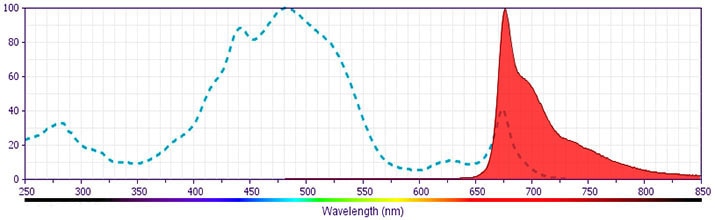
- PerCP-Cy5.5–labelled antibodies can be used with FITC- and R-PE–labelled reagents in single-laser flow cytometers with no significant spectral overlap of PerCP-Cy5.5, FITC, and R-PE fluorescence.
- PerCP-Cy5.5 is optimized for use with a single argon ion laser emitting 488-nm light. Because of the broad absorption spectrum of the tandem fluorochrome, extra care must be taken when using dual-laser cytometers, which may directly excite both PerCP and Cy5.5™. We recommend the use of cross-beam compensation during data acquisition or software compensation during data analysis.
- Caution: Sodium azide yields highly toxic hydrazoic acid under acidic conditions. Dilute azide compounds in running water before discarding to avoid accumulation of potentially explosive deposits in plumbing.
- Source of all serum proteins is from USDA inspected abattoirs located in the United States.
- An isotype control should be used at the same concentration as the antibody of interest.
The H1 (FB1) antibody specificially binds to a cytoplasmic domain of CD20. CD20 is a 33-37-kDa four transmembrane phosphoprotein that is expressed by B lymphocytes from the pre-B stage and most malignant B cells and is lost during plasma cell differentiation. Low level CD20 expression is observed on a subset of normal circulating T lymphocytes, and CD20-positive T-cell lymphomas have been reported. The CD20 molecule is associated with membrane lipid raft domains, acts as a channel for calcium ions, and is involved in the regulation of B cell activation and survival. The cytoplasmic domain regions are serine and threonine rich and contain multiple phosphorylation consensus sequences.
개발 참고 자료 (4)
-
Cragg MS, Walshe CA, Ivanov AO, Glennie MJ. The biology of CD20 and its potential as a target for mAb therapy. Curr Dir Autoimmun. 2005; 8:140-174. (Biology). 참조 보기
-
Kitamura A, Yamashita Y, Mori N. CD20-positive cytotoxic T cell lymphoma: report of two cases and review of the literature. J Clin Exp Hematop. 2005; 45(1):45-50. (Biology).
-
Nozawa Y, Abe M, Ohno H, Fukuhara S, Wakasa H. Production of two monoclonal antibodies (FB1 and FB21) useful for the identification of human B lymphocytes in formalin-fixed, paraffin-embedded tissues. J Pathol. 1994; 173:347-354. (Immunogen). 참조 보기
-
Nozawa Y, Abe M, Wakasa H. Three mAb, FUN-1, FB1, and FB21, that recognize B-cell antigens in frozen or paraffin-embedded tissue sections. In: Schlossman SF. Stuart F. Schlossman .. et al., ed. Leucocyte typing V : white cell differentiation antigens : proceedings of the fifth international workshop and conference held in Boston, USA, 3-7 November, 1993. Oxford: Oxford University Press; 1995:705-706.
Please refer to Support Documents for Quality Certificates
Global - Refer to manufacturer's instructions for use and related User Manuals and Technical data sheets before using this products as described
Comparisons, where applicable, are made against older BD Technology, manual methods or are general performance claims. Comparisons are not made against non-BD technologies, unless otherwise noted.
For Research Use Only. Not for use in diagnostic or therapeutic procedures.
