





.png)


준비 및 보관


권장 분석 절차
Recommended Assay Procedure:
For detecting low expression levels of chemokine receptors, a multi-step staining procedure is recommended. Our purified and biotinylated formats, Cat. No. 551852 and 551968, respectively, are useful for use in detecting low levels of expression using multi-step staining protocols.
제품 고시
- Since applications vary, each investigator should titrate the reagent to obtain optimal results.
- Please refer to www.bdbiosciences.com/us/s/resources for technical protocols.
- Caution: Sodium azide yields highly toxic hydrazoic acid under acidic conditions. Dilute azide compounds in running water before discarding to avoid accumulation of potentially explosive deposits in plumbing.
관련 제품
.png?imwidth=320)
The 2B11/CXCR4 monoclonal antibody specifically binds to mouse CD184, which is also known as the C-X-C Chemokine Receptor type 4 , CXCR4. CXCR4 (previously known as Fusin and LESTR), is a seven-transmembrane, G-protein-coupled receptor. It is the specific receptor for the CXC chemokine, SDF-1/CXCL12. Mouse CXCR4 shows 91% homology at the amino acid level with human CXCR4. CXCR4 is widely expressed by hematopoietic and non-hematopoietic cell types including neutrophils, monocytes, T cells, B cells, CD34-positive progenitor cells, endothelial cells, neurons and astrocytes. Human CXCR4 is used by T-tropic HIV-1 as a co-receptor for viral entry. The mouse Cxcr4 gene has been mapped to chromosome 1.
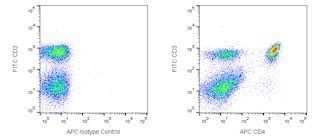
This antibody is routinely tested by flow cytometric analysis. Other applications were tested at BD Biosciences Pharmingen during antibody development only or reported in the literature.
개발 참고 자료 (10)
-
Bleul CC, Farzan M, Choe H, et al. The lymphocyte chemoattractant SDF-1 is a ligand for LESTR/fusin and blocks HIV-1 entry. Nature. 1996; 382(6594):829-833. (Biology). 참조 보기
-
Bleul CC, Wu L, Hoxie JA, Springer TA, Mackay CR. The HIV coreceptors CXCR4 and CCR5 are differentially expressed and regulated on human T lymphocytes.. Proc Natl Acad Sci U S A. 1997; 94(5):1925-1930. (Biology). 참조 보기
-
Feng Y, Broder CC, Kennedy PE, Berger EA. HIV-1 entry cofactor: functional cDNA cloning of a seven-transmembrane, G protein-coupled receptor. Science. 1996; 272(5263):872-877. (Biology). 참조 보기
-
Forster R, Kremmer E, Schubel A, et al. Intracellular and surface expression of the HIV-1 coreceptor CXCR4/fusin on various leukocyte subsets: rapid internalization and recycling upon activation. J Immunol. 1998; 160(3):1522-1531. (Immunogen). 참조 보기
-
Gupta SK, Lysko PG, Pillarisetti K, Ohlstein E, Stadel JM. Chemokine receptors in human endothelial cells. Functional expression of CXCR4 and its transcriptional regulation by inflammatory cytokines. J Biol Chem. 1998; 273(7):4282-4287. (Biology). 참조 보기
-
Heesen M, Berman MA, Benson JD, Gerard C, Dorf ME. Cloning of the mouse fusin gene, homologue to a human HIV-1 co-factor. J Immunol. 1996; 157(12):5455-5460. (Biology). 참조 보기
-
Hesselgesser J, Halks-Miller M, DelVecchio V, et al. CD4-independent association between HIV-1 gp120 and CXCR4: functional chemokine receptors are expressed in human neurons. Curr Biol. 1997; 7(2):112-121. (Biology). 참조 보기
-
Loetscher M, Geiser T, O'Reilly T, Zwahlen R, Baggiolini M, Moser B. Cloning of a human seven-transmembrane domain receptor, LESTR, that is highly expressed in leukocytes. J Biol Chem. 1994; 269(1):232-237. (Biology). 참조 보기
-
Oberlin E, Amara A, Bachelerie F, et al. The CXC chemokine SDF-1 is the ligand for LESTR/fusin and prevents infection by T-cell-line-adapted HIV-1. Nature. 1996; 382(6594):833-835. (Biology). 참조 보기
-
Schabath R, Muller G, Schubel A, Kremmer E, Lipp M, Forster R. The murine chemokine receptor CXCR4 is tightly regulated during T cell development and activation. J Leukoc Biol. 1999; 66(6):996-1004. (Biology). 참조 보기
Please refer to Support Documents for Quality Certificates
Global - Refer to manufacturer's instructions for use and related User Manuals and Technical data sheets before using this products as described
Comparisons, where applicable, are made against older BD Technology, manual methods or are general performance claims. Comparisons are not made against non-BD technologies, unless otherwise noted.
For Research Use Only. Not for use in diagnostic or therapeutic procedures.
