





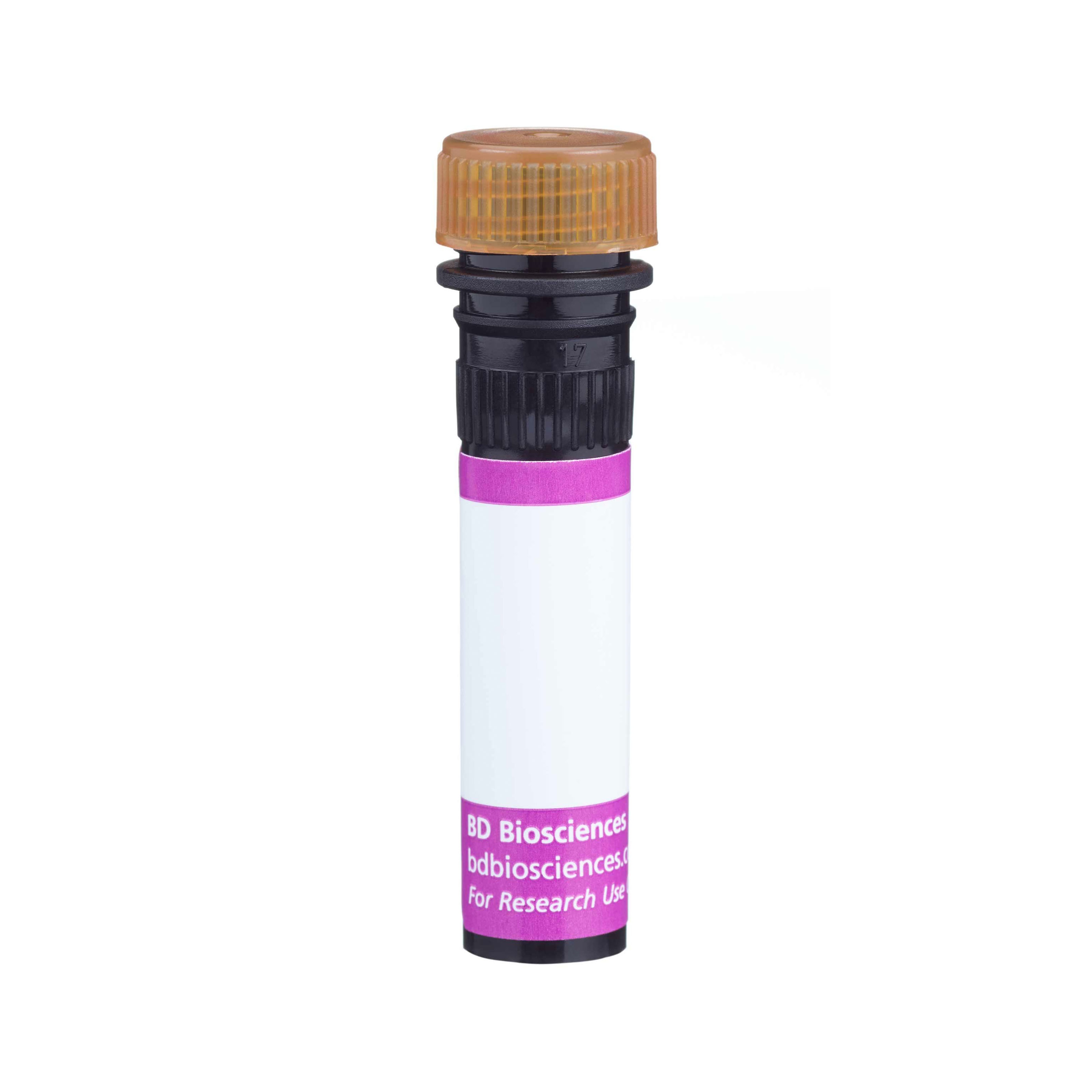


준비 및 보관


권장 분석 절차
BD™ CompBeads can be used as surrogates to assess fluorescence spillover (Compensation). When fluorochrome conjugated antibodies are bound to CompBeads, they have spectral properties very similar to cells. However, for some fluorochromes there can be small differences in spectral emissions compared to cells, resulting in spillover values that differ when compared to biological controls. It is strongly recommended that when using a reagent for the first time, users compare the spillover on cells and CompBead to ensure that BD Comp beads are appropriate for your specific cellular application.
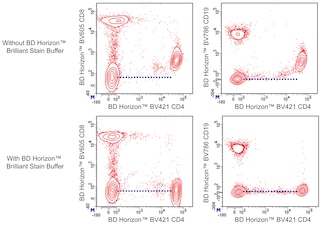
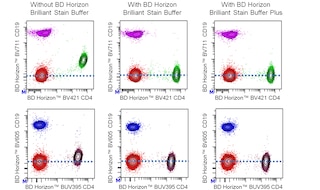
For optimal and reproducible results, BD Horizon Brilliant Stain Buffer should be used anytime two or more BD Horizon Brilliant dyes are used in the same experiment. Fluorescent dye interactions may cause staining artifacts which may affect data interpretation. The BD Horizon Brilliant Stain Buffer was designed to minimize these interactions. More information can be found in the Technical Data Sheet of the BD Horizon Brilliant Stain Buffer (Cat. No. 563794/566349) or the BD Horizon Brilliant Stain Buffer Plus (Cat. No. 566385).
제품 고시
- The production process underwent stringent testing and validation to assure that it generates a high-quality conjugate with consistent performance and specific binding activity. However, verification testing has not been performed on all conjugate lots.
- Researchers should determine the optimal concentration of this reagent for their individual applications.
- An isotype control should be used at the same concentration as the antibody of interest.
- Caution: Sodium azide yields highly toxic hydrazoic acid under acidic conditions. Dilute azide compounds in running water before discarding to avoid accumulation of potentially explosive deposits in plumbing.
- For fluorochrome spectra and suitable instrument settings, please refer to our Multicolor Flow Cytometry web page at www.bdbiosciences.com/colors.
- Please refer to www.bdbiosciences.com/us/s/resources for technical protocols.
- BD Horizon Brilliant Stain Buffer is covered by one or more of the following US patents: 8,110,673; 8,158,444; 8,575,303; 8,354,239.
- Please refer to http://regdocs.bd.com to access safety data sheets (SDS).
- BD Horizon Brilliant Violet 786 is covered by one or more of the following US patents: 8,110,673; 8,158,444; 8,227,187; 8,455,613; 8,575,303; 8,354,239.
- Cy is a trademark of GE Healthcare.
관련 제품
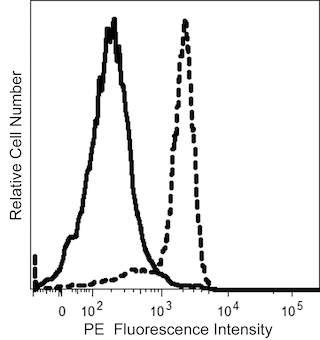
The LC4 monoclonal antibody specifically recognizes the human variable beta 5.1 (Vβ5.1) domain of the beta subunit for the αβ T cell receptor for antigen (TCR αβ). TCR Vβ5.1 is encoded by TRBV5-1 (T cell receptor beta variable 5-1), one of five functional genes within the TRBV5 subgroup in the T cell receptor beta (TRB) locus. The heterodimeric TCR αβ is composed of two disulfide-linked transmembrane glycoproteins, ie, highly variable TCRα and TCRβ chains. These chains are each comprised of an extracellular N-terminal variable (V) region domain followed by a constant (C) region domain, a transmembrane region, and a short C-terminal cytoplasmic tail. The TCR Vβ repertoire is known to be extensive due to the many different combinations of TCR gene segments (Vβ, Dβ, and Jβ) as well as junctional region diversity. TCR Vβ5.1 is variably expressed on subsets of TCR αβ-positive thymocytes and peripheral CD4+ or CD8+ T cells. In association with the CD3 complex of signaling proteins, the TCR αβ recognizes peptide-major histocompatibility complexes (pMHC) that are displayed on other cells to mediate cellular responses. The LC4 antibody is useful for analyzing the levels of TCR Vβ5.1 expressed by individual cells as well as the numbers or frequencies of TCR Vβ5.1-positive cells within test samples. The LC4 antibody can be used to help characterize the TCR Vβ repertoires of T cell populations during health as well as in response to vaccination, infectious disease, aging, transplantation, autoimmunity or cancer.
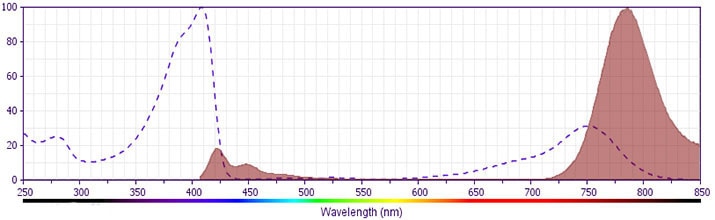
The antibody was conjugated to BD Horizon™ BV786 which is part of the BD Horizon Brilliant™ Violet family of dyes. This dye is a tandem fluorochrome of BD Horizon BV421 with an Ex Max of 405-nm and an acceptor dye with an Em Max at 786-nm. BD Horizon BV786 can be excited by the violet laser and detected in a filter used to detect Cy™7-like dyes (eg, 780/60-nm filter).
개발 참고 자료 (5)
-
Choi YW, Kotzin B, Lafferty J, et al. A method for production of antibodies to human T-cell receptor beta-chain variable regions.. Proc Natl Acad Sci USA. 1991; 88(19):8357-61. (Clone-specific: Flow cytometry). 참조 보기
-
Janson CH, Grunewald J, Osterborg A, et al. Predominant T cell receptor V gene usage in patients with abnormal clones of B cells.. Blood. 1991; 77(8):1776-80. (Clone-specific: Flow cytometry). 참조 보기
-
Maecker HT, Levy R. Prevalence of antigen receptor variants in human T cell lines and tumors.. J Immunol. 1989; 142(4):1395-404. (Immunogen: Flow cytometry, Functional assay, Immunocytochemistry). 참조 보기
-
van den Beemd R, Boor PP, van Lochem EG, et al. Flow cytometric analysis of the Vbeta repertoire in healthy controls.. Cytometry. 2000; 40(4):336-45. (Clone-specific: Flow cytometry). 참조 보기
-
von Bonin M, Wermke M, Cosgun KN, et al. In vivo expansion of co-transplanted T cells impacts on tumor re-initiating activity of human acute myeloid leukemia in NSG mice.. PLoS ONE. 2013; 8(4):e60680. (Clone-specific: Flow cytometry). 참조 보기
Please refer to Support Documents for Quality Certificates
Global - Refer to manufacturer's instructions for use and related User Manuals and Technical data sheets before using this products as described
Comparisons, where applicable, are made against older BD Technology, manual methods or are general performance claims. Comparisons are not made against non-BD technologies, unless otherwise noted.
For Research Use Only. Not for use in diagnostic or therapeutic procedures.
