





Performance You Can Trust, with the Flexibility You Need
BD Horizon Brilliant™ UV and BD Horizon Brilliant™ Violet Dyes simplify flow cytometry panel design without compromising performance. With broad clone availability and a range of fluorochrome brightness levels, these fluorochromes empower researchers to build panels with confidence using either conventional or spectral flow cytometry.

- Expand multicolor capabilities
Extended, usable emission spectra provide greater flexibility in dye distribution across the spectrum. A wide range of emission profiles makes it easier to design panels optimized for both conventional and spectral flow cytometry.
- Resolve critical markers with bright fluorochromes
Bright fluorochromes are essential for detecting cell populations with low receptor expression. BD Horizon Brilliant™ Fluorochromes deliver brighter signals than many traditional dyes, enabling clear identification of cell populations across a wide range of receptor densities.
BD Horizon Brilliant™ Fluorochromes are based on patented chemistries derived from Nobel Prize-winning research on conductive polymers1, extending the effective use of ultraviolet and violet lasers in flow cytometry panel design.
Shop our collection of BD Horizon Brilliant™ Dyes:
| BD Horizon Brilliant™ Violet Dyes > | BD Horizon Brilliant™ UV Dyes > |
The Power of Bright UV and Violet Polymer Dyes
BD Horizon Brilliant™ Dyes
Find the relative brightness and spillover for the BD Horizon Brilliant™ Fluorochromes.*
*Chart contains representative BD Horizon Brilliant™ UV and BD Horizon Brilliant™ Violet Fluorochromes compatible with any flow cytometry instrument equipped with UV and/or violet lasers. Table may differ based on instrument configuration and settings. Spillover ranking is based on cross-laser excitation and does not take into account spillover into adjacent or residual detectors.
Application Data
Expanded multicolor capabilities, simplifying a 10-color panel by reducing challenging fluorochrome combinations
| Laser | Fluorochrome | Marker | Clone | Catalog No. |
|---|---|---|---|---|
| UV 355 nm 40 mW | BUV395 | CD3 | SK7 | |
BUV496 | CD4 | SK3 | ||
BUV615 | CD27 | M-T271 | ||
| Violet 405 nm 100 mW | BV421 | CD279 | EH12.1 | |
BV480 | CD45RA | HI100 | ||
BV750 | CD8 | RPA-T8 | ||
| Blue 488 nm 100 mW | FITC | CD57 | NK1 | |
| Yellow-Green 561 nm 150 mW | PE | CD95 | DX2 | |
PE-Cy7 | CD28 | CD28.2 | ||
| Red 628 nm 200 mW | APC | CD197 | 2-L1-A |
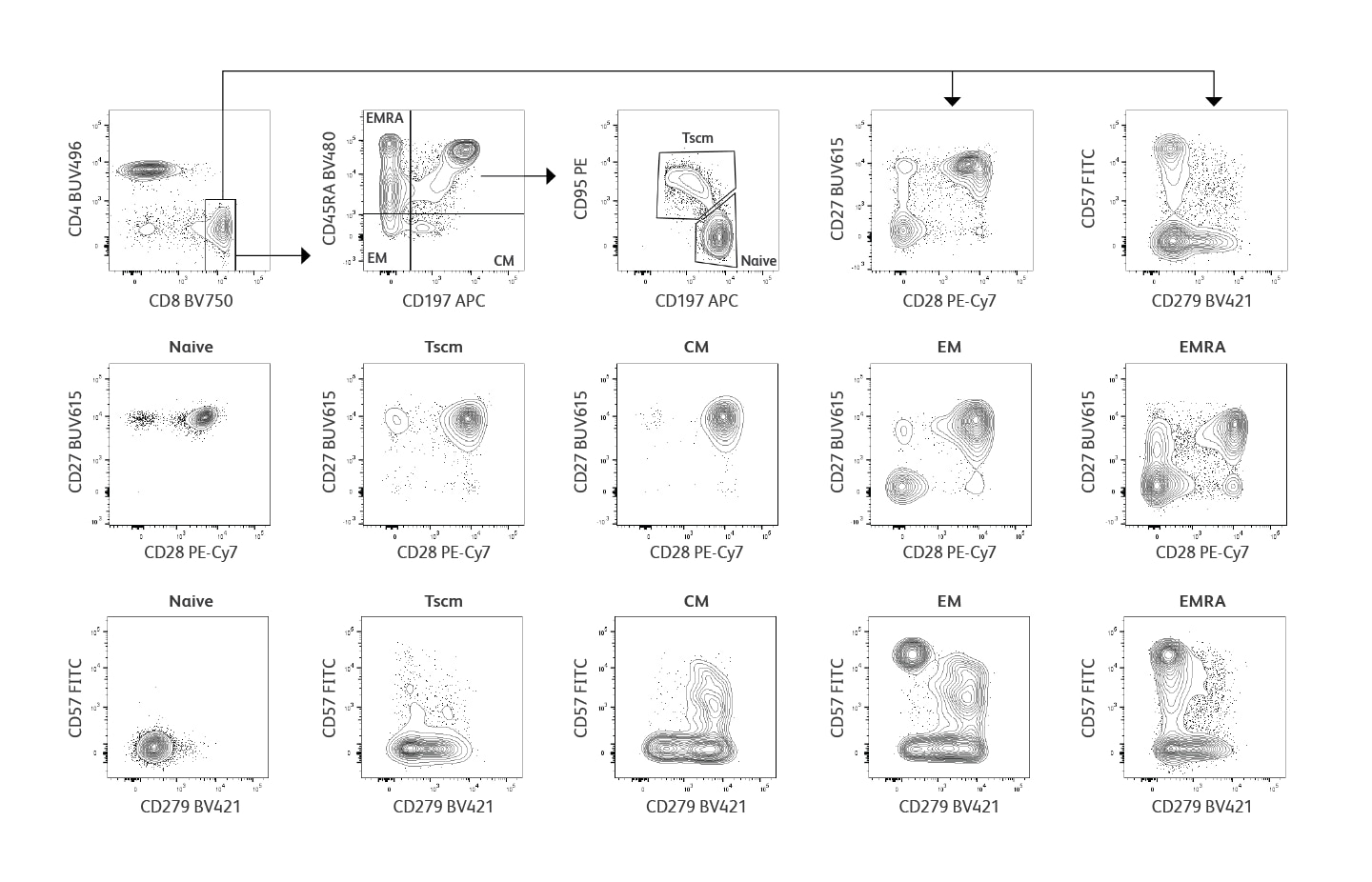
Example of a 10-fluorochrome combination with minimal spillover on a 5-laser (UV, violet, blue, yellow/green and red) BD LSRFortessa™ X-20 Cell Analyzer
Summary of spread across the selected fluorochromes generated using human peripheral blood mononuclear cells with mouse anti-human CD4, including stain index for CD4 calculated on the same instrument. The ability to distribute fluorochromes across more lasers enabled the expansion of the 5-color human T-cell panel to a 10-color panel with minimal increase in overall spillover and spread. Note that the amount of spread would vary depending on antigen density (lower spread for markers expressed lower than CD4 and higher spread for markers expressed higher). Similarly, the stain index values may change depending on instrument, instrument configuration and set-up. Clear resolution of each population of interest was ensured by the overall minimal spillover and spread between fluorochromes in the panel.
Evaluating Spillover and Spread into Other Detectors to Simplify Your Panel Design
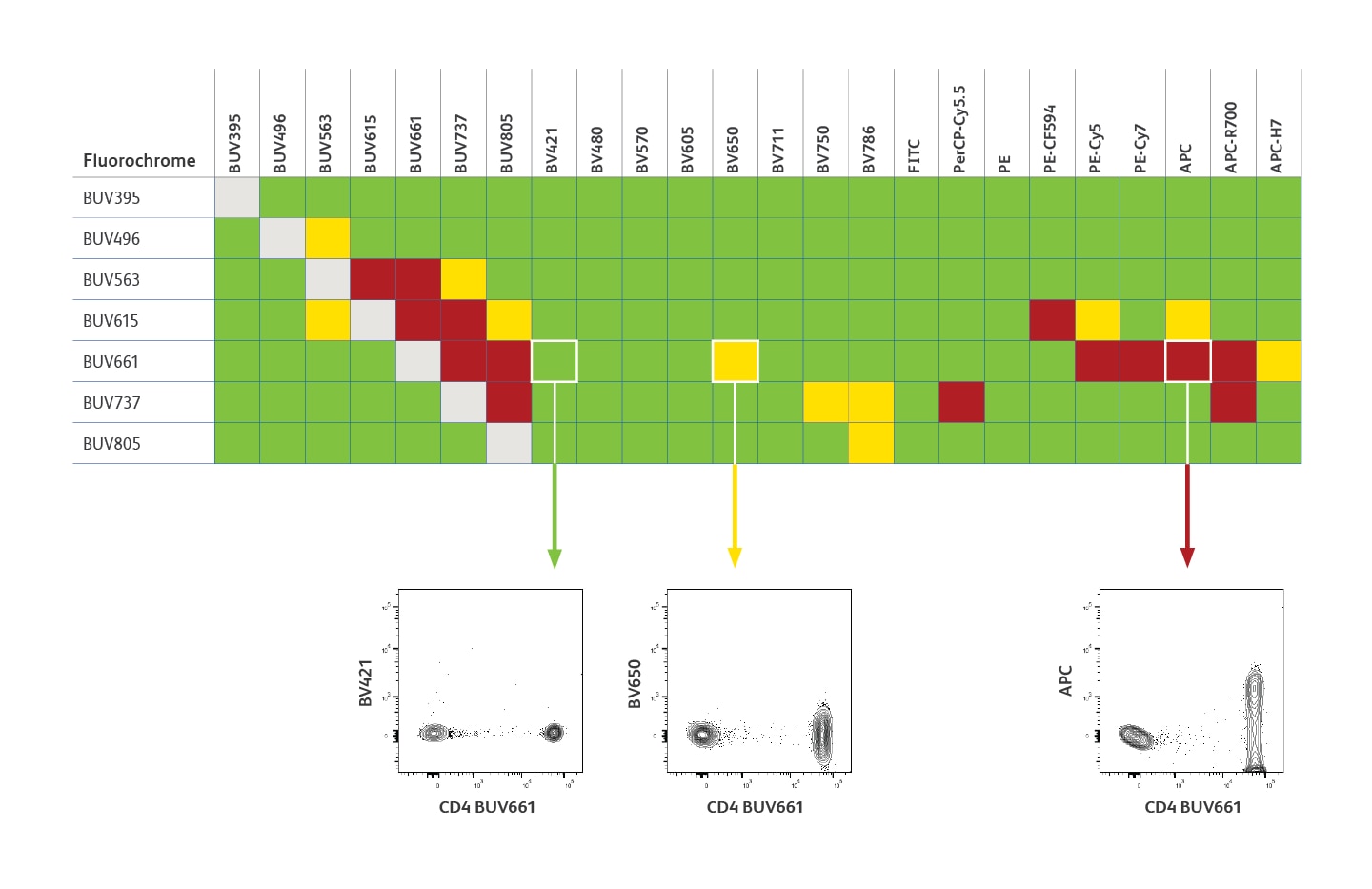
Representative summary of spread introduced by BD Horizon Brilliant™ UV Dyes into other detectors
A spread matrix was generated after staining human blood cells with CD4 conjugated with BD Horizon Brilliant™ UV Dyes (single stain). Samples were acquired on a BD FACSymphony™ A5 Cell Analyzer. Spread from an individual dye (row) into all the other detectors (columns) was visually assessed and color-coded as shown in the representative plots. Green=minimal spread; Yellow=medium spread; Red=high spread. The table shows how some BD Horizon Brilliant™ Dyes such as BUV395, BUV496 and BUV805 introduce very minimal to no spread into all the other detectors. Other BUV dyes have minimal impact on the majority of the other detectors. Please note that the amount of spread would vary depending on antigen density (lower spread for markers expressed lower than CD4 and higher spread for markers expressed higher) instrument configuration and set-up.
A strategic set of fluorochromes with minimal spillover, including three BUV dyes were used. This combination of fluorochromes enables simplified panel design by reducing challenging fluorochrome combinations and allows for generation of high-quality data through minimal introduction of spread.
Discover a new way to expand your flow cytometry panels. BD Horizon Brilliant™ UV 615 Reagents are designed to deliver clarity and provide flexibility in your panel design.
Frequently Asked Questions
What buffer are the BD Horizon™ Brilliant Fluorochromes compatible with?
All our buffers are compatible with the BD Horizon Brilliant™ Ultraviolet and BD Horizon Brilliant™ Violet Fluorochromes.
Do I need to use BD Horizon™ Brilliant Stain Buffer (BSB)?
Yes, BD Horizon™ Brilliant Stain Buffer is recommended whenever a panel includes more than one BD Horizon Brillant™ Fluorochrome.
What is the recommended workflow for using BD Horizon™ Brilliant stain buffer?
When using more than one BV or BUV conjugate in the same panel, add and mix the BD Horizon™ Brilliant Stain Buffer before introducing the second or any subsequent BV/BUV reagents. This helps prevent dye–dye interactions that can occur when multiple Brilliant Violet or Brilliant Ultraviolet fluorophores are combined.
Is BD Horizon™ Brilliant Stain Buffer recommended if only one BV/BUV reagent is used?
BD Horizon™ Brilliant Stain Buffer is not required when using a single BV/BUV conjugate. However, it can still be beneficial, as it can reduce non‑specific binding and decrease binding by anti‑PEG antibodies.
Is BD Horizon™ Brilliant Stain Buffer recommended for single color controls?
Yes. If BD Horizon™ Brilliant Stain Buffer is used in the final staining combination, it should also be included in the BV/BUV single‑color control tubes to enable consistent staining conditions.
Do I need to use BD Horizon™ Brilliant Stain Buffer if I am using either BUV or BV fluorochromes?
Yes. BD Horizon™ Brilliant Stain Buffer should be used whenever BD Horizon Brilliant™ Fluorochromes are used together in a panel. Using the buffer as directed helps ensure optimal staining performance and consistency.
Are these fluorochromes stable in different buffers?
Each dye has been tested during development and demonstrated stability across all buffer systems offered by BD Biosciences.
Which of these fluorochromes are tandems?
BD Horizon Brilliant™ Violet Fluorochromes, BV605, BV650, BV711, BV750 and BV786 and BD Horizon Brilliant™ UV Fluorochromes, BUV496, BUV563, BUV615, BUV661, BUV737 and BUV805 are polymer-based tandem fluorochromes.
Can I use these BV and BUV conjugated fluorochromes with compensation beads?
Yes. However, in some cases, compensation values for BV711 and BV786 conjugates may be higher in the violet 450/50 channel when using Thermo Fisher UltraComp Compensation Beads. In these situations, we recommend using BD SpectraComp™ Unmixing and Compensation Particles or setting compensation using cells.
What is the difference between BD Horizon™ Brilliant Stain Buffer and BD Horizon™ Brilliant Stain Buffer Plus?
The two buffers perform equivalently, but they differ in the volume required during staining. BD Horizon™ Brilliant Stain Buffer requires a 50 µL addition, while BD Horizon™ Brilliant Stain Buffer Plus requires only 10 µL. The lower volume of the Plus formulation may better support certain staining workflows, especially when panel design or sample volume is limited.
Reference
- Shirakawa H, Louis EJ, MacDiarmid AG, Chiang CK, Heeger AJ. Synthesis of electrically conducting organic polymers: halogen derivatives of polyacetylene, (CH)x. J. Chem Soc., Chem. Commun; 1977; 578-580. DOI: 10.1039/C39770000578


For Research Use Only. Not for use in diagnostic or therapeutic purposes. Not for Resale.