


A Bright Fluorochrome Suitable for Low to Medium Antigen Density Markers
BD Horizon Brilliant™ Violet 605 (BV605) Fluorochrome is a tandem fluorochrome consisting of a BV421 donor with an excitation maximum of 407 nm and an acceptor dye with an emission maximum of 605 nm. As part of the BD Horizon Brilliant™ Violet Family of Dyes, BV605 supports conventional and spectral flow cytometry research applications, including:
- Detection of low to medium antigen density markers
- Multicolor panels using several violet laser-excited dyes
- Surface and intracellular staining workflows
BV605 is a violet laser-excited fluorochrome (405 nm) with peak emission at 605 nm
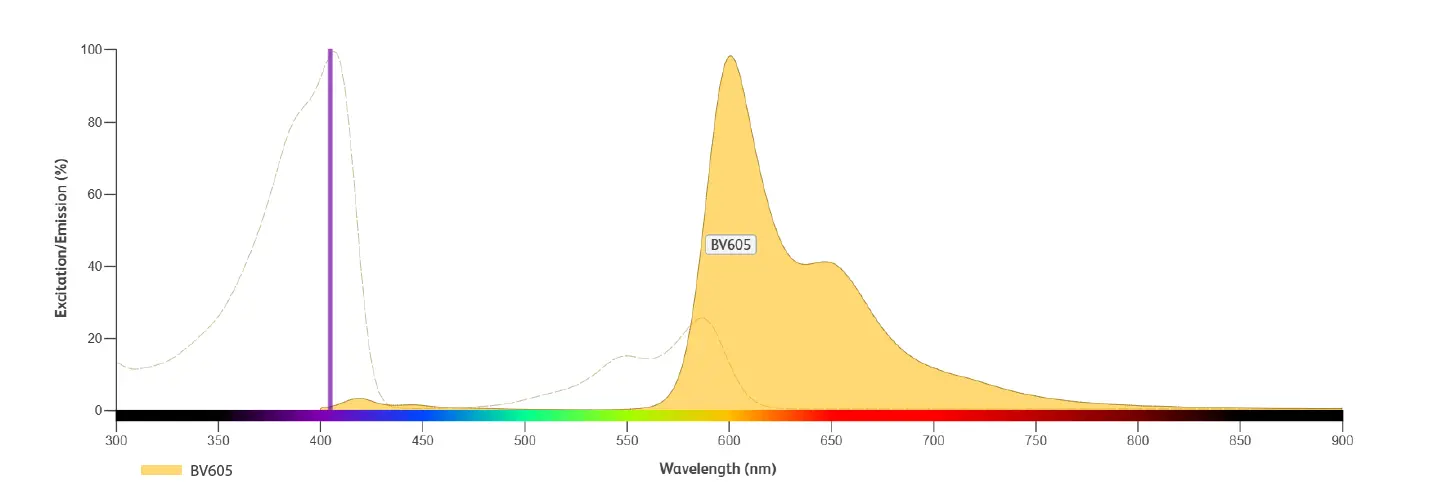
| Format | Ex Max | Em Max | Spectral | Conventional | Relative Brightness | Spillover* (1 = low, 4 = high) | Alternative To |
|---|---|---|---|---|---|---|---|
| BV7605 | 407 nm | 605 nm | Yes | Yes | 3 | Qdot™ 605, StarBright™ Violet 610 |
*Value may vary based on instrument configuration and settings. Spillover ranking is based on cross-laser excitation on five-laser spectral instruments and does not take into account spillover into adjacent detectors.
BD Horizon™ BV605-Conjugated Primary Antibodies Can Be Used to Detect a Wide Variety of Markers
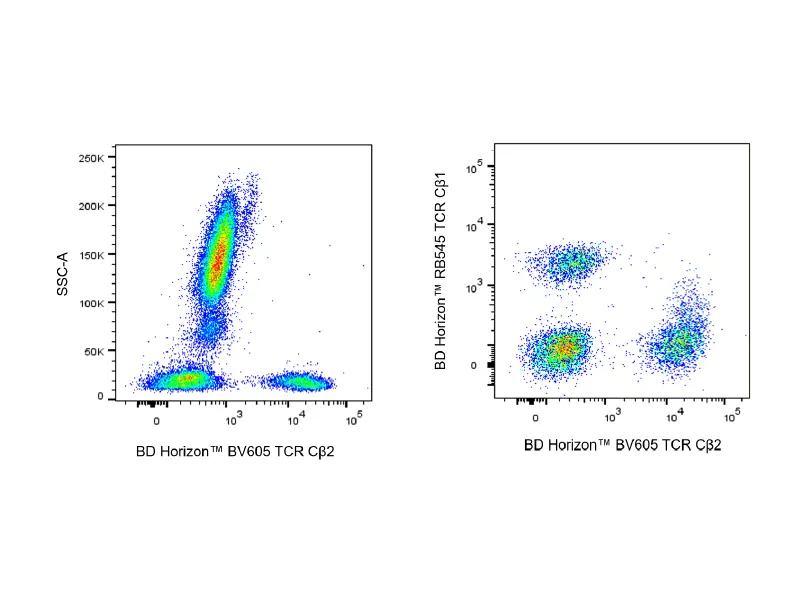
Human whole blood was stained with BD Horizon™ BV605 Mouse Anti-Human TCR Cβ2 antibody (SAM.2.rMAb) (Left Plot) and BD OptiBuild™ RB545 Mouse Anti-Human TCR Cβ1 antibody (JOVI.1) (Right Plot). Erythrocytes were lysed with BD FACS™ Lysing Solution. Flow cytometry and data analysis were performed using a BD FACSymphony™ A5 Cell Analyzer System and analyzed with FlowJo™ Software.

Multicolor Flow Cytometry
BV605-conjugated antibodies clearly stain CD163 in a multicolor flow cytometry panel
The 18-color dendritic cell subset panel for flow cytometry was designed for a comprehensive characterization of human dendritic cells (DCs). The panel enables the identification of 6 major DC subsets including cDC1, cDC2, CD123⁺Axl⁺ DCs, CD11c⁺Axl⁺ DCs, pDCs and CD16⁺ DCs1,2. The panel further allows the analysis of eight additional surface markers including BV605 CD163 (GHI/61) used for refined DC immunophenotyping.
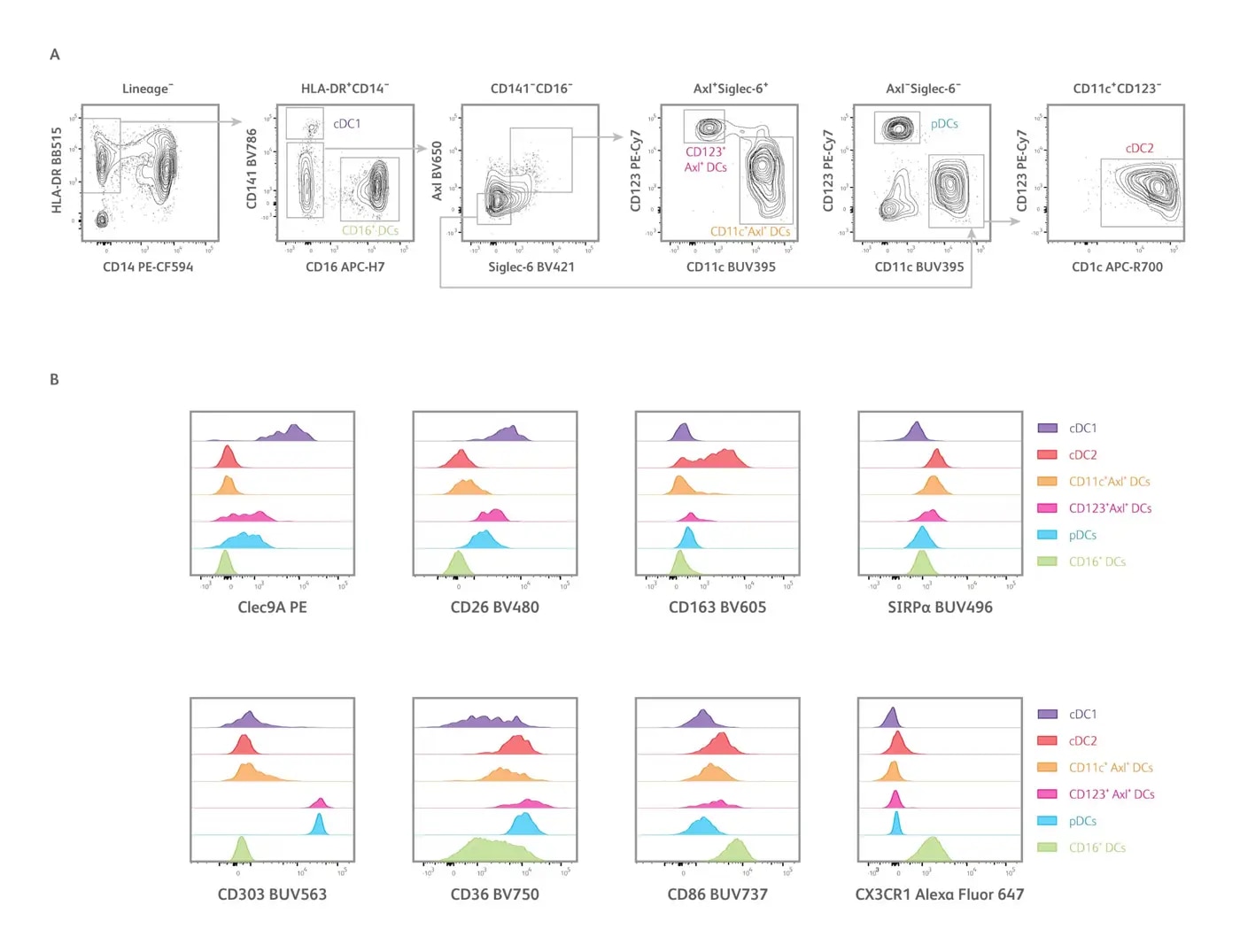
Deep immunophenotyping of human dendritic cells using the dendritic cell subset panel.
Representative analysis of PBMCS isolated from healthy human subjects (N = 3). A) Identification of major dendritic cell (DC) subsets. After exclusion of CD3+, CD56+ and
CD19+ lineage cells (not shown), DCs were identified and gated as HLA-DR+CD14- cells. From this gate, CD141+ cDC1 (blue) and CD16+ DCs (green) were identified. From the CD141-CD16- gate, AxI+ DCs were defined as Axl*Siglec-6+ cells. AxI+ DCs were further divided into CD123+ (violet) and CD11c* (oronge) AxI+ DCs. From the Axl-Siglec-6- gate, CD123+CD11c pDCs (aqua) and CD11c+CD1ct cDC2 (red) were identified. B) The 18-color panel further enabled the analysis of eight additional DC phenotyping markers and the identification of distinct expression patterns across the major DC subsets. Samples were acquired on a 5-laser, 28-color BD FACSymphony™ A3 Flow Cytometer. Data were analyzed using FlowJo™ v10 software.
FAQs
- What laser and filter set should I use with BV605?
A violet laser around 405 nm and an optical filter such as a 610/20 nm bandpass filter or similar. BV605 has a 407 nm excitation maximum and an emission maximum near 605 nm.
Confirm compatibility with the laser and optical configuration of your cytometer using the BD® Spectrum Viewer.
- Is BV605 a tandem dye and what does that mean for my workflow?
Yes. BV605 is a tandem fluorochrome comprising a BV421 donor and an acceptor dye with emission near 605 nm. Like other tandem dyes, its performance can be affected by light exposure, temperature, and fixation protocols. Minimize exposure to these factors and validate performance under your specific fixation and permeabilization conditions.
- What should I take into consideration when using BV605 in a multicolor panel?
It is a best practice to evaluate spectral overlap between adjacent fluorochromes during panel design. For BV605, BV650 is considered an adjacent dye and should be assessed for potentially spreading populations. On instruments equipped with a 561 nm yellow-green laser, the BV605 acceptor can also be excited by this laser, resulting in cross-laser excitation and increased spillover into detectors used for fluorochromes such as PE-CF594 or BD Horizon RealYellow™ 610 Reagents.
Ensure your instrument’s configuration compatibility with this dye in the BD® Spectrum Viewer.
- Can I use BV605 for conventional and spectral flow cytometry?
Yes. BV605 is compatible with conventional flow cytometers equipped with a violet laser and a filter centered near 610 nm. It also supports spectral flow cytometry, where software uses the complete fluorescence spectra for spectral unmixing.
- Should I use BD Horizon™ Brilliant Stain Buffer when using BV605 with other BD Horizon Brilliant™ Dyes?
Yes. Always use BD Horizon™ Brilliant Stain Buffer when using two or more BD Horizon Brilliant™ Dyes. Otherwise, dye-dye interactions between the fluorochromes may produce artifacts.
For Research Use Only. Not for use in diagnostic or therapeutic procedures. Not for resale. QDot is a trademark of Thermo Fisher Scientific. StarBright is a trademark of Bio-Rad Laboratories.