





.png)


Preparation And Storage


Recommended Assay Procedures
This antibody conjugate is suitable for intracellular staining of human whole blood (using BD Phosflow™ Lyse/Fix Buffer) and peripheral blood mononuclear cells (using BD Cytofix™ Fixation Buffer or BD Phosflow™ Fix Buffer I).
Product Notices
- This reagent has been pre-diluted for use at the recommended Volume per Test. We typically use 1 × 10^6 cells in a 100-µl experimental sample (a test).
- Source of all serum proteins is from USDA inspected abattoirs located in the United States.
- Caution: Sodium azide yields highly toxic hydrazoic acid under acidic conditions. Dilute azide compounds in running water before discarding to avoid accumulation of potentially explosive deposits in plumbing.
- Warning: Some APC-Cy7 and PE-Cy7 conjugates show changes in their emission spectrum with prolonged exposure to formaldehyde. If you are unable to analyze fixed samples within four hours, we recommend that you use BD™ Stabilizing Fixative (Cat. No. 338036).
- Please observe the following precautions: Absorption of visible light can significantly alter the energy transfer occurring in any tandem fluorochrome conjugate; therefore, we recommend that special precautions be taken (such as wrapping vials, tubes, or racks in aluminum foil) to prevent exposure of conjugated reagents, including cells stained with those reagents, to room illumination.
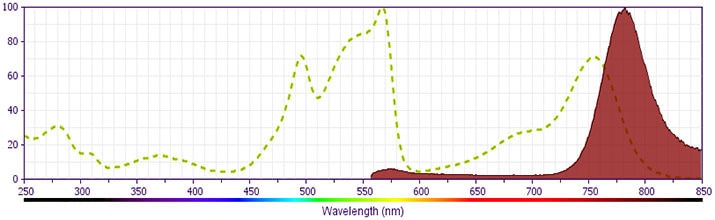
- PE-Cy7 is a tandem fluorochrome composed of R-phycoerythrin (PE), which is excited by 488-nm light and serves as an energy donor, coupled to the cyanine dye Cy7, which acts as an energy acceptor and fluoresces maximally at 780 nm. PE-Cy7 tandem fluorochrome emission is collected in a detector for fluorescence wavelengths of 750 nm and higher. Although every effort is made to minimize the lot-to-lot variation in the efficiency of the fluorochrome energy transfer, differences in the residual emission from PE may be observed. Therefore, we recommend that individual compensation controls be performed for every PE-Cy7 conjugate. PE-Cy7 is optimized for use with a single argon ion laser emitting 488-nm light, and there is no significant overlap between PE-Cy7 and FITC emission spectra. When using dual-laser cytometers, which may directly excite both PE and Cy7, we recommend the use of cross-beam compensation during data acquisition or software compensation during data analysis.
- For fluorochrome spectra and suitable instrument settings, please refer to our Multicolor Flow Cytometry web page at www.bdbiosciences.com/colors.
- Cy is a trademark of GE Healthcare.
- Species cross-reactivity detected in product development may not have been confirmed on every format and/or application.
- Please refer to www.bdbiosciences.com/us/s/resources for technical protocols.
Companion Products


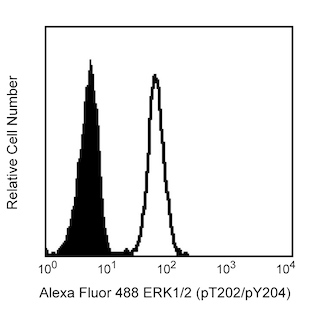
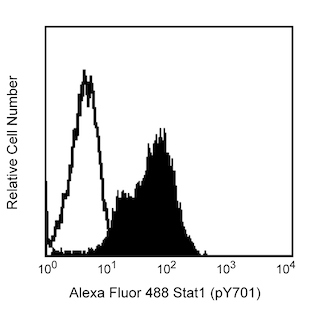
Stat (Signal transducer and activators of transcription) proteins mediate the biological activity of cytokines, including interleukins, interferons, erythropoietin, and growth factors. Ligand-receptor interaction activates constitutively-associated JAK family kinases and subsequent recruitment/activation of Stat proteins by tyrosine phosphorylation. Active Stat proteins then move to the nucleus to promote transcription of cytokine-inducible genes. Seven Stat proteins have been cloned, each of which is differentially expressed and/or activated in a cytokine-specific and cell type-specific manner. Stat5 has been characterized and shown to be encoded by two separate genes, Stat5a and Stat5b, which share over 90% identity at the amino acid level. Stat5a has been shown to be involved in lactogenesis and mammary development, while Stat5b has been shown to be involved in growth hormone signaling and liver gene expression. Both Stat5a and Stat5b are involved in IL-2 induced peripheral T cell proliferation. The peptide hormone, prolactin, binds to the prolactin receptor (PRLR) to initiate the lactogenic response. There are at least three forms of PRLR; however, only the long form activates the 92-kDa Stat5 protein by inducing phosphorylation at Y694. Once phosphorylated, Stat5 becomes an essential transcription factor which binds to the β-casein gene promoter. The presence of an SH2 domain within Stat5 suggests that it may directly interact with protein tyrosine kinases (PTKs) such as JAK2.
The 47 monoclonal antibody recognizes the phosphorylated Y694 of Stat5a. The homologous phosphorylation site in Stat5b is Y699.
Development References (4)
-
Bromberg J, Darnell JE. The role of STATs in transcriptional control and their impact on cellular function. Oncogene. 2000; 19(21):2468-2473. (Biology). View Reference
-
Gouilleux F, Wakao H, Mundt M, Groner B. Prolactin induces phosphorylation of Tyr694 of Stat5 (MGF), a prerequisite for DNA binding and induction of transcription. EMBO J. 1994; 13(18):4361-4369. (Biology). View Reference
-
Imada K, Leonard WJ. The Jak-STAT pathway. Mol Immunol. 2000; 37:1-11. (Biology). View Reference
-
Riou C, Yassine-Diab B, Van grevenynghe J, et al. Convergence of TCR and cytokine signaling leads to FOXO3a phosphorylation and drives the survival of CD4+ central memory T cells.. J Exp Med. 2007; 204(1):79-91. (Clone-specific: Flow cytometry). View Reference
Please refer to Support Documents for Quality Certificates
Global - Refer to manufacturer's instructions for use and related User Manuals and Technical data sheets before using this products as described
Comparisons, where applicable, are made against older BD Technology, manual methods or are general performance claims. Comparisons are not made against non-BD technologies, unless otherwise noted.
For Research Use Only. Not for use in diagnostic or therapeutic procedures.
