Dear Customer, If you experience any text readability or display issues on our website, please update your web browser to the latest version
.
See More
Dear Customer, If you experience any text readability or display issues on our website, please update your web browser to the latest version
.
See MoreDear Customer, If you experience any text readability or display issues on our website, please update your web browser to the latest version
.
This page has been recently translated and is available in French now.
Looks like you're visiting us from {countryName}.
Would you like to stay on the current location site or be switched to your location?
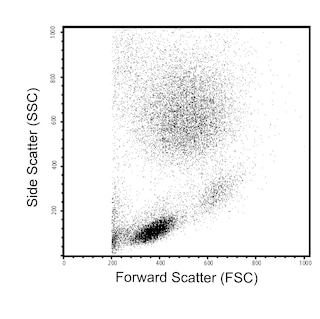
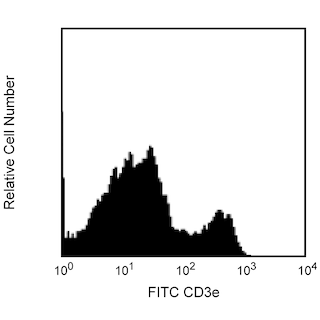
Multicolor flow cytometric analysis of CD197 expression on BALB/c mouse thymocytes. Thymocytes were stained with FITC Hamster Anti-Mouse CD3 antibody (Cat. No. 553061/553062/561827) and BD Horizon™ BV421 Rat Anti-Mouse CD197 antibody (Cat. No. 562675). The two-color flow cytometric dot plot shows the correlated expression patterns of CD3 versus CD197 for gated events with the forward and side light-scatter characteristics of viable thymocytes. Flow cytometry was performed using a BD™ LSR II Flow Cytometer System.
Any use of products other than the permitted use without the express written authorization of Becton, Dickinson and Company is strictly prohibited.
The monoclonal antibody 4B12/CCR7 reacts with the mouse C-C chemokine receptor type 7 (CCR7). CCR7 is also known as CD197 (previously known as EBI1, Ebi1h and CMKBR7) and plays a central role in mediating homeostatic B and T lymphocyte trafficking to and within secondary lymphoid tissues. CD197 is a seven-transmembrane, G-protein-coupled, 43 kDa glycoprotein receptor that is specific for the CC chemokines, MIP3ß/Exodus-3/ELC/CKb11/Scya19/CCL19 and 6Ckine/Exodus-2/SLC/TCA4/CKb9/Scya21/CCL21. The mouse Ccr7 gene is located on chromosome 11. CD197 (CCR7) is differentially expressed by subsets of thymocytes. Positive CD197 expression appears to be involved in the cortex-to-medulla migration of positively-selected thymocytes wherein they complete functional maturation including the establishment of central tolerance. It is most highly expressed by some mature medullary single-positive thymocytes. CD197 is also expressed by subsets of mature peripheral CD4+ and CD8+ T lymphocytes including naïve and regulatory T cells and central memory T cells. In addition, it is differentially expressed by subsets of B lymphocytes, dendritic cells, and Langerhans cells. CD197 serves as a homing receptor that helps guide these various cell types to and within lymphoid tissues. In this way, CCR7 supports protective immunity while safeguarding self tolerance. Reportedly, the 4B12/CCR7 antibody is not agonistic, is not blocked by CCL21 nor by physiologic levels of CCL19, nor does the antibody block the binding of CCL21 to CCR7. The immunogen used to generate the 4B12 hybridoma was a mouse CCR7-transfected rat cell line.
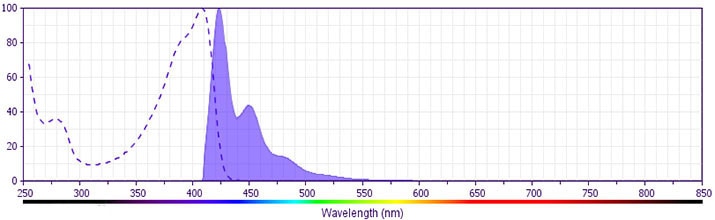
The antibody was conjugated to BD Horizon™ BV421 which is part of the BD Horizon™ Brilliant Violet™ family of dyes. With an Ex Max of 407-nm and Em Max at 421-nm, BD Horizon™ BV421 can be excited by the violet laser and detected in the standard Pacific Blue™ filter set (eg, 450/50-nm filter). BD Horizon™ BV421 conjugates are very bright, often exhibiting a 10 fold improvement in brightness compared to Pacific Blue™ conjugates.
Please refer to Support Documents for Quality Certificates
Global - Refer to manufacturer's instructions for use and related User Manuals and Technical data sheets before using this products as described
Comparisons, where applicable, are made against older BD Technology, manual methods or are general performance claims. Comparisons are not made against non-BD technologies, unless otherwise noted.
For Research Use Only. Not for use in diagnostic or therapeutic procedures.