







Preparation And Storage


Product Notices
- This reagent has been pre-diluted for use at the recommended Volume per Test. We typically use 1 × 10^6 cells in a 100-µl experimental sample (a test).
- Source of all serum proteins is from USDA inspected abattoirs located in the United States.
- An isotype control should be used at the same concentration as the antibody of interest.
- Please refer to www.bdbiosciences.com/us/s/resources for technical protocols.
- Caution: Sodium azide yields highly toxic hydrazoic acid under acidic conditions. Dilute azide compounds in running water before discarding to avoid accumulation of potentially explosive deposits in plumbing.
- For fluorochrome spectra and suitable instrument settings, please refer to our Multicolor Flow Cytometry web page at www.bdbiosciences.com/colors.
- Pacific Blue™ is a trademark of Molecular Probes, Inc., Eugene, OR.
- Brilliant Violet™ 421 is a trademark of Sirigen.
Companion Products
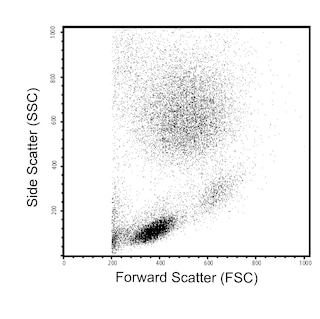

The DX12 monoclonal antibody specifically binds to human CD161 which is also known as Natural killer cell surface protein P1A (NKR-P1A). CD161 is encoded by the KLRB1 (Killer cell lectin-like receptor subfamily B member 1) gene. CD161 is a member of the C-type lectin superfamily and is also referred to as C-type lectin domain family 5 member B (CLEC5B). CD161 is a 80 kDa disulfide-linked homodimer, type II membrane glycoprotein. CD161 is expressed mostly on NK cell populations and on subsets of CD4+ and CD8+ αβ T cells, NKT cells and γδ T cells. Reports indicate that CD161 is expressed preferentially on CD45RO+ T cells, however, it can be found on a subset of thymocytes and fetal liver T cells. Its function has not been fully elucidated, but reports indicate that NKR-P1A may serve as a specific receptor for some NK cell targets. The DX12 antibody can reportedly inhibit spontaneous cytotoxicity mediated by certain NK cell clones.
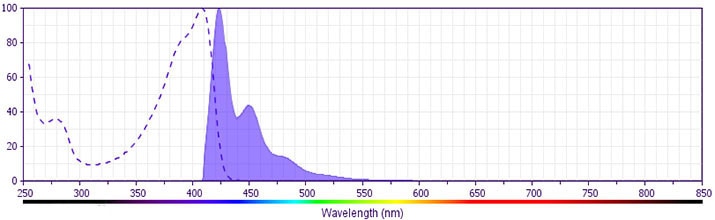
The antibody was conjugated to BD Horizon™ BV421 which is part of the BD Horizon™ Brilliant Violet™ family of dyes. With an Ex Max of 407-nm and Em Max at 421-nm, BD Horizon™ BV421 can be excited by the violet laser and detected in the standard Pacific Blue™ filter set (eg, 450/50-nm filter). BD Horizon™ BV421 conjugates are very bright, often exhibiting a 10 fold improvement in brightness compared to Pacific Blue™ conjugates.
Development References (4)
-
Ida H, Morita C, Porcelli S, Anderson P. CD161 workshop: Reactivity of workshop natural killer cell monoclonal antibodies on fresh and interleukin 2-activated peripheral blood natural killer cells and CD4-negative CD8-negative αβ and γδ T-cell clones. In: Kishimoto T. Tadamitsu Kishimoto .. et al., ed. Leucocyte typing VI : white cell differentiation antigens : proceedings of the sixth international workshop and conference held in Kobe, Japan, 10-14 November 1996. New York: Garland Pub.; 1997:313-317.
-
Lanier LL, Chang C, Phillips JH. Human NKR-P1A. A disulfide-linked homodimer of the C-type lectin superfamily expressed by a subset of NK and T lymphocytes. J Immunol. 1994; 153(6):2417-2428. (Immunogen: Inhibition). View Reference
-
Loza MJ, Metelitsa LS, Perussia B. NKT and T cells: coordinate regulation of NK-like phenotype and cytokine production. Eur J Immunol. 2002; 32(12):3453-3462. (Clone-specific: Flow cytometry). View Reference
-
Poggi A, Revello V, Nanni L, Costa P, Moretta A. CD161 (human NKR-P1A) workshop panel report. In: Kishimoto T. Tadamitsu Kishimoto .. et al., ed. Leucocyte typing VI : white cell differentiation antigens : proceedings of the sixth international workshop and conference held in Kobe, Japan, 10-14 November 1996. New York: Garland Pub.; 1997:307-312.
Please refer to Support Documents for Quality Certificates
Global - Refer to manufacturer's instructions for use and related User Manuals and Technical data sheets before using this products as described
Comparisons, where applicable, are made against older BD Technology, manual methods or are general performance claims. Comparisons are not made against non-BD technologies, unless otherwise noted.
For Research Use Only. Not for use in diagnostic or therapeutic procedures.
