





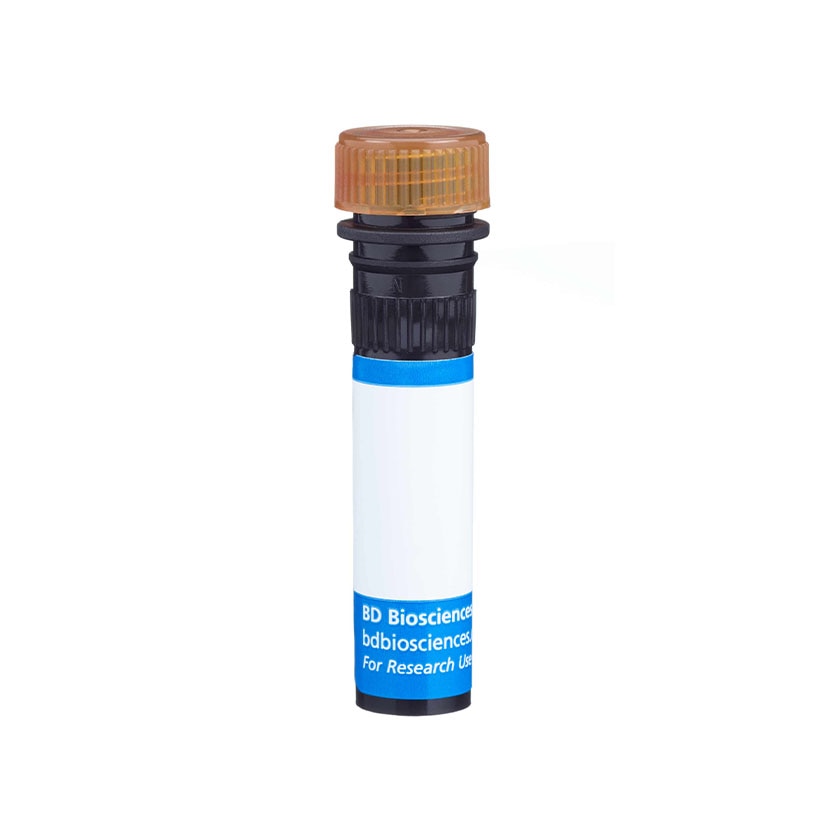


Preparation And Storage


Product Notices
- This reagent has been pre-diluted for use at the recommended Volume per Test. We typically use 1 × 10^6 cells in a 100-µl experimental sample (a test).
- An isotype control should be used at the same concentration as the antibody of interest.
- Source of all serum proteins is from USDA inspected abattoirs located in the United States.
- Caution: Sodium azide yields highly toxic hydrazoic acid under acidic conditions. Dilute azide compounds in running water before discarding to avoid accumulation of potentially explosive deposits in plumbing.
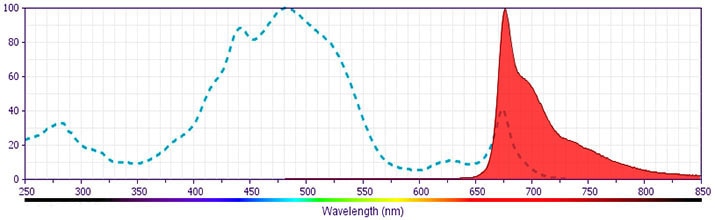
- PerCP-Cy5.5–labelled antibodies can be used with FITC- and R-PE–labelled reagents in single-laser flow cytometers with no significant spectral overlap of PerCP-Cy5.5, FITC, and R-PE fluorescence.
- PerCP-Cy5.5 is optimized for use with a single argon ion laser emitting 488-nm light. Because of the broad absorption spectrum of the tandem fluorochrome, extra care must be taken when using dual-laser cytometers, which may directly excite both PerCP and Cy5.5™. We recommend the use of cross-beam compensation during data acquisition or software compensation during data analysis.
- Species cross-reactivity detected in product development may not have been confirmed on every format and/or application.
- Cy is a trademark of GE Healthcare.
- Please observe the following precautions: Absorption of visible light can significantly alter the energy transfer occurring in any tandem fluorochrome conjugate; therefore, we recommend that special precautions be taken (such as wrapping vials, tubes, or racks in aluminum foil) to prevent exposure of conjugated reagents, including cells stained with those reagents, to room illumination.
- For fluorochrome spectra and suitable instrument settings, please refer to our Multicolor Flow Cytometry web page at www.bdbiosciences.com/colors.
- Please refer to www.bdbiosciences.com/us/s/resources for technical protocols.
Companion Products
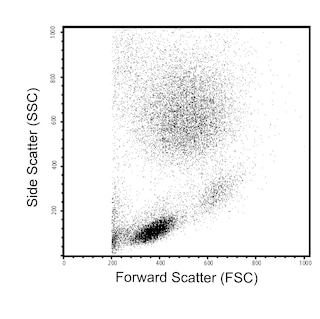
The 11A9 monoclonal antibody specifically binds to CD196, which is also known as CCR6. CCR6 is a seven-transmembrane, G-protein-coupled, glycoprotein receptor that is a member of the beta chemokine receptor family. The human CCR6 gene has been mapped to chromosome 6q27. CCR6 is a receptor for the CC chemokine CCL20/MIP-3alpha/LARC/Exodus and also binds with lower affinity to and mediates responses to beta-defensin2/hBD-2. CCR6 is predominantly expressed by B lymphocytes, certain subsets of effector and memory T cells and by immature dendritic cells but not by monocytes, NK cells, or granulocytes. Skin-homing CLA (Cutaneous Lymphocyte Antigen)-positive memory T cells, Th1 cells, regulatory T cells and IL-17A-producing Th17 cells predominantly express high levels of CCR6. CCR6 mediates the trafficking of T, B, and dendritic cells to epithelial sites near the skin and mucosal surfaces during inflammatory and immunological responses. An N-terminal peptide of human CCR6 was used as an immunogen to generate the 11A9 hybridoma. The 11A9 antibody does not cross-react with human CCR1, CCR2, CCR3, CCR4, CCR5, CCR7, CCR8, CCR9, CXCR1, CXCR2, CXCR3, CXCR4 and CXCR5 receptors. This antibody is NOT a neutralizing antibody.
Development References (11)
-
Baba M, Imai T, Nishimura M, et al. Identification of CCR6, the specific receptor for a novel lymphocyte-directed CC chemokine LARC. J Biol Chem. 1997; 272(23):14893-14898. (Biology). View Reference
-
Greaves DR, Wang W, Dairaghi DJ, et al. CCR6, a CC chemokine receptor that interacts with macrophage inflammatory protein 3alpha and is highly expressed in human dendritic cells. J Exp Med. 1997; 186(6):837-844. (Biology). View Reference
-
Homey B, Dieu-Nosjean MC, Wiesenborn A, et al. Up-regulation of macrophage inflammatory protein-3 alpha/CCL20 and CC chemokine receptor 6 in psoriasis. J Immunol. 2000; 164(12):6621-6632. (Biology). View Reference
-
Kim CH, Rott L, Kunkel EJ, et al. Rules of chemokine receptor association with T cell polarization in vivo. J Clin Invest. 2001; 108(9):1331-1339. (Biology). View Reference
-
Liao F, Alderson R, Su J, Ullrich SJ, Kreider BL, Farber JM. STRL22 is a receptor for the CC chemokine MIP-3alpha. Biochem Biophys Res Commun. 1997; 236(1):212-217. (Biology). View Reference
-
Liao F, Lee HH, Farber JM. Cloning of STRL22, a new human gene encoding a G-protein-coupled receptor related to chemokine receptors and located on chromosome 6q27. Genomics. 1997; 40(1):175-180. (Biology). View Reference
-
Liao F, Rabin RL, Smith CS, Sharma G, Nutman TB, Farber JM. CC-chemokine receptor 6 is expressed on diverse memory subsets of T cells and determines responsiveness to macrophage inflammatory protein 3 alpha. J Immunol. 1999; 162(1):186-194. (Biology). View Reference
-
Lim HW, Lee J, Hillsamer P, Kim CH. Human Th17 cells share major trafficking receptors with both polarized effector T cells and FOXP3+ regulatory T cells. J Immunol. 2008; 180(1):122-129. (Biology). View Reference
-
Power CA, Church DJ, Meyer A, et al. Cloning and characterization of a specific receptor for the novel CC chemokine MIP-3alpha from lung dendritic cells. J Exp Med. 1997; 186(6):825-835. (Biology). View Reference
-
Yang D, Chertov O, Bykovskaia SN, et al. Beta-defensins: linking innate and adaptive immunity through dendritic and T cell CCR6. Science. 1999; 286(5439):525-528. (Biology). View Reference
-
Zaballos A, Varona R, Gutierrez J, Lind P, Marquez G. Molecular cloning and RNA expression of two new human chemokine receptor-like genes. Biochem Biophys Res Commun. 1996; 227(3):846-853. (Biology). View Reference
Please refer to Support Documents for Quality Certificates
Global - Refer to manufacturer's instructions for use and related User Manuals and Technical data sheets before using this products as described
Comparisons, where applicable, are made against older BD Technology, manual methods or are general performance claims. Comparisons are not made against non-BD technologies, unless otherwise noted.
For Research Use Only. Not for use in diagnostic or therapeutic procedures.
