





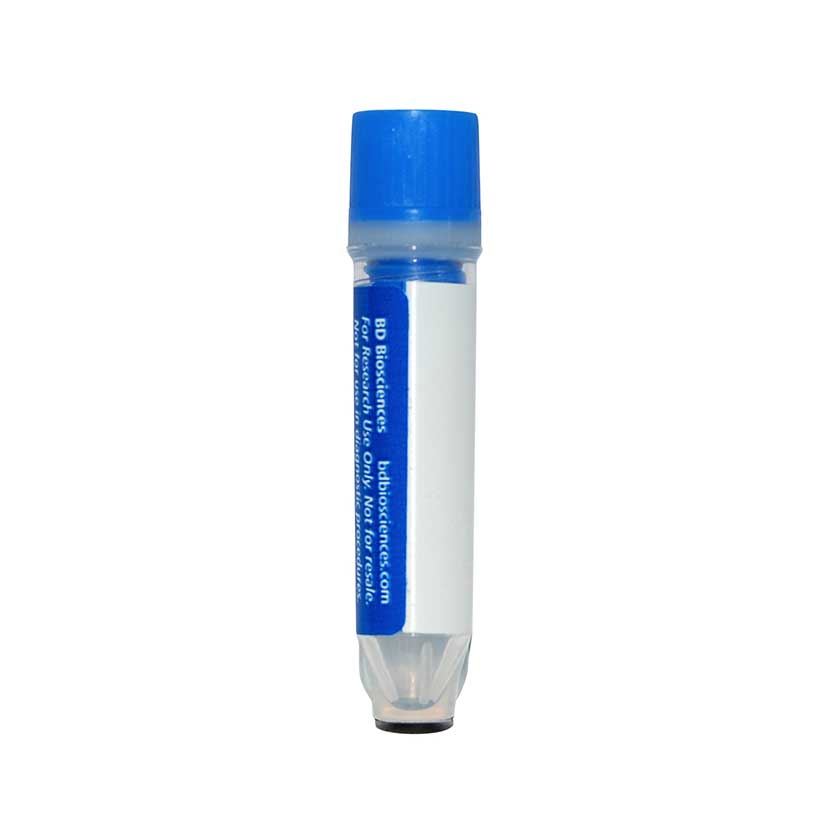


Preparation And Storage


Recommended Assay Procedures
Put all BD® AbSeq Reagents to be pooled into a Latch Rack for 500 µL Tubes (Thermo Fisher Scientific Cat. No. 4900). Arrange the tubes so that they can be easily uncapped and re-capped with an 8-Channel Screw Cap Tube Capper (Thermo Fisher Scientific Cat. No. 4105MAT) and the reagents aliquoted with a multi-channel pipette.
BD® AbSeq tubes should be centrifuged for ≥ 30 seconds at 400 × g to ensure removal of any content in the cap/tube threads prior to the first opening.
Product Notices
- This reagent has been pre-diluted for use at the recommended volume per test. Typical use is 2 µl for 1 × 10^6 cells in a 200-µl staining reaction.
- Source of all serum proteins is from USDA inspected abattoirs located in the United States.
- Caution: Sodium azide yields highly toxic hydrazoic acid under acidic conditions. Dilute azide compounds in running water before discarding to avoid accumulation of potentially explosive deposits in plumbing.
- The production process underwent stringent testing and validation to assure that it generates a high-quality conjugate with consistent performance and specific binding activity. However, verification testing has not been performed on all conjugate lots.
- Illumina is a trademark of Illumina, Inc.
- Please refer to http://regdocs.bd.com to access safety data sheets (SDS).
- Please refer to bd.com/genomics-resources for technical protocols.
- For U.S. patents that may apply, see bd.com/patents.
Companion Products



The 10E9.6 monoclonal antibody specifically binds to the 97-110 kDa cell surface glycoprotein E-selectin (CD62E), also known as endothelial-leukocyte adhesion molecule-1 (ELAM-1), which is expressed on endotoxin- or cytokine-stimulated mouse endothelial cells. A suspension of TNFα stimulated mouse brain capillary endothelioma cells, from the cell line bEnd.3, was used as the immunogen. The epitope recognized by mAb 10E9.6 has been mapped to the first and/or second complement regulatory protein repeat domains of E-selectin. The 10E9.6 antibody has been reported to block binding of a monocyte cell line to E-selectin in vitro and to block neutrophil migration in BALB/c, but not C57BL/6 mice. It has no effect on leukocyte rolling in TNFα-treated mouse venules or on in vitro adhesion of myeloid cells to E-selectin. Studies have demonstrated that Cutaneous Lymphocyte Antigen (CLA), recognized by mAb HECA-452 (Cat. no. 555946), may be a ligand for CD62E.
Development References (7)
-
Borges E, Pendl G, Eytner R, Steegmaier M, Zollner O, Vestweber D. The binding of T cell-expressed P-selectin glycoprotein ligand-1 to E- and P-selectin is differentially regulated. J Biol Chem. 1997; 272(45):28786-28792. (Biology). View Reference
-
Bosse R, Vestweber D. Only simultaneous blocking of the L- and P-selectin completely inhibits neutrophil migration into mouse peritoneum. Eur J Immunol. 1994; 24(12):3019-3024. (Immunogen: Blocking, ELISA, Immunoprecipitation). View Reference
-
Eppihimer MJ, Wolitzky B, Anderson DC, Labow MA, Granger DN. Heterogeneity of expression of E- and P-selectins in vivo. Circ Res. 1996; 79(3):560-569. (Biology: Blocking). View Reference
-
Ley K, Bullard DC, Arbones ML, et al. Sequential contribution of L- and P-selectin to leukocyte rolling in vivo. J Exp Med. 1995; 181(2):669-675. (Biology). View Reference
-
Pendl GG, Robert C, Steinert M, et al. Immature mouse dendritic cells enter inflamed tissue, a process that requires E- and P-selectin, but not P-selectin glycoprotein ligand 1. Blood. 2002; 99(3):946-956. (Biology). View Reference
-
Ramos CL, Kunkel EJ, Lawrence MB, et al. Differential effect of E-selectin antibodies on neutrophil rolling and recruitment to inflammatory sites. Blood. 1997; 89(8):3009-3018. (Immunogen: Blocking). View Reference
-
Weller A, Isenmann S, Vestweber D. Cloning of the mouse endothelial selectins. Expression of both E- and P-selectin is inducible by tumor necrosis factor alpha. J Biol Chem. 1992; 267(21):15176-15183. (Biology). View Reference
Please refer to Support Documents for Quality Certificates
Global - Refer to manufacturer's instructions for use and related User Manuals and Technical data sheets before using this products as described
Comparisons, where applicable, are made against older BD Technology, manual methods or are general performance claims. Comparisons are not made against non-BD technologies, unless otherwise noted.
For Research Use Only. Not for use in diagnostic or therapeutic procedures.
Refer to manufacturer's instructions for use and related User Manuals and Technical Data Sheets before using this product as described.
Comparisons, where applicable, are made against older BD technology, manual methods or are general performance claims. Comparisons are not made against non-BD technologies, unless otherwise noted.