





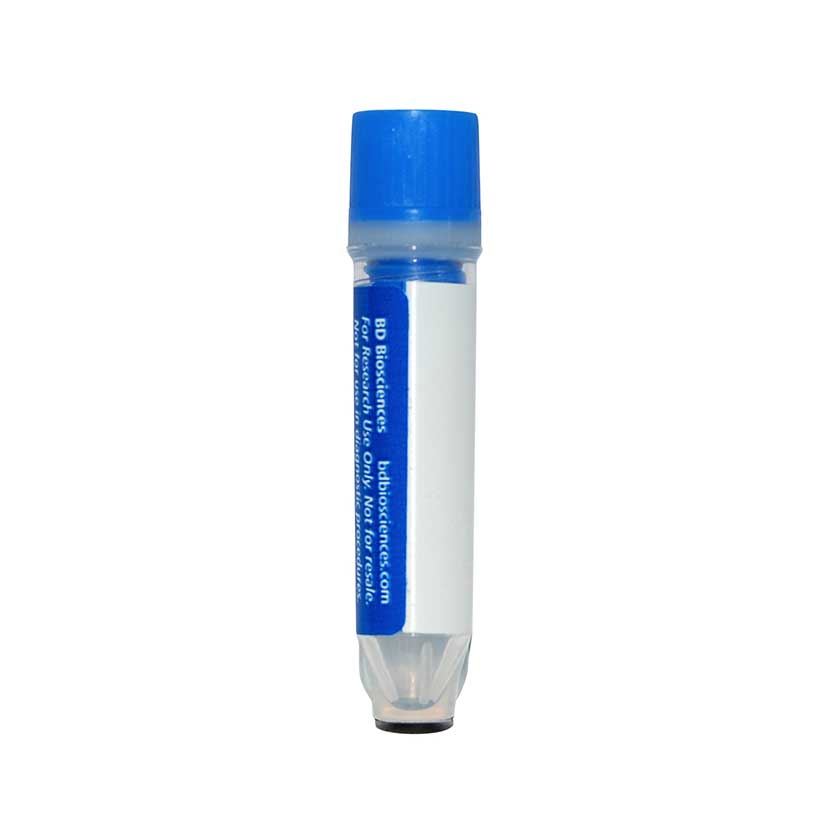


Preparation And Storage


Recommended Assay Procedures
Put all BD® AbSeq Reagents to be pooled into a Latch Rack for 500 µL Tubes (Thermo Fisher Scientific Cat. No. 4900). Arrange the tubes so that they can be easily uncapped and re-capped with an 8-Channel Screw Cap Tube Capper (Thermo Fisher Scientific Cat. No. 4105MAT) and the reagents aliquoted with a multi-channel pipette.
BD® AbSeq tubes should be centrifuged for ≥ 30 seconds at 400 × g to ensure removal of any content in the cap/tube threads prior to the first opening.
Product Notices
- This reagent has been pre-diluted for use at the recommended volume per test. Typical use is 2 µl for 1 × 10^6 cells in a 200-µl staining reaction.
- Source of all serum proteins is from USDA inspected abattoirs located in the United States.
- Caution: Sodium azide yields highly toxic hydrazoic acid under acidic conditions. Dilute azide compounds in running water before discarding to avoid accumulation of potentially explosive deposits in plumbing.
- The production process underwent stringent testing and validation to assure that it generates a high-quality conjugate with consistent performance and specific binding activity. However, verification testing has not been performed on all conjugate lots.
- Illumina is a trademark of Illumina, Inc.
- Please refer to http://regdocs.bd.com to access safety data sheets (SDS).
- Please refer to bd.com/genomics-resources for technical protocols.
- For U.S. patents that may apply, see bd.com/patents.
Companion Products



The RM2-5 monoclonal antibody specifically binds to the immunoglobulin superfamily adhesion molecule, CD2 (LFA-2). CD2 is a type I transmembrane glycoprotein that serves as the the major receptor for CD48 in the mouse. CD2 is involved in T-cell activation, immunoregulation, and thymocyte maturation. In the mouse, CD2 is expressed on peripheral T lymphocytes, B lymphocytes, and NK cells, and a subpopulation of intraepithelial T lymphocytes. CD2 is expressed throughout mouse thymic ontogeny, except for distinct subsets of the CD4-CD8- early thymocytes. In the mouse bone marrow, CD2 is expressed on B220+ sIg+ CD43- pre-B cells, but not on CD43+ pro-B cells. The RM2-5 antibody is one of a set of five anti-mouse CD2 monoclonal antibodies that were classified into two groups according to their mutual competition in binding to cell surface CD2 and which block CD2-mediated cell-cell adhesion.
Development References (16)
-
Ayroldi E, Migliorati G, Cannarile L, Moraca R, Delfino DV, Riccardi C. CD2 rescues T cells from T-cell receptor/CD3 apoptosis: a role for the Fas/Fas-L system. Blood. 1997; 89(10):3717-3726. (Biology). View Reference
-
Cibotti R, Punt JA, Dash KS, Sharrow SO, Singer A. Surface molecules that drive T cell development in vitro in the absence of thymic epithelium and in the absence of lineage-specific signals. Immunity. 1997; 6(3):245-255. (Clone-specific: Induction). View Reference
-
Criado G, Feito MJ, Rojo JM. CD4-dependent and -independent association of protein tyrosine kinases to the T cell receptor/CD3 complex of CD4+ mouse T lymphocytes. Eur J Immunol. 1996; 26(6):1228-1234. (Clone-specific: Immunoprecipitation). View Reference
-
Davis SJ, van der Merwe PA. The structure and ligand interactions of CD2: implications for T-cell function. Immunol Today. 1996; 17(4):177-187. (Biology). View Reference
-
Hayday A, Theodoridis E, Ramsburg E, Shires J. Intraepithelial lymphocytes: exploring the Third Way in immunology. Nat Immunol. 2001; 2(11):997-1003. (Biology). View Reference
-
Kato K, Koyanagi M, Okada H, et al. CD48 is a counter-receptor for mouse CD2 and is involved in T cell activation. J Exp Med. 1992; 176(5):1241-1249. (Biology). View Reference
-
Kuo S, El Guindy A, Panwala CM, Hagan PM, Camerini V. Differential appearance of T cell subsets in the large and small intestine of neonatal mice. Pediatr Res. 2001; 49(4):543-551. (Biology). View Reference
-
Masten BJ, Yates JL, Pollard Koga AM, Lipscomb MF. Characterization of accessory molecules in murine lung dendritic cell function: roles for CD80, CD86, CD54, and CD40L. Am J Respir Cell Mol Biol. 1997; 16(3):335-342. (Clone-specific: Blocking). View Reference
-
Nakamura T, Takahashi K, Fukazawa T, et al. Relative contribution of CD2 and LFA-1 to murine T and natural killer cell functions. J Immunol. 1990; 145(11):3628-3634. (Immunogen: Blocking, Inhibition). View Reference
-
Papavasiliou F, Misulovin Z, Suh H, Nussenzweig MC. The role of Ig beta in precursor B cell transition and allelic exclusion. Science. 1995; 268(5209):408-411. (Biology). View Reference
-
Rakasz E, Hagen M, Sandor M, Lynch RG. Gamma delta T cells of the murine vagina: T cell response in vivo in the absence of the expression of CD2 and CD28 molecules. Int Immunol. 1997; 9(1):161-167. (Biology). View Reference
-
Rodewald HR, Awad K, Moingeon P, et al. Fc gamma RII/III and CD2 expression mark distinct subpopulations of immature CD4-CD8- murine thymocytes: in vivo developmental kinetics and T cell receptor beta chain rearrangement status. J Exp Med. 1993; 177(4):1079-1092. (Biology). View Reference
-
Teh SJ, Killeen N, Tarakhovsky A, Littman DR, Teh HS. CD2 regulates the positive selection and function of antigen-specific CD4- CD8+ T cells. Blood. 1997; 89(4):1308-1318. (Biology). View Reference
-
Yagita H, Asakawa J, Tansyo S, Nakamura T, Habu S, Okumura K. Expression and function of CD2 during murine thymocyte ontogeny. Eur J Immunol. 1989; 19(12):2211-2217. (Biology). View Reference
-
Yagita H, Nakamura T, Asakawa J, et al. CD2 expression in murine B cell lineage. Int Immunol. 1989; 1(1):94-98. (Biology). View Reference
-
Yagita H, Nakamura T, Karasuyama H, Okumura K. Monoclonal antibodies specific for murine CD2 reveal its presence on B as well as T cells. Proc Natl Acad Sci U S A. 1989; 86(2):645-649. (Immunogen: Flow cytometry). View Reference
Please refer to Support Documents for Quality Certificates
Global - Refer to manufacturer's instructions for use and related User Manuals and Technical data sheets before using this products as described
Comparisons, where applicable, are made against older BD Technology, manual methods or are general performance claims. Comparisons are not made against non-BD technologies, unless otherwise noted.
For Research Use Only. Not for use in diagnostic or therapeutic procedures.
Refer to manufacturer's instructions for use and related User Manuals and Technical Data Sheets before using this product as described.
Comparisons, where applicable, are made against older BD technology, manual methods or are general performance claims. Comparisons are not made against non-BD technologies, unless otherwise noted.