





BD Pharmingen™ Purified Mouse Anti-Human DP-1
Clone TFD10 (RUO)


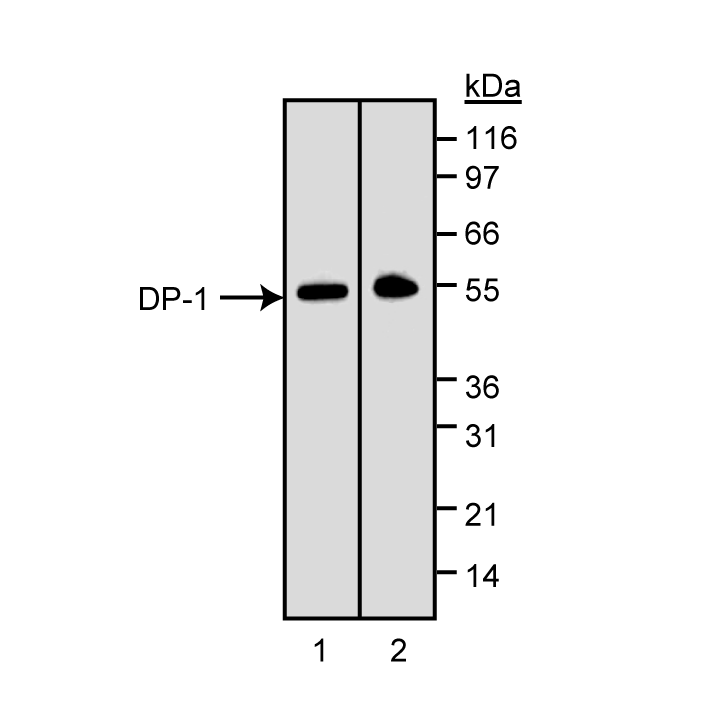
Western blot analysis of human DP-1. Lysates from Daudi Burkitt lymphoma cells (lane 1) and HeLa cervical carcinoma cells (lane 2) were probed with anti-DP-1 (clone TDF10, Cat. No. 556462). DP-1 is observed as an ~55 kDa band.
Western blot analysis of human DP-1. Lysates from Daudi Burkitt lymphoma cells (lane 1) and HeLa cervical carcinoma cells (lane 2) were probed with anti-DP-1 (clone TDF10, Cat. No. 556462). DP-1 is observed as an ~55 kDa band.


Preparation And Storage


Recommended Assay Procedures
Western blot: Please refer to http://www.bdbiosciences.com/pharmingen/protocols/Western_Blotting.shtml
Clone TFD10 is useful for western blot (1-2 µg/ml) of human DP-1. Several human cell lines may be used as a positive control for this application includingL HeLa, cervical carcinoma (ATCC CCL-2); RD, Rhabdomysarcoma (ATCC CCL-136); Daudi, Burkitt lymphoma (ATCC CCL-213) and CEM peripheral blood T cell lines (ATCC CCL-119).
Product Notices
- Since applications vary, each investigator should titrate the reagent to obtain optimal results.
- Caution: Sodium azide yields highly toxic hydrazoic acid under acidic conditions. Dilute azide compounds in running water before discarding to avoid accumulation of potentially explosive deposits in plumbing.
- Please refer to www.bdbiosciences.com/us/s/resources for technical protocols.
DP-1 and DP-2 are transcription factors which form heterodimers with several members of the E2F family. DP-1 binding to E2F is often required for interaction between E2F and the retinoblastoma family of proteins (Rb, p107 and p130), which restrict E2F/DP complexes to the cytoplasm. These E2F inhibitors are phosphorylated by complexes which are formed during the cell cycle, e.g., cyclin-cdk complexes. Phosphorylation of RB or other inhibitors releases the E2F/DP complex to enter the nucleus, thus providing temporally regulated activation of E2F responsive genes. While some E2F proteins can act alone, formation of a DP-1 heterodimer provides enhanced DNA binding and transcriptional activity to E2F. E2F-DNA binding sites have been identified in the promoter regions of genes important for growth regulation, e.g., c-myc, N-myc, cdc2 and cyclin A as well as within genes which are important for DNA synthesis, e.g., DNA polymerase α and thymidine kinase. Activation of specific gene(s) may also be dependent on the formation of distinct DP/E2F complexes. Cotransfection studies demonstrate specific interactions between E2Fs and DP-1 or -2. DP-1 binds to E2F-1 through -4, while DP-2 is specific for E2F-4. DP-1 may also play a role as a proto-oncogene in cooperation with Ras proteins, a mechanism, which is independent of E2F. DP-1 has a molecular weight of 52-55 kDa by SDS-PAGE. The TFD10 antibody recognizes an epitope between amino acids 83-204 of human DP-1. The specificity of the antibody was verified by immunoprecipitation of in vitro translated DP-1 protein and by western blot analysis of cell extracts.
Development References (4)
-
Helin K, Wu CL, Fattaey AR, et al. Heterodimerization of the transcription factors E2F-1 and DP-1 leads to cooperative trans-activation. Genes Dev. 1993; 7(10):1850-1861. (Biology). View Reference
-
Huber HE, Edwards G, Goodhart PJ, et al. Transcription factor E2F binds DNA as a heterodimer. Proc Natl Acad Sci U S A. 1993; 90(8):3525-3529. (Biology). View Reference
-
Jooss K, Lam EW, Bybee A, Girling R, Muller R, La Thangue NB. Proto-oncogenic properties of the DP family of proteins. Oncogene. 1995; 10(8):1529-1536. (Biology). View Reference
-
Magae J, Wu CL, Illenye S, Harlow E, Heintz NH. Nuclear localization of DP and E2F transcription factors by heterodimeric partners and retinoblastoma protein family members. J Cell Sci. 1996; 109(7):1717-1726. (Biology). View Reference
Please refer to Support Documents for Quality Certificates
Global - Refer to manufacturer's instructions for use and related User Manuals and Technical data sheets before using this products as described
Comparisons, where applicable, are made against older BD Technology, manual methods or are general performance claims. Comparisons are not made against non-BD technologies, unless otherwise noted.
For Research Use Only. Not for use in diagnostic or therapeutic procedures.