





BD Pharmingen™ Purified Rat Anti-Cdk4
Clone ACD1 (RUO)


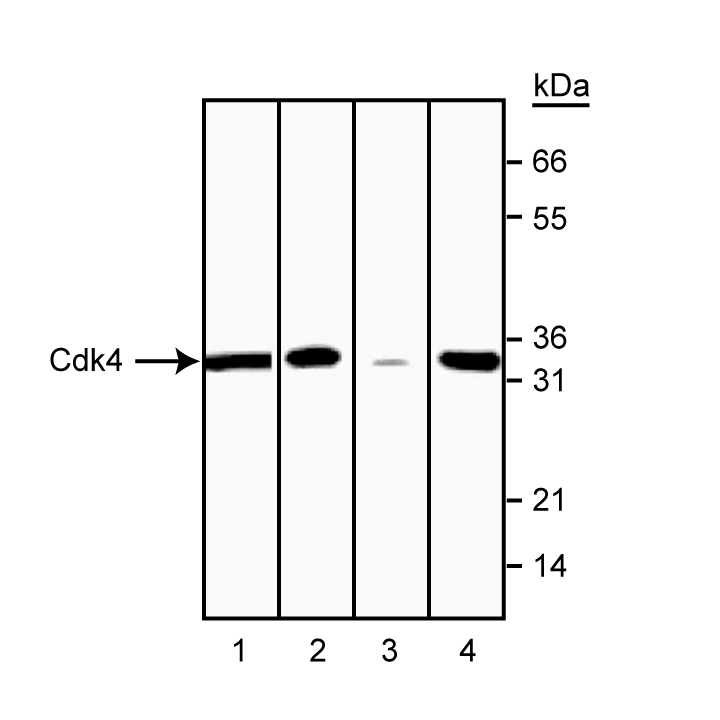
Western blot analysis of Cdk4 in mouse and human cell lysates using anti-Cdk4 (Cat. No. 554132). Lane 1, mouse 3T3 cells; lane 2, 293 human embryonic kidney cells; lane 3, HeLa human cervical carcinoma cells; lane 4, Saos-2 human osteogenic sarcoma cells. Anti-Cdk4 identifies Cdk4 as an ~32 kD band.
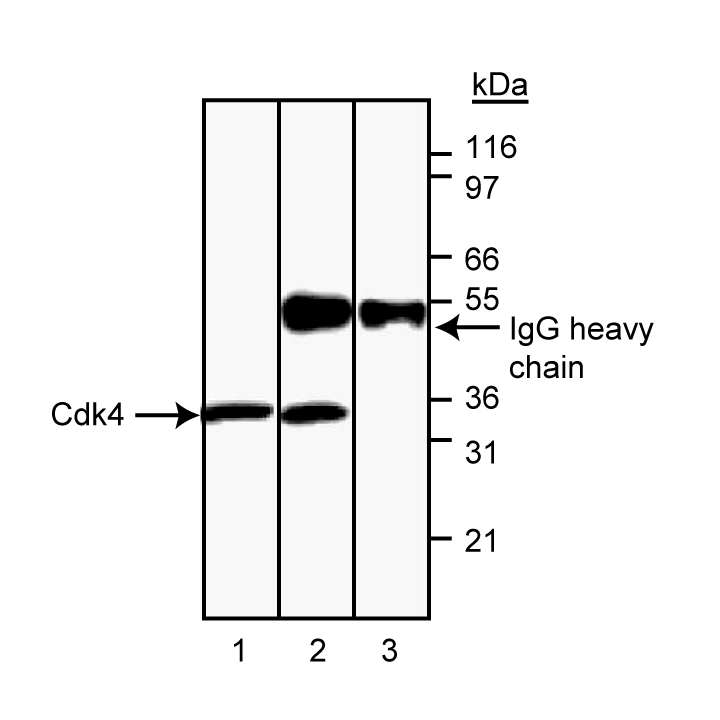
Immunoprecipitation/western blot analysis of dk4 using mouse 3T3 cells. Lane 1, WB using anti-Cdk4, clone ACD1. 3T3 cell lysates were immunoprecipitated with either ACD1 (lane 2) or a Rat IgG isotype control (lane 3). The immune complexes were analyzed by western blot analysis using ACD1, which identifies Cdk4 as an ~32 kD band.
Western blot analysis of Cdk4 in mouse and human cell lysates using anti-Cdk4 (Cat. No. 554132). Lane 1, mouse 3T3 cells; lane 2, 293 human embryonic kidney cells; lane 3, HeLa human cervical carcinoma cells; lane 4, Saos-2 human osteogenic sarcoma cells. Anti-Cdk4 identifies Cdk4 as an ~32 kD band.
Immunoprecipitation/western blot analysis of dk4 using mouse 3T3 cells. Lane 1, WB using anti-Cdk4, clone ACD1. 3T3 cell lysates were immunoprecipitated with either ACD1 (lane 2) or a Rat IgG isotype control (lane 3). The immune complexes were analyzed by western blot analysis using ACD1, which identifies Cdk4 as an ~32 kD band.


Preparation And Storage


Recommended Assay Procedures
Applications include immunoprecipitation (1-2 µg/1x10^6 cells) and western blot analysis (1-2 µg/ml). HeLa carcinoma cells (ATCC CCL-2), Saos-2 osteosarcoma cells (ATCC HTB-85), 293 adenovirus-transformed cells (ATCC CRL-1573), and NIH/3T3 (ATCC CRL-1658) are suggested as positive controls.
Product Notices
- Since applications vary, each investigator should titrate the reagent to obtain optimal results.
- Please refer to www.bdbiosciences.com/us/s/resources for technical protocols.
- Caution: Sodium azide yields highly toxic hydrazoic acid under acidic conditions. Dilute azide compounds in running water before discarding to avoid accumulation of potentially explosive deposits in plumbing.
Cyclins and cyclin-dependent kinases (cdks) are essential for cell-cycle control in eukarytotes. Cyclins, regulatory subunits, bind to cyclin- dependent kinases (cdks), catalytic subunits, to form active cyclin-cdk complexes. Cdk subunits by themselves are inactive and binding to a cyclin is required for their activity. Cyclins A, B1, D, and E undergo periodic synthesis and degradation, thereby providing a mechanism to regulate cdk activity throughout the cell cycle. Additionally, cdk activity is further regulated by activating and inhibitory phosphorylations, and small proteins called inhibitors of cdk activity, that bind to cyclins, Cdks, or cyclin-cdk complexes. Cdk4 was originally called PSK-J3, and following demonstration of its association with D-type cyclins, became known as Cdk4.2 D-type cyclins also associate with Cdks 2 and 5, although Cdk4 appears to be the most abundant partner. The D-type cyclins (D1, D2, and D3) are expressed in response to growth factors or mitogens, and rapidly degrade when mitogens are withdrawn. D cyclins appear to promote G0 to G1 transitions and the rate of G1 progression. For example, cyclin D-Cdk4 and cyclin D-Cdk6 complexes phosphorylate the retinoblastoma protein (Rb) which removes the G1 phase block caused by underphosphorylated Rb. ACD1 recognizes mouse and human Cdk4. Recombinant full-length mouse cdk4 was used as an immunogen.
Development References (2)
-
Grana X, Reddy EP. Cell cycle control in mammalian cells: role of cyclins, cyclin dependent kinases (CDKs), growth suppressor genes and cyclin-dependent kinase inhibitors (CKIs). Oncogene. 1995; 11(2):211-219. (Biology). View Reference
-
Matsushime H, Ewen ME, Strom DK, et al. Identification and properties of an atypical catalytic subunit (p34PSK-J3/cdk4) for mammalian D type G1 cyclins. Cell. 1992; 71(2):323-334. (Biology). View Reference
Please refer to Support Documents for Quality Certificates
Global - Refer to manufacturer's instructions for use and related User Manuals and Technical data sheets before using this products as described
Comparisons, where applicable, are made against older BD Technology, manual methods or are general performance claims. Comparisons are not made against non-BD technologies, unless otherwise noted.
For Research Use Only. Not for use in diagnostic or therapeutic procedures.