





BD Pharmingen™ Purified Mouse Anti-PTEN
Clone A2B1 (RUO)


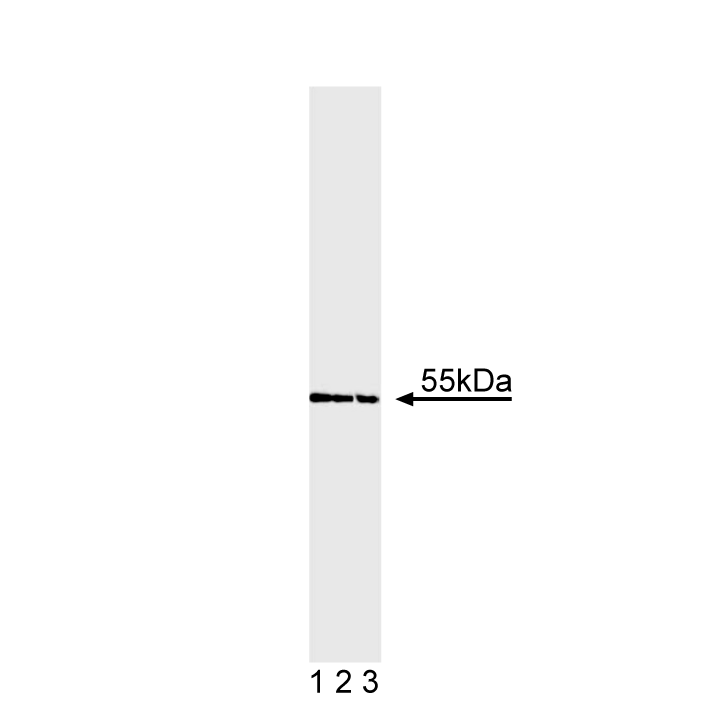
Western blot analysis of PTEN. Human lung fibroblast lysate from the WI-38 cell line (ATCC Cat. No. CCL-75™) was probed with Purified Mouse anti-PTEN (Cat. No. 559600) antibody at a concentration of 6.0 (lane 1), 2.0 (lane 2), or 0.5 µg/ml (lane 3). PTEN is identified as a protein of ~55 kDa.
Western blot analysis of PTEN. Human lung fibroblast lysate from the WI-38 cell line (ATCC Cat. No. CCL-75™) was probed with Purified Mouse anti-PTEN (Cat. No. 559600) antibody at a concentration of 6.0 (lane 1), 2.0 (lane 2), or 0.5 µg/ml (lane 3). PTEN is identified as a protein of ~55 kDa.


Preparation And Storage


Recommended Assay Procedures
WI-38 (ATCC Cat. No. CCL-75™) cells are recommended as a positive control.
Product Notices
- Since applications vary, each investigator should titrate the reagent to obtain optimal results.
- Please refer to www.bdbiosciences.com/us/s/resources for technical protocols.
- Caution: Sodium azide yields highly toxic hydrazoic acid under acidic conditions. Dilute azide compounds in running water before discarding to avoid accumulation of potentially explosive deposits in plumbing.
- Sodium azide is a reversible inhibitor of oxidative metabolism; therefore, antibody preparations containing this preservative agent must not be used in cell cultures nor injected into animals. Sodium azide may be removed by washing stained cells or plate-bound antibody or dialyzing soluble antibody in sodium azide-free buffer. Since endotoxin may also affect the results of functional studies, we recommend the NA/LE (No Azide/Low Endotoxin) antibody format, if available, for in vitro and in vivo use.
- All other brands are trademarks of their respective owners.
Cancer can develop when cells escape normal growth control mechanisms through mutations in proto-oncogenes or tumor suppressor genes. A characteristic of most oncogene and tumor suppressor gene products is that they are components of signal transduction pathways that are essential for maintaining cellular homeostasis. PTEN (phosphatase and tensin homolog), also known as MMAC1 (mutated in multiple advanced cancers 1), is a tumor suppressor gene that is mutated at high frequency in multiple tumor types. The protein encoded by PTEN is a phosphatase that preferentially dephosphorylates phosphoinositide substrates. It is believed that a mechanism by which PTEN mutations cause tumors is the loss of its negative control on the phosphoinositide 3-kinase signaling pathway that regulates cell growth and survival. PTEN also plays a role in the maintenance of hematopoietic stem cells.
The A2B1 monoclonal antibody recognizes PTEN, regardless of phosphorylation status.
Development References (3)
-
Cantley LC, Neel BG. New insights into tumor suppression: PTEN suppresses tumor formation by restraining the phosphoinositide 3-kinase/AKT pathway. Proc Natl Acad Sci U S A. 1999; 96(8):4240-4245. (Biology). View Reference
-
Steck PA, Pershouse MA, Jasser SA, et al. Identification of a candidate tumour suppressor gene, MMAC1 at chromosome 10q23.3 that is mutated in multiple advanced cancers. Nat Genet. 1997; 15(4):356-362. (Biology). View Reference
-
Suzuki A, de la Pompa JL, Stambolic V, et al. High cancer susceptibility and embryonic lethality associated with mutation of the PTEN tumor suppressor gene in mice. Curr Biol. 1998; 8(21):1169-1178. (Biology). View Reference
Please refer to Support Documents for Quality Certificates
Global - Refer to manufacturer's instructions for use and related User Manuals and Technical data sheets before using this products as described
Comparisons, where applicable, are made against older BD Technology, manual methods or are general performance claims. Comparisons are not made against non-BD technologies, unless otherwise noted.
For Research Use Only. Not for use in diagnostic or therapeutic procedures.