







Preparation And Storage


Product Notices
- This reagent has been pre-diluted for use at the recommended Volume per Test. We typically use 1 × 10^6 cells in a 100-µl experimental sample (a test).
- An isotype control should be used at the same concentration as the antibody of interest.
- Brilliant Violet™ 650 is a trademark of Sirigen.
- Alexa Fluor® is a registered trademark of Molecular Probes, Inc., Eugene, OR.
- Source of all serum proteins is from USDA inspected abattoirs located in the United States.
- Caution: Sodium azide yields highly toxic hydrazoic acid under acidic conditions. Dilute azide compounds in running water before discarding to avoid accumulation of potentially explosive deposits in plumbing.
- For fluorochrome spectra and suitable instrument settings, please refer to our Multicolor Flow Cytometry web page at www.bdbiosciences.com/colors.
- Please refer to www.bdbiosciences.com/us/s/resources for technical protocols.
Companion Products
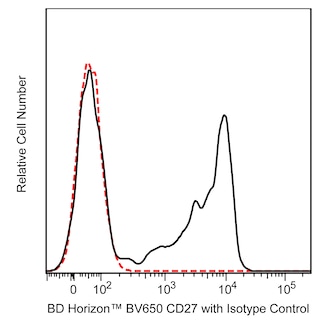
The L128 monoclonal antibody specifically binds to human CD27. CD27 is a 55-kDa disulfide-linked dimer that is a member of the nerve growth factor (NGF) super family. This family also includes CD40, rat OX40, tumor necrosis factor (TNF) receptors and CD95 (Fas). With its ligand CD70, CD27 acts in a co-stimulatory fashion on T lymphocytes. Present on most peripheral blood T lymphocytes and medullary thymocytes, the CD27 antigen is upregulated upon activation with the release of a soluble form, 28 to 32 kDa. It is also detected on a subpopulation of approximately 33% of circulating B lymphocytes. Following exposure to antigens, CD45RA+ T lymphocytes respond by upregulating the CD27 antigen. After maximal stimulation, the CD27 antigen cannot be re-expressed on long-term cultures or on CD45RA-CD27+ T lymphocytes. The CD4+CD27- population is contained within the memory CD45RO+ subset that proliferates after exposure to allergens. Two subpopulations of B lymphocytes bearing the CD27 antigen secrete IgM (δ+) and IgG (δ-).
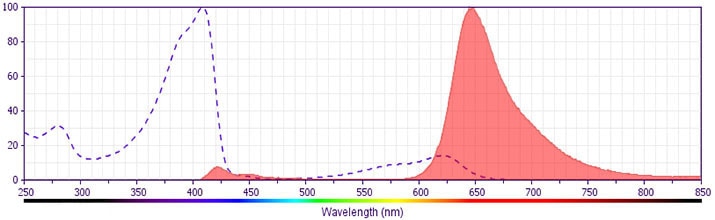
The antibody was conjugated to BD Horizon™ BV650 which is part of the BD Horizon™ Brilliant Violet™ family of dyes. This dye is a tandem fluorochrome of BD Horizon™ BV421 with an Ex Max of 405-nm and an acceptor dye with an Em Max at 650-nm. BD Horizon™ BV650 can be excited by the violet laser and detected in a filter used to detect APC-like dyes (eg, 660/20-nm filter). Due to the excitation and emission characteristics of the acceptor dye, there will be spillover into the APC and Alexa Fluor® 700 detectors. However, the spillover can be corrected through compensation as with any other dye combination.
Development References (11)
-
Baars PA, Maurice MM, Rep M, Hooibrink B, van Lier RA. Heterogeneity of the circulating human CD4+ T cell population. Further evidence that the CD4+CD45RA-CD27- T cell subset contains specialized primed T cells. J Immunol. 1995; 154(1):17-25. (Biology). View Reference
-
Bowman MR, Crimmins MA, Yetz-Aldape J, Kriz R, Kelleher K, Herrmann S. The cloning of CD70 and its identification as the ligand for CD27. J Immunol. 1994; 152(4):1756-1761. (Biology). View Reference
-
Camerini D, Walz G, Loenen WA, Borst J, Seed B. The T cell activation antigen CD27 is a member of the nerve growth factor/tumor necrosis factor receptor gene family. J Immunol. 1991; 147(9):3165-3169. (Biology). View Reference
-
De Jong R, Brouwer M, Hooibrink B, Van der Pouw-Kraan T, Miedema F, Van Lier RA. The CD27- subset of peripheral blood memory CD4+ lymphocytes contains functionally differentiated T lymphocytes that develop by persistent antigenic stimulation in vivo. Eur J Immunol. 1992; 22(4):993-999. (Biology). View Reference
-
Hintzen RQ, Lens SM, Beckmann MP, Goodwin RG, Lynch D, van Lier RA. Characterization of the human CD27 ligand, a novel member of the TNF gene family. J Immunol. 1994; 152(4):1762-1773. (Biology). View Reference
-
Hintzen RQ, de Jong R, Hack CE, et al. A soluble form of the human T cell differentiation antigen CD27 is released after triggering of the TCR/CD3 complex. J Immunol. 1991; 147(1):29-35. (Biology). View Reference
-
Hintzen RQ, de Jong R, Lens SM, Brouwer M, Baars P, van Lier RA. Regulation of CD27 expression on subsets of mature T-lymphocytes. J Immunol. 1993; 151(5):2426-2435. (Biology). View Reference
-
Kobata T, Agematsu K, Kameoka J, Schlossman SF, Morimoto C. CD27 is a signal-transducing molecule involved in CD45RA+ naive T cell costimulation. J Immunol. 1994; 153(12):5422-5432. (Biology). View Reference
-
Kobata T, Morimoto C. CD27 Workshop Panel Report. In: Kishimoto T. Tadamitsu Kishimoto .. et al., ed. Leucocyte typing VI : white cell differentiation antigens : proceedings of the sixth international workshop and conference held in Kobe, Japan, 10-14 November 1996. New York: Garland Pub.; 1997:67-69.
-
Morimoto C. Cluster report: CD27. In: Schlossman SF. Stuart F. Schlossman .. et al., ed. Leucocyte typing V : white cell differentiation antigens : proceedings of the fifth international workshop and conference held in Boston, USA, 3-7 November, 1993. Oxford: Oxford University Press; 1995:356-357.
-
Reiter C. T9. Cluster report: CD27. In: Knapp W. W. Knapp .. et al., ed. Leucocyte typing IV : white cell differentiation antigens. Oxford New York: Oxford University Press; 1989:350.
Please refer to Support Documents for Quality Certificates
Global - Refer to manufacturer's instructions for use and related User Manuals and Technical data sheets before using this products as described
Comparisons, where applicable, are made against older BD Technology, manual methods or are general performance claims. Comparisons are not made against non-BD technologies, unless otherwise noted.
For Research Use Only. Not for use in diagnostic or therapeutic procedures.
