







Preparation And Storage


Recommended Assay Procedures
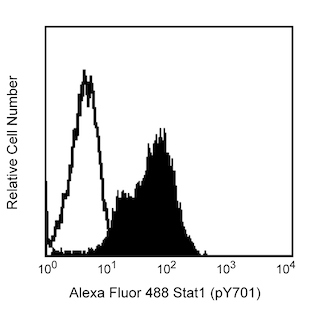
This antibody conjugate is suitable for intracellular staining of human cell lines and peripheral blood mononuclear cells using BD Cytofix™ Fixation Buffer. Any of the three BD Phosflow™ permeabilization buffers may be used. For more information and suggested protocols, investigators are encouraged to visit http://www.bdbiosciences.com/research/ics/resources/index.jsp
Product Notices
- This reagent has been pre-diluted for use at the recommended Volume per Test. We typically use 1 × 10^6 cells in a 100-µl experimental sample (a test).
- Please refer to www.bdbiosciences.com/us/s/resources for technical protocols.
- The Alexa Fluor®, Pacific Blue™, and Cascade Blue® dye antibody conjugates in this product are sold under license from Molecular Probes, Inc. for research use only, excluding use in combination with microarrays, or as analyte specific reagents. The Alexa Fluor® dyes (except for Alexa Fluor® 430), Pacific Blue™ dye, and Cascade Blue® dye are covered by pending and issued patents.
- Alexa Fluor® is a registered trademark of Molecular Probes, Inc., Eugene, OR.
- Alexa Fluor® 647 fluorochrome emission is collected at the same instrument settings as for allophycocyanin (APC).
- For fluorochrome spectra and suitable instrument settings, please refer to our Multicolor Flow Cytometry web page at www.bdbiosciences.com/colors.
- Caution: Sodium azide yields highly toxic hydrazoic acid under acidic conditions. Dilute azide compounds in running water before discarding to avoid accumulation of potentially explosive deposits in plumbing.
- Source of all serum proteins is from USDA inspected abattoirs located in the United States.
Companion Products
The K10-895.12.50 monoclonal antibody recognizes the phosphorylated serine 529 (pS529) in the transactivation domain of the human NF-κB p65 subunit. Nuclear factor κB (NF-κB) is a ubiquitously expressed transcription factor that regulates the expression of many other genes. It is crucial for cellular responses to a variety of stimuli including stress and microbial pathogens that lead to immunity, inflammation, proliferation, differentiation, survival, apoptosis, and tumorigenesis. The most studied NF-κB complex consists of the p50 (also known as NF-κB1) and p65 (also known as REL-A) subunits, both containing a 300-amino acid region with homology to the Rel proto-oncogene product (RH domain). The RH domain contains motifs for dimerization, nuclear localization, and binding to specific DNA sequences. In addition to the RH domain, the p65 subunit contains the transactivation domain, which is responsible for the interaction with the inhibitor IκB and which contains phosphorylation sites. In most cell types, the p50/p65 heterodimer is located within the cytoplasm complexed to IκB. This complex prevents nuclear translocation and activity of NF-κB. In response to stimuli such as cytokines, LPS, DNA damage, and microbial infections, IκB is phosphorylated at critical residues. This phosphorylation induces dissociation of the IκB/NF-κB complex, allowing the free heterodimeric NF-κB to translocate to the nucleus. Furthermore, optimal activation of NF-κB requires phosphorylation in the transactivation domain of p65. In the nucleus, activated NF-κB dimers bind to the κB sites within promoters and enhancers and function as transcriptional regulators.
Development References (3)
-
Natoli G, Saccani S, Bosisio D, Marazzi I. Interactions of NF-kappaB with chromatin: the art of being at the right place at the right time. Nat Immunol. 2005; 6(5):439-445. (Biology). View Reference
-
Siebenlist U, Brown K, Claudio E. Control of lymphocyte development by nuclear factor-kappaB. Nat Rev Immunol. 2005; 5:435-445. (Biology). View Reference
-
Viatour P, Merville M-P, Bours V, Chariot A. Phosphorylation of NF-kappaB and IkappaB proteins: implications in cancer and inflammation. Trends Biochem Sci. 2005; 30(1):43-52. (Biology). View Reference
Please refer to Support Documents for Quality Certificates
Global - Refer to manufacturer's instructions for use and related User Manuals and Technical data sheets before using this products as described
Comparisons, where applicable, are made against older BD Technology, manual methods or are general performance claims. Comparisons are not made against non-BD technologies, unless otherwise noted.
For Research Use Only. Not for use in diagnostic or therapeutic procedures.
Refer to manufacturer's instructions for use and related User Manuals and Technical Data Sheets before using this product as described.
Comparisons, where applicable, are made against older BD technology, manual methods or are general performance claims. Comparisons are not made against non-BD technologies, unless otherwise noted.
