





A Bright, Narrower Emission Spectrum Dye for the Violet Laser
The BD Horizon Brilliant™ Violet 480 (BV480) Fluorochrome is a bright and versatile dye in the BD Horizon Brilliant™ Violet Family of Dyes. The BV480 Fluorochrome has a narrower emission profile compared to V500 or BV510 and works well for multicolor flow cytometry. BV480 delivers:
- Reliable staining performance for both conventional and spectral flow cytometry
- Good resolution of low to medium antigen expression markers
- Reduced spillover compared to BV510 into BV605, BV650, BV711 and BUV496
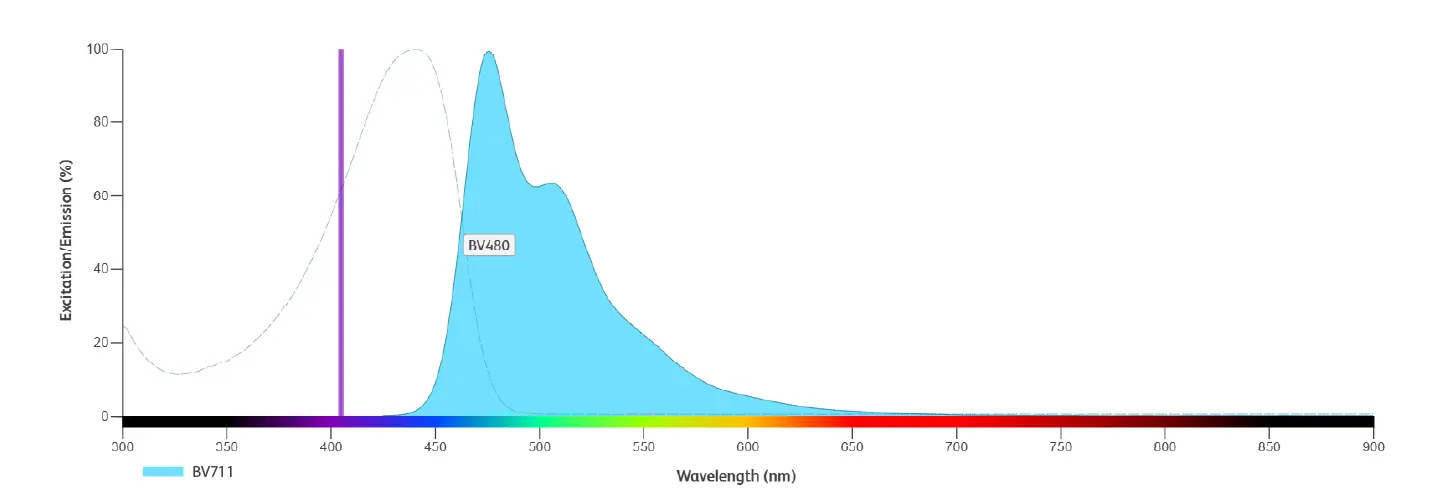
BV480 is a violet laser-excited fluorochrome (405 nm) with peak emission at 479 nm
| Format | Ex Max | Em Max | Spectral | Conventional | Relative Brightness | Spillover* (1 = low, 4 = high) | Alternative To |
|---|---|---|---|---|---|---|---|
| BV480 | 440 nm | 479 nm | Yes | Yes | 2 | BV510**, V500 |
*Value may vary based on instrument configuration and settings. Spillover ranking is based on cross-laser excitation on five-laser spectral instruments and does not take into account spillover into adjacent detectors.
** BV480 and BV510 are typically detected with the same filter on conventional flow cytometers (for example, 525/50)
Performance
BV480 demonstrates lower spillover compared to BV510 or V500
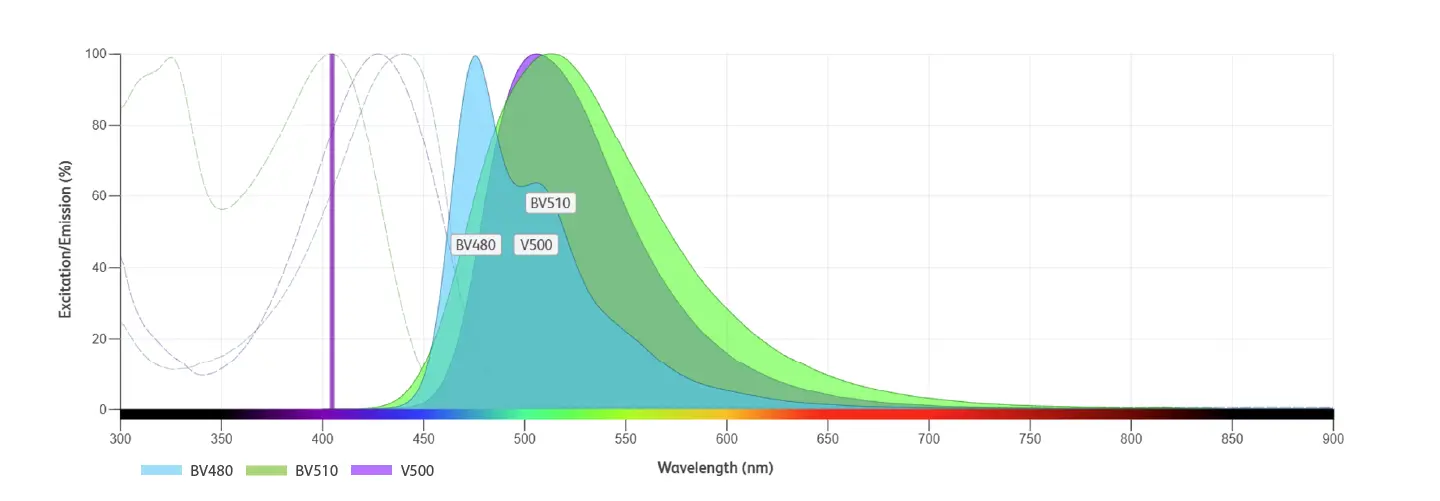
While BV480, BV510 and V500 have a similar peak emission wavelength, BV480 demonstrates the least amount of adjacent spillover. Excitation and emission spectra from BD® Spectrum Viewer.
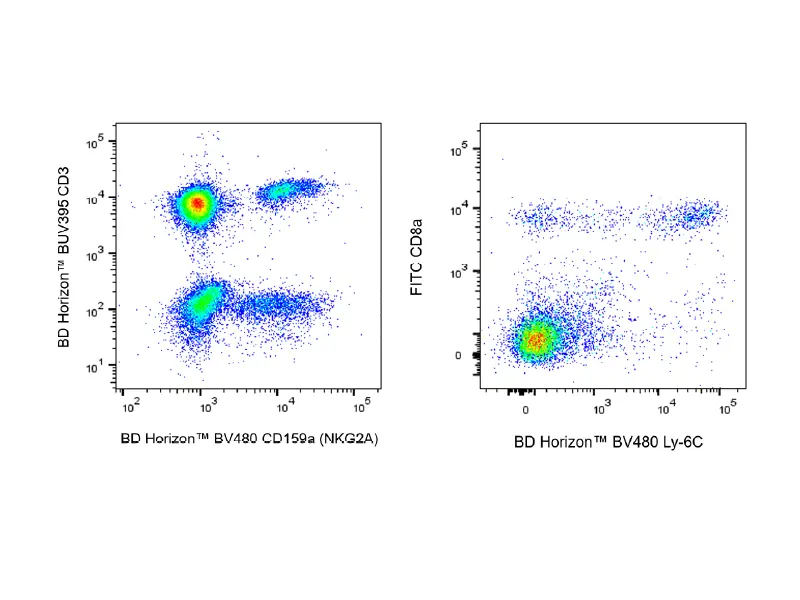
BV480-conjugated Primary Antibodies Support Detection of Low to Moderate Expression Markers
Left: Human whole blood was treated with BD Pharm Lyse™ Lysing Buffer to lyse erythrocytes. The leukocytes were washed, preincubated with BD Pharmingen™ Human BD Fc Block™ and stained with BD Horizon™ Brilliant Stain Buffer, BD Horizon™ BUV395 Mouse Anti-Human CD3 (UCHT1) and BD Horizon™ BV480 Rat Anti-Human CD159a (NKG2A) (DD11-740.rMAb) Antibodies. Flow cytometry and data analysis were performed using a 5-laser flow cytometer system and FlowJo™ Software.
Right: Mouse splenocytes were first preincubated with Purified Rat Anti-Mouse CD16/CD32 antibody (Mouse BD Fc Block™), then stained with BD Horizon™ BV480 Rat Anti-Mouse Ly-6C (HK1.4.rMab) and BD Pharmingen™ FITC Rat Anti-Mouse CD8a (53-6.7) FITC. Flow cytometry and data analysis were performed using a BD LSRFortessa™ X-20 Cell Analyzer and FlowJo™ Software.

Ensuring Reproducible Data with Lot-to-lot Consistency
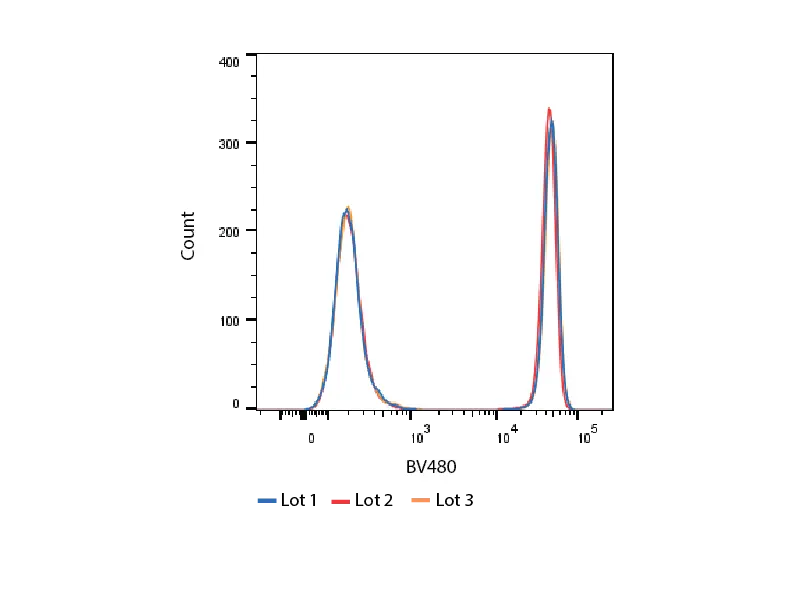
BV480 reagents offer stable performance with lot-to-lot consistency. Human whole blood was stained with three lots of human CD4 (SK3) followed by lysis with BD Pharm Lyse™ Lysing Buffer (Lot 1: Blue line, Lot 2: Red line, Lot 3: Orange line). Samples were run on a BD® LSR II Flow Cytometer and analyzed with FlowJo™ Software.
Applications
BV480 Reagents Are Well Suited for Multicolor Panel Design
BV480 resolves CD45RA in a 24-color T cell activation panel
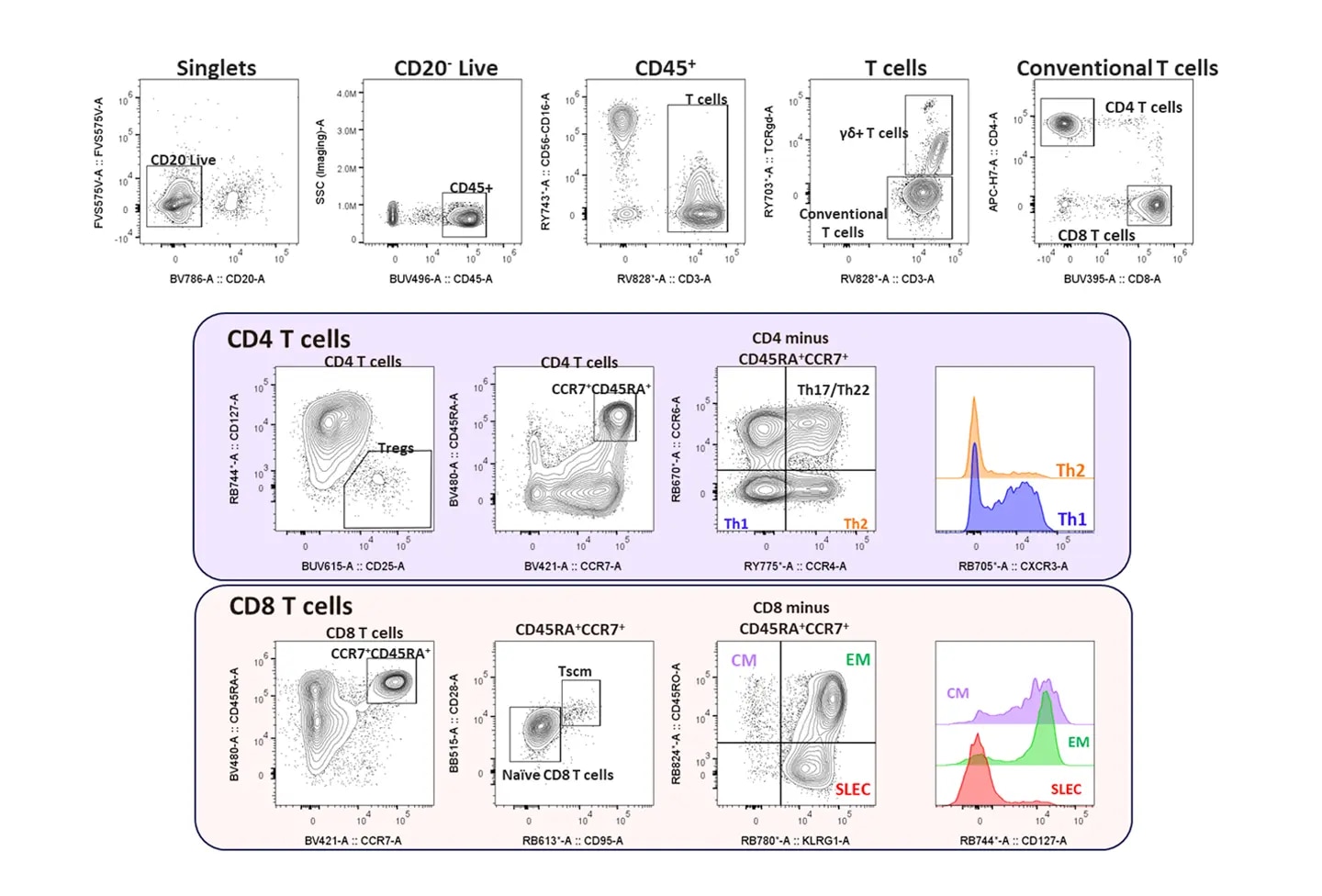
Analysis of PBMC with a 24-color T cell activation panel including BV480.
PBMCs were isolated from a healthy donor and divided into two conditions: unstimulated and stimulated. After 24 hours, both samples were collected and labeled with BV480 Mouse Anti-Human CD45RA. CAR T cells were spiked into the stimulated sample. Samples were then stained with the remaining 23 markers of the 24-color T cell activation panel and analyzed on a BD FACSDiscover™ A8 Cell Analyzer.
FAQs
- What are the excitation and emission maxima of BV480?
BV480 has an excitation maximum of 440 nm and an emission maximum of 479 nm. As part of the BD Horizon Brilliant™ Dyes family, it is a polymer-based dye engineered for narrower emission and higher fluorescence intensity than earlier violet-excited fluorochromes like V500.
- What laser and filter set should I use with BV480?
BV480 is excited by the violet laser (405nm) and detected using an optical filter centered near 480nm, such as a 525/50 bandpass filter. This is the same channel used for BV510 and V500, since all three dyes share a similar emission profile.
- Is BV480 a tandem dye?
No, BV480 is a non-tandem polymer fluorochrome. BV480 consists of a single conjugated polymer structure rather than a donor-acceptor pair. This distinguishes it from tandem dyes, which can be prone to degradation or dissociation over time, especially with light exposure or improper storage. As a non-tandem dye, BV480 offers more stable, consistent performance across experiments and lot-to-lot manufacturing.
- What are the considerations when using BV480 and BUV496 together?
Evaluate the actual spread of BV480 into BUV496. While BV480 has less spectral overlap with BUV496 than BV510, BV480 is brighter than BV510, so evaluating the actual spread into BUV496 is recommended when assigning fluorochromes to markers.
- Can BV480 and BV510 be used together on a spectral flow cytometer?
Yes, they are spectrally distinct and can be unmixed on a spectral flow cytometer. BV480 is brighter than BV510 which should be considered when assigning the fluorochrome to a marker as there will be signal overlap with BV510 possibly impacting resolution. However, do not use both BV480 and BV510 together in conventional flow cytometry experiments. Only spectral flow cytometers can unmix the emission spectra of both dyes.
- Is BV480 a better alternative to BV510 or V500?
Yes, in most cases. BV480 has less adjacent spillover into BV605 than BV510 or V500 and may provide better marker resolution as it is a brighter dye. The instrument configuration would also impact the decision, BV480 will have more spillover into BV421 if using a V450/50 filter. Review spectrum viewer and instrument configuration to help identify the best dye to use.
-
Brochure
(2)


-
Poster
(1)
-
Performance Guide
(2)
For Research Use Only. Not for use in diagnostic or therapeutic procedures.
Refer to manufacturer's instructions for use and related User Manuals and Technical Data Sheets before using this product as described.
Comparisons, where applicable, are made against older BD technology, manual methods or are general performance claims. Comparisons are not made against non-BD technologies, unless otherwise noted.