







Preparation And Storage


Recommended Assay Procedures
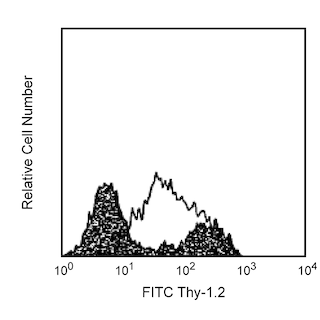
Immunofluorescent Staining and Flow Cytometric Analysis: The purified form of TR75-89 (Cat. No. 559916) can be used for the immunofluorescent staining (≤ 1 µg antibody/10e6 cells) and flow cytometric analysis of normal mouse cells or cell lines to measure their expressed levels of p75 TNFR. An appropriate purified immunoglobulin isotype control is clone G235-2356 (Cat. No. 553951). A three-layer staining protocol is recommended for maximizing the detection of p75 TNFR expressed by cells as detailed in the figure legend.
Note: TR75-89 is a nonblocking antibody that can be used for the unobstructed immunofluorescent staining and flow cytometric analysis of cells in systems where ligands (e.g., TNF) for p75 TNF receptors are present. Based on our testing results (data not shown), the presence of exogenous recombinant mouse TNF (Cat. No. 554589) at levels ≤ 1 µg per 10e6 cells was insufficient to inhibit the binding of TR75-89 to L929 cells that express p75 TNFR (at 0.25 µg antibody/10e6 cells). Please note also that as a consequence of in vivo or in vitro activation, cell surface p75 TNFR can either be shed by cells or transiently expressed at higher levels. As a result, cellular activation can affect the cell's overall expressed level of surface p75 TNFR.
IP: The TR75-89 antibody has been reported to be useful for the immunoprecipitation of p75 TNFR from lysates of mouse Meth A fibrosarcoma cells. Please note that this application is not routinely tested at BD Biosciences Pharmingen.
Product Notices
- Since applications vary, each investigator should titrate the reagent to obtain optimal results.
- Please refer to www.bdbiosciences.com/us/s/resources for technical protocols.
- Although hamster immunoglobulin isotypes have not been well defined, BD Biosciences Pharmingen has grouped Armenian and Syrian hamster IgG monoclonal antibodies according to their reactivity with a panel of mouse anti-hamster IgG mAbs. A table of the hamster IgG groups, Reactivity of Mouse Anti-Hamster Ig mAbs, may be viewed at http://www.bdbiosciences.com/documents/hamster_chart_11x17.pdf.
- Caution: Sodium azide yields highly toxic hydrazoic acid under acidic conditions. Dilute azide compounds in running water before discarding to avoid accumulation of potentially explosive deposits in plumbing.
Companion Products

.png?imwidth=320)

The TR75-89 monoclonal antibody specifically binds to the extracellular region of CD120b, the 75 kDa receptor for the mouse cytokines, tumor necrosis factor (TNF, aka TNF-α) and lymphotoxin-alpha (LT-α, aka lymphotoxin, TNF-β). This receptor, referred to as the p75 or Type II Tumor Necrosis Factor Receptor (TNFRII), or TNFRSF1B, is expressed by a variety of cell lines and normal cell types including T cells, monocytes, macrophages, and neutrophils. Resting B cells express low or undetectable levels of TNFRII whereas mature erythrocytes are uniformly negative for TNFRII expression. In addition, the TR75-89 antibody can bind to a soluble, truncated form of the mouse Type II TNFR that is shed by cells in response to certain stimuli, e.g., cells treated with LPS or TNF. The in vivo administration of nonblocking, nonagonistic TR75-89 antibody reportedly results in the linear accumulation of shed, soluble forms of p75 TNFR in the circulation. The TR75-89 antibody does not recognize the 55 kDa (p55) Type I TNFR (aka, CD120a). TR75-89 does not block the binding and does not neutralize the bioactivity of the TNF ligand on L929 target cell populations that express p75 (and p55) TNFR. The immunogen used to generate the TR75-89 hybridoma was a purified, soluble extracellular domain of the mouse Type II TNFR.
This antibody is routinely tested by flow cytometric analysis. Other applications were tested at BD Biosciences Pharmingen during antibody development only or reported in the literature.
Development References (4)
-
Pinckard JK, Sheehan KC, Arthur CD, Schreiber RD. Constitutive shedding of both p55 and p75 murine TNF receptors in vivo. J Immunol. 1997; 158(8):3869-3873. (Clone-specific). View Reference
-
Pinckard JK, Sheehan KC, Schreiber RD. Ligand-induced formation of p55 and p75 tumor necrosis factor receptor heterocomplexes on intact cells. J Biol Chem. 1997; 272(16):10784-10789. (Clone-specific: Immunoprecipitation). View Reference
-
Sheehan KC, Pinckard JK, Arthur CD, Dehner LP, Goeddel DV, Schreiber RD. Monoclonal antibodies specific for murine p55 and p75 tumor necrosis factor receptors: identification of a novel in vivo role for p75. J Exp Med. 1995; 181(2):607-617. (Clone-specific). View Reference
-
Zola H. Detection of cytokine receptors by flow cytometry. In: Coligan JE, Kruisbeek AM, Margulies DH, Shevach EM, Strober W, ed. Current Protocols in Immunology. New York: Green Publishing Associates and Wiley-Interscience; 1995:6.21.1-6.21.18.
Please refer to Support Documents for Quality Certificates
Global - Refer to manufacturer's instructions for use and related User Manuals and Technical data sheets before using this products as described
Comparisons, where applicable, are made against older BD Technology, manual methods or are general performance claims. Comparisons are not made against non-BD technologies, unless otherwise noted.
For Research Use Only. Not for use in diagnostic or therapeutic procedures.
