







Preparation And Storage


Product Notices
- Since applications vary, each investigator should titrate the reagent to obtain optimal results.
- An isotype control should be used at the same concentration as the antibody of interest.
- Caution: Sodium azide yields highly toxic hydrazoic acid under acidic conditions. Dilute azide compounds in running water before discarding to avoid accumulation of potentially explosive deposits in plumbing.
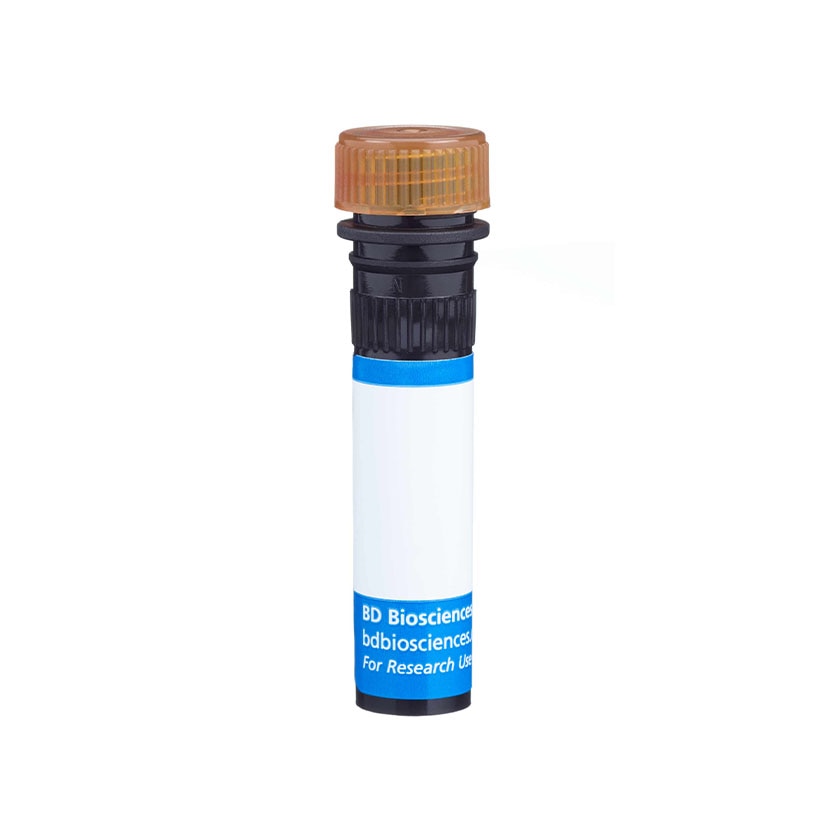
- Please observe the following precautions: Absorption of visible light can significantly alter the energy transfer occurring in any tandem fluorochrome conjugate; therefore, we recommend that special precautions be taken (such as wrapping vials, tubes, or racks in aluminum foil) to prevent exposure of conjugated reagents, including cells stained with those reagents, to room illumination.
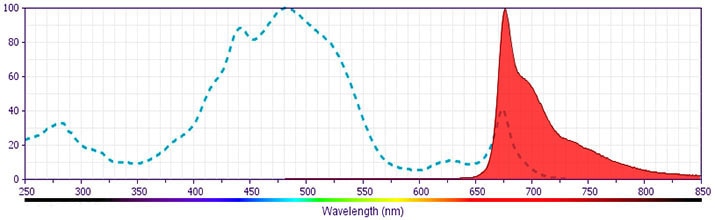
- PerCP-Cy5.5–labelled antibodies can be used with FITC- and R-PE–labelled reagents in single-laser flow cytometers with no significant spectral overlap of PerCP-Cy5.5, FITC, and R-PE fluorescence.
- PerCP-Cy5.5 is optimized for use with a single argon ion laser emitting 488-nm light. Because of the broad absorption spectrum of the tandem fluorochrome, extra care must be taken when using dual-laser cytometers, which may directly excite both PerCP and Cy5.5™. We recommend the use of cross-beam compensation during data acquisition or software compensation during data analysis.
- For fluorochrome spectra and suitable instrument settings, please refer to our Multicolor Flow Cytometry web page at www.bdbiosciences.com/colors.
- Cy is a trademark of GE Healthcare.
- Please refer to www.bdbiosciences.com/us/s/resources for technical protocols.
Companion Products

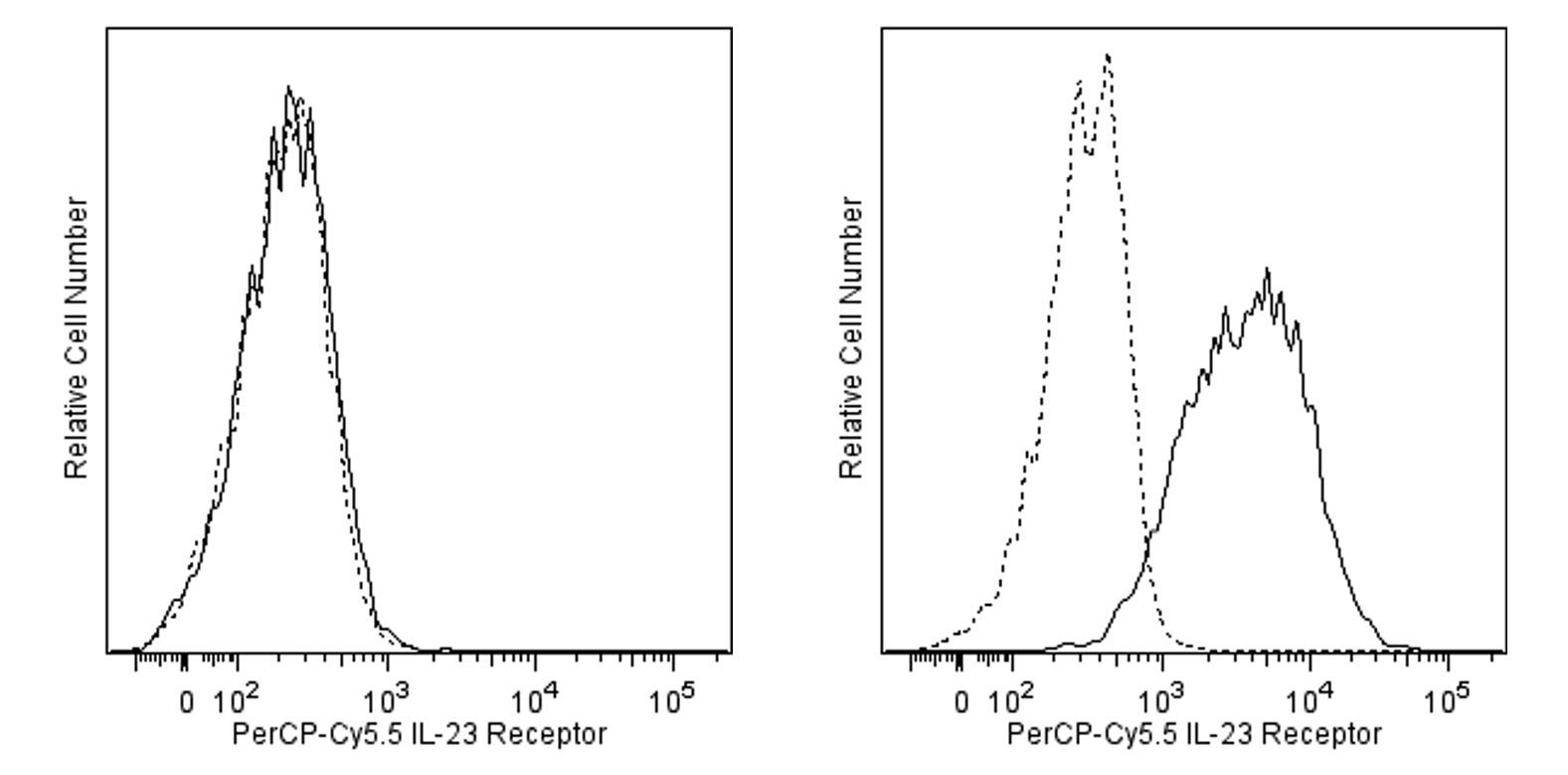
The O78-1208 monoclonal antibody specifically binds to the mouse Interleukin-23 Receptor (IL-23R) subunit that is encoded by the il23r gene. The IL-23R subunit is a type I transmembrane glycoprotein and member of the hemopoietin receptor superfamily. The mouse IL-23 Receptor complex is comprised of IL-23R and IL-12 receptor beta 1 (IL-12Rβ1) subunits. The IL-23R complex can bind IL-23, a cytokine that plays roles in innate and adaptive immunity as well as in autoimmune diseases, eg, by the generation and maintenance of Th17 cells. Mouse IL-23R is expressed by activated/memory CD4+ T cells, Th1, Th2 and Th17 cells, γδ T cells, dendritic cells and macrophages as determined by IL-23R mRNA expression and IL-23R-GFP reporter mouse studies. The IL-23-bound IL-23R complex transduces an intracellular signal pathway mediated by a Jak-STAT signaling cascade.
Development References (6)
-
Awasthi A, Riol-Blanco L, Jager A, et al. Cutting edge: IL-23 receptor gfp reporter mice reveal distinct populations of IL-17-producing cells. J Immunol. 2009; 182(10):5904-5908. (Biology). View Reference
-
Jones LL, Alli R, Li B, Geiger TL. Differential T Cell Cytokine Receptivity and Not Signal Quality Distinguishes IL-6 and IL-10 Signaling during Th17 Differentiation.. J Immunol. 2016; 196(7):2973-85. (Clone-specific). View Reference
-
Lankford CS, Frucht DM. A unique role for IL-23 in promoting cellular immunity. J Leukoc Biol. 2003; 73(1):49-56. (Biology). View Reference
-
Monk JM, Hou TY, Turk HF, McMurray DN, Chapkin RS. n3 PUFAs reduce mouse CD4+ T-cell ex vivo polarization into Th17 cells.. J Nutr. 2013; 143(9):1501-8. (Clone-specific). View Reference
-
Parham C, Chirica M, Timans J, et al. A receptor for the heterodimeric cytokine IL-23 is composed of IL-12Rbeta1 and a novel cytokine receptor subunit, IL-23R. J Immunol. 2002; 168(11):5699-5708. (Biology: Calcium Flux). View Reference
-
Petermann F, Rothhammer V, Claussen MC, et al. gammadelta T cells enhance autoimmunity by restraining regulatory T cell responses via an interleukin-23-dependent mechanism. Immunity. 2010; 33(3):351-363. (Biology). View Reference
Please refer to Support Documents for Quality Certificates
Global - Refer to manufacturer's instructions for use and related User Manuals and Technical data sheets before using this products as described
Comparisons, where applicable, are made against older BD Technology, manual methods or are general performance claims. Comparisons are not made against non-BD technologies, unless otherwise noted.
For Research Use Only. Not for use in diagnostic or therapeutic procedures.
