





.png)


Preparation And Storage


Product Notices
- Since applications vary, each investigator should titrate the reagent to obtain optimal results.
- An isotype control should be used at the same concentration as the antibody of interest.
- Although hamster immunoglobulin isotypes have not been well defined, BD Biosciences Pharmingen has grouped Armenian and Syrian hamster IgG monoclonal antibodies according to their reactivity with a panel of mouse anti-hamster IgG mAbs. A table of the hamster IgG groups, Reactivity of Mouse Anti-Hamster Ig mAbs, may be viewed at http://www.bdbiosciences.com/documents/hamster_chart_11x17.pdf.
- Alexa Fluor® 700 has an adsorption maximum of ~700nm and a peak fluorescence emission of ~720nm. Before staining cells with this reagent, please confirm that your flow cytometer is capable of exciting the fluorochrome and discriminating the resulting fluorescence.
- Alexa Fluor® is a registered trademark of Molecular Probes, Inc., Eugene, OR.
- The Alexa Fluor®, Pacific Blue™, and Cascade Blue® dye antibody conjugates in this product are sold under license from Molecular Probes, Inc. for research use only, excluding use in combination with microarrays, or as analyte specific reagents. The Alexa Fluor® dyes (except for Alexa Fluor® 430), Pacific Blue™ dye, and Cascade Blue® dye are covered by pending and issued patents.
- Caution: Sodium azide yields highly toxic hydrazoic acid under acidic conditions. Dilute azide compounds in running water before discarding to avoid accumulation of potentially explosive deposits in plumbing.
- For fluorochrome spectra and suitable instrument settings, please refer to our Multicolor Flow Cytometry web page at www.bdbiosciences.com/colors.
- Please refer to www.bdbiosciences.com/us/s/resources for technical protocols.
Companion Products
.png?imwidth=320)
.png?imwidth=320)
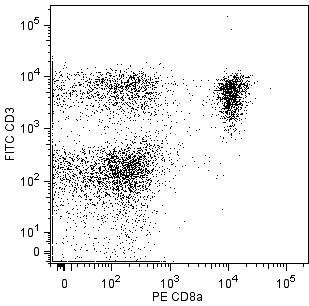
The H57-597 antibody reacts with a common epitope of the β chain of the T-cell Receptor (TCR) complex on αβ TCR-expressing thymocytes, peripheral T lymphocytes, NK1.1+ thymocytes, and NK-T cells of all mouse strains tested. It does not react with γδ TCR-bearing T cells. In the fetal and adult thymus, the TCR β-chain may form homodimers or pair with the pre-TCR α-chain on the surface of immature thymocytes before TCR α-chain expression. Plate-bound or soluble H57-597 antibody activates αβ TCR-bearing T cells, and plate-bound mAb can induce apoptotic death.
Development References (15)
-
Atsuta N, Nishimura H, Nakamura N, Emoto M, Iwatsuki T, Yoshikai Y. Diversity of V gamma gene segments rearranged to the J gamma 4 gene in mice. J Immunol. 1995; 154(2):676-684. (Biology). View Reference
-
Bendelac A, Killeen N, Littman DR, Schwartz RH. A subset of CD4+ thymocytes selected by MHC class I molecules. Science. 1994; 263(5154):1774-1778. (Biology). View Reference
-
Bonneville M, Itohara S, Krecko EG, et al. Transgenic mice demonstrate that epithelial homing of gamma/delta T cells is determined by cell lineages independent of T cell receptor specificity. J Exp Med. 1990; 171(4):1015-1026. (Biology). View Reference
-
Castro JE, Listman JA, Jacobson BA, et al. Fas modulation of apoptosis during negative selection of thymocytes. Immunity. 1996; 5(6):617-627. (Biology). View Reference
-
Davenport C, Kumar V, Bennett M. Rapid rejection of H2k and H2k/b bone marrow cell grafts by CD8+ T cells and NK cells in irradiated mice. J Immunol. 1995; 155(8):3742-3749. (Biology). View Reference
-
Gascoigne NR. Transport and secretion of truncated T cell receptor beta-chain occurs in the absence of association with CD3. J Biol Chem. 1990; 265(16):9296-9301. (Biology). View Reference
-
Groettrup M, von Boehmer H. T cell receptor beta chain dimers on immature thymocytes from normal mice. Eur J Immunol. 1993; 23(6):1393-1396. (Biology). View Reference
-
Kubo RT, Born W, Kappler JW, Marrack P, Pigeon M. Characterization of a monoclonal antibody which detects all murine alpha beta T cell receptors. J Immunol. 1989; 142(8):2736-2742. (Immunogen: Flow cytometry). View Reference
-
Lefrancois L. Phenotypic complexity of intraepithelial lymphocytes of the small intestine. J Immunol. 1991; 147(6):1746-1751. (Biology). View Reference
-
Saint-Ruf C, Panigada M, Azogui O, Debey P, von Boehmer H, Grassi F. Different initiation of pre-TCR and gammadeltaTCR signalling. Nature. 2000; 406(6795):524-527. (Biology). View Reference
-
Saint-Ruf C, Ungewiss K, Groettrup M, Bruno L, Fehling HJ, von Boehmer H. Analysis and expression of a cloned pre-T cell receptor gene. Science. 1994; 266(5188):1208-1212. (Biology). View Reference
-
Skeen MJ, Ziegler HK. Induction of murine peritoneal gamma/delta T cells and their role in resistance to bacterial infection. J Exp Med. 1993; 178(3):971-984. (Biology). View Reference
-
Vicari AP, Zlotnik A. Mouse NK1.1+ T cells: a new family of T cells. Immunol Today. 1996; 17(2):71-76. (Biology). View Reference
-
Wagner DH Jr, Hagman J, Linsley PS, Hodsdon W, Freed JH, Newell MK. Rescue of thymocytes from glucocorticoid-induced cell death mediated by CD28/CTLA-4 costimulatory interactions with B7-1/B7-2. J Exp Med. 1996; 184(5):1631-1638. (Biology). View Reference
-
van der Heyde HC, Elloso MM, Chang WL, Kaplan M, Manning DD, Weidanz WP. Gamma delta T cells function in cell-mediated immunity to acute blood-stage Plasmodium chabaudi adami malaria. J Immunol. 1995; 154(8):3985-3990. (Biology). View Reference
Please refer to Support Documents for Quality Certificates
Global - Refer to manufacturer's instructions for use and related User Manuals and Technical data sheets before using this products as described
Comparisons, where applicable, are made against older BD Technology, manual methods or are general performance claims. Comparisons are not made against non-BD technologies, unless otherwise noted.
For Research Use Only. Not for use in diagnostic or therapeutic procedures.
