







Preparation And Storage


Recommended Assay Procedures
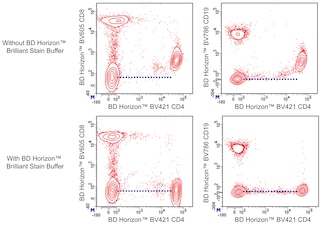
For optimal and reproducible results, BD Horizon Brilliant Stain Buffer should be used anytime two or more BD Horizon Brilliant dyes (including BD OptiBuild Brilliant reagents) are used in the same experiment. Fluorescent dye interactions may cause staining artifacts which may affect data interpretation. The BD Horizon Brilliant Stain Buffer was designed to minimize these interactions. More information can be found in the Technical Data Sheet of the BD Horizon Brilliant Stain Buffer (Cat. No. 563794).
Product Notices
- This antibody was developed for use in flow cytometry.
- The production process underwent stringent testing and validation to assure that it generates a high-quality conjugate with consistent performance and specific binding activity. However, verification testing has not been performed on all conjugate lots.
- Researchers should determine the optimal concentration of this reagent for their individual applications.
- An isotype control should be used at the same concentration as the antibody of interest.
- Caution: Sodium azide yields highly toxic hydrazoic acid under acidic conditions. Dilute azide compounds in running water before discarding to avoid accumulation of potentially explosive deposits in plumbing.
- For fluorochrome spectra and suitable instrument settings, please refer to our Multicolor Flow Cytometry web page at www.bdbiosciences.com/colors.
- Please refer to www.bdbiosciences.com/us/s/resources for technical protocols.
- BD Horizon Brilliant Stain Buffer is covered by one or more of the following US patents: 8,110,673; 8,158,444; 8,575,303; 8,354,239.
- BD Horizon Brilliant Violet 786 is covered by one or more of the following US patents: 8,110,673; 8,158,444; 8,227,187; 8,455,613; 8,575,303; 8,354,239.
- Cy is a trademark of GE Healthcare.
Companion Products
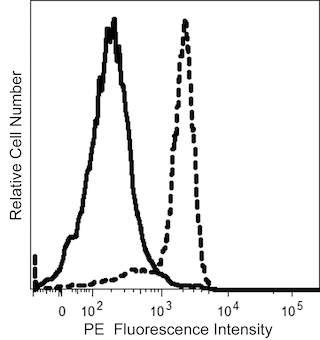
The CRCBT-02-001 monoclonal antibody specifically binds to human CD364 which is also known as Peptidase inhibitor 16 (PI-16) or Protease inhibitor 16. PI-16 is a glycophosphatidylinositol-linked, 436 amino acid surface glycoprotein. It is a member of the cysteine-rich secretory protein (CRISP) family and is likewise known as CRISP9. PI-16 is a putative serine protease inhibitor and can serve as a binding protein for PSP94 (prostate secretory protein of 94 amino acids) termed PSPBP. Serum levels of PSP94 and PI-16 can reportedly serve as key targets for prostate cancer research. PI-16 is highly expressed by the activated/memory, FoxP3-bright subsets of regulatory T cells. PI-16-positive regulatory T cells expressed uniformly high levels of the chemokine receptors, CCR4 and CCR6, when compared with PI-16-negative T regulatory cells. The results suggest that the CCR4+CCR6+ regulatory T cells are capable of homing to inflammatory sites and regulating effector T cells such as CCR4+CCR6+ Th17-like cells. PI-16 is also expressed by subsets of memory CD4+ and CD8-bright T cells. It is not expressed by B cells or monocytes.
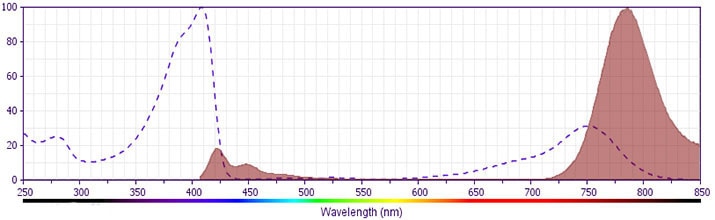
The antibody was conjugated to BD Horizon™ BV786 which is part of the BD Horizon Brilliant™ Violet family of dyes. This dye is a tandem fluorochrome of BD Horizon BV421 with an Ex Max of 405-nm and an acceptor dye with an Em Max at 786-nm. BD Horizon BV786 can be excited by the violet laser and detected in a filter used to detect Cy™7-like dyes (eg, 780/60-nm filter).
Development References (5)
-
Grose RH, Millard DJ, Mavrangelos C, et al. Comparison of blood and synovial fluid th17 and novel peptidase inhibitor 16 Treg cell subsets in juvenile idiopathic arthritis. J Rheumatol. 2012; 39(10):2021-2031. (Clone-specific: Flow cytometry). View Reference
-
Nicholson IC, Mavrangelos C, Bird DR, et al. PI16 is expressed by a subset of human memory Treg with enhanced migration to CCL17 and CCL20. Cell Immunol. 2012; 275(1-2):12-18. (Immunogen: Flow cytometry). View Reference
-
Reeves JR, Dulude H, Panchal C, Daigneault L, Ramnani DM. Prognostic value of prostate secretory protein of 94 amino acids and its binding protein after radical prostatectomy. Clin Cancer Res. 2006; 12(20 Pt 1):6018-6022. (Clone-specific). View Reference
-
Sadlon TJ, Wilkinson BG, Pederson S, et al. Genome-wide identification of human FOXP3 target genes in natural regulatory T cells. J Immunol. 2010; 185(2):1071-1081. (Biology). View Reference
-
Whitaker HC, Warren AY, Eeles R, Kote-Jarai Z, Neal DE. The potential value of microseminoprotein-beta as a prostate cancer biomarker and therapeutic target. Prostate. 2012; 70(3):333-340. (Biology). View Reference
Please refer to Support Documents for Quality Certificates
Global - Refer to manufacturer's instructions for use and related User Manuals and Technical data sheets before using this products as described
Comparisons, where applicable, are made against older BD Technology, manual methods or are general performance claims. Comparisons are not made against non-BD technologies, unless otherwise noted.
For Research Use Only. Not for use in diagnostic or therapeutic procedures.
