







Preparation And Storage


Recommended Assay Procedures
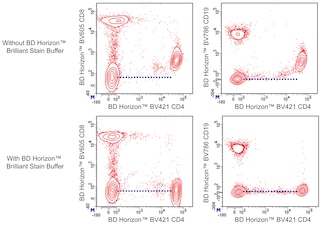
For optimal and reproducible results, BD Horizon Brilliant Stain Buffer should be used anytime two or more BD Horizon Brilliant dyes (including BD OptiBuild Brilliant reagents) are used in the same experiment. Fluorescent dye interactions may cause staining artifacts which may affect data interpretation. The BD Horizon Brilliant Stain Buffer was designed to minimize these interactions. More information can be found in the Technical Data Sheet of the BD Horizon Brilliant Stain Buffer (Cat. No. 563794).
Product Notices
- This antibody was developed for use in flow cytometry.
- The production process underwent stringent testing and validation to assure that it generates a high-quality conjugate with consistent performance and specific binding activity. However, verification testing has not been performed on all conjugate lots.
- Researchers should determine the optimal concentration of this reagent for their individual applications.
- An isotype control should be used at the same concentration as the antibody of interest.
- Caution: Sodium azide yields highly toxic hydrazoic acid under acidic conditions. Dilute azide compounds in running water before discarding to avoid accumulation of potentially explosive deposits in plumbing.
- For fluorochrome spectra and suitable instrument settings, please refer to our Multicolor Flow Cytometry web page at www.bdbiosciences.com/colors.
- Please refer to www.bdbiosciences.com/us/s/resources for technical protocols.
- BD Horizon Brilliant Stain Buffer is covered by one or more of the following US patents: 8,110,673; 8,158,444; 8,575,303; 8,354,239.
- BD Horizon Brilliant Violet 650 is covered by one or more of the following US patents: 8,110,673; 8,158,444; 8,227,187; 8,455,613; 8,575,303; 8,354,239.
- Alexa Fluor® is a registered trademark of Life Technologies Corporation.
Companion Products
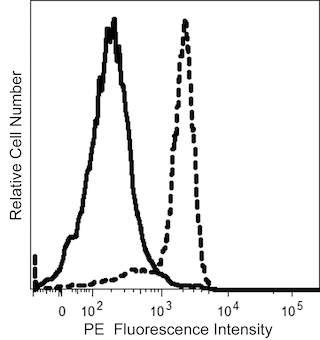
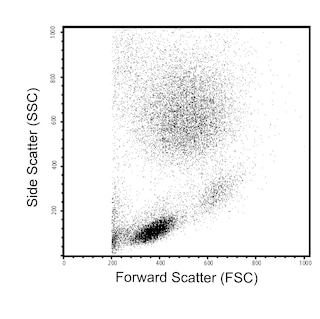
The L106 monoclonal antibody specifically recognizes CD134 which is also known as OX40, OX40L receptor or TAX transcriptionally-activated glycoprotein 1 receptor (TXGP1L). CD134 is a ~48 kDa type I transmembrane glycoprotein that is encoded by TNFRSF4 (TNF receptor superfamily member 4) and belongs to the TNF/NGF receptor family. By sequence analysis, CD134 is related to the antigen recognized by the rat monoclonal antibody Ox 40. The CD134 antigen (Human Ox 40) is found on activated peripheral CD4+ T lymphocytes and a subset of activated CD8+ T lymphocytes. It is not expressed on CD3-activated purified CD8+ T lymphocytes. It is also present on HUT-102, an HTLV- 1-infected T-lymphocyte line. Its ligand, gp34 (CD252 or Ox 40 Ligand encoded by TNFSF4), is found on some antigen presenting cells including B cells and dendritic cells as well as Epstein Barr virus (EBV)-transformed B lymphocytes. Preliminary evidence suggests a possible role for CD134 antigen in graft rejection.
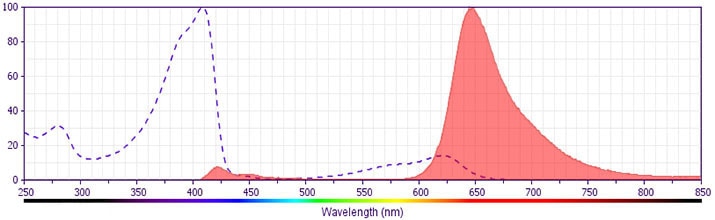
The antibody was conjugated to BD Horizon™ BV650 which is part of the BD Horizon Brilliant™ Violet family of dyes. This dye is a tandem fluorochrome of BD Horizon BV421 with an Ex Max of 405-nm and an acceptor dye with an Em Max at 650-nm. BD Horizon BV650 can be excited by the violet laser and detected in a filter used to detect APC-like dyes (eg, 660/20-nm filter). Due to the excitation and emission characteristics of the acceptor dye, there will be spillover into the APC and Alexa Fluor® 700 detectors. However, the spillover can be corrected through compensation as with any other dye combination.
Development References (5)
-
Godfrey W, Buck D, Harara M, Benike C, Engleman E. Studies of the L106 protein and its gene: Evidence that L106 and Ox 40 are homologous. In: Schlossman SF. Stuart F. Schlossman .. et al., ed. Leucocyte typing V : white cell differentiation antigens : proceedings of the fifth international workshop and conference held in Boston, USA, 3-7 November, 1993. Oxford: Oxford University Press; 1995:1157-1160.
-
Godfrey WR, Fagnoni FF, Harara MA, Buck D, Engleman EG. Identification of a human OX-40 ligand, a costimulator of CD4+ T cells with homology to tumor necrosis factor. J Exp Med. 1994 August; 180(2):757-762. (Clone-specific: Flow cytometry). View Reference
-
Lamb LS, Abhyankar SA, Hazlett L, et al. Expression of CD134 (0X-40) on T cells during the first 100 days following allogeneic bone marrow transplantation as a marker for lymphocyte activation and therapy-resistant graft-versus-host disease.. Cytometry. 1999; 38(5):238-43. (Biology). View Reference
-
Mallett S, Fossum S, Barclay AN. Characterization of the MRC OX40 antigen of activated CD4 positive T lymphocytes--a molecule related to nerve growth factor receptor. EMBO J. 1990; 9(4):1063-1068. (Biology). View Reference
-
Paterson DJ, Jefferies WA, Green JR. Antigens of activated rat T lymphocytes including a molecule of 50,000 Mr detected only on CD4 positive T blasts. Mol Immunol. 1987; 24(12):1281-1290. (Biology). View Reference
Please refer to Support Documents for Quality Certificates
Global - Refer to manufacturer's instructions for use and related User Manuals and Technical data sheets before using this products as described
Comparisons, where applicable, are made against older BD Technology, manual methods or are general performance claims. Comparisons are not made against non-BD technologies, unless otherwise noted.
For Research Use Only. Not for use in diagnostic or therapeutic procedures.
