





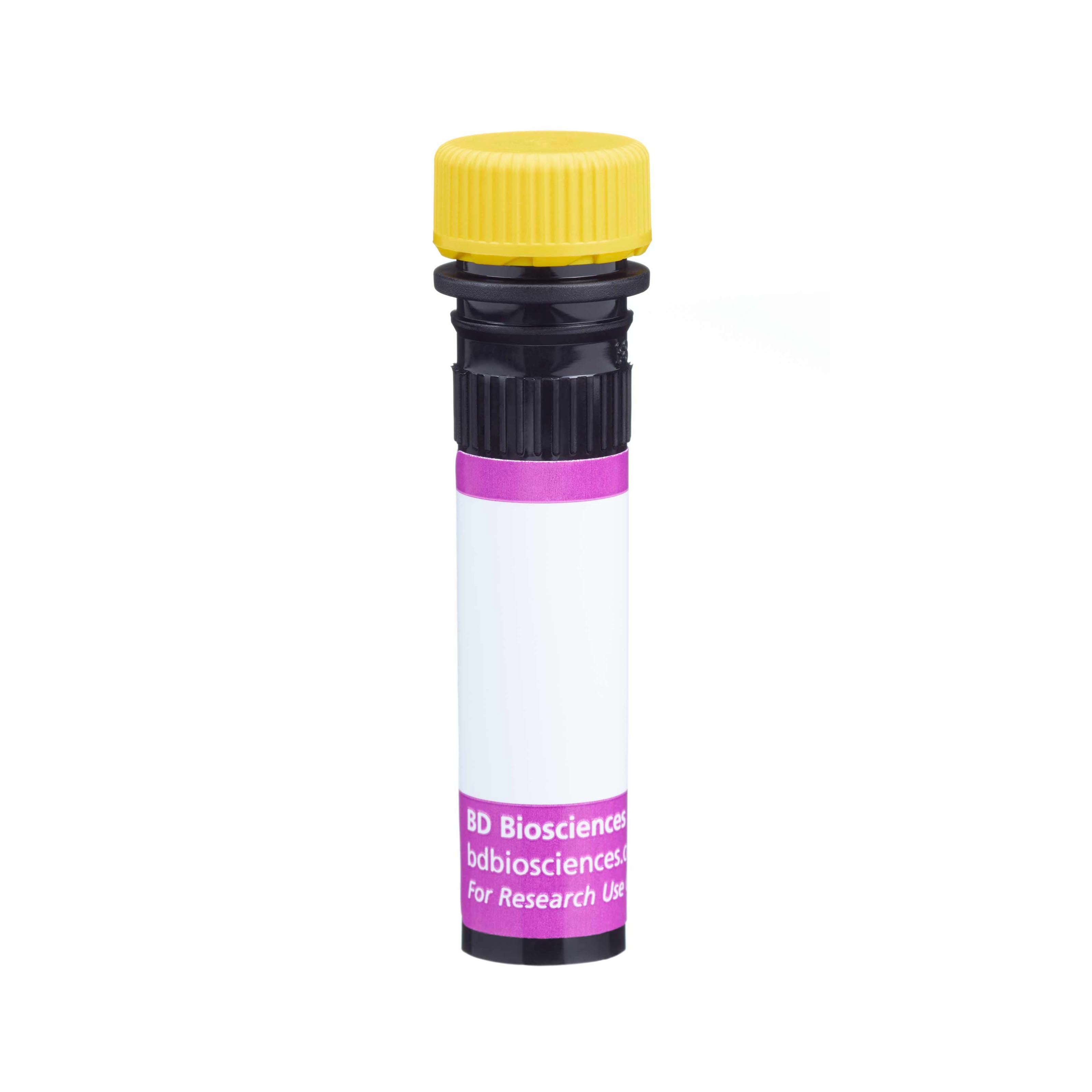


Preparation And Storage


Recommended Assay Procedures
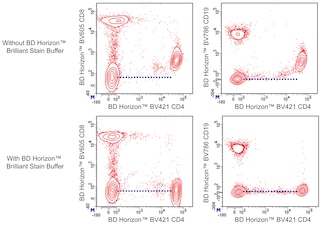
For optimal and reproducible results, BD Horizon Brilliant Stain Buffer should be used anytime two or more BD Horizon Brilliant dyes (including BD OptiBuild Brilliant reagents) are used in the same experiment. Fluorescent dye interactions may cause staining artifacts which may affect data interpretation. The BD Horizon Brilliant Stain Buffer was designed to minimize these interactions. More information can be found in the Technical Data Sheet of the BD Horizon Brilliant Stain Buffer (Cat. No. 563794).
Product Notices
- This antibody was developed for use in flow cytometry.
- The production process underwent stringent testing and validation to assure that it generates a high-quality conjugate with consistent performance and specific binding activity. However, verification testing has not been performed on all conjugate lots.
- Researchers should determine the optimal concentration of this reagent for their individual applications.
- An isotype control should be used at the same concentration as the antibody of interest.
- Caution: Sodium azide yields highly toxic hydrazoic acid under acidic conditions. Dilute azide compounds in running water before discarding to avoid accumulation of potentially explosive deposits in plumbing.
- For fluorochrome spectra and suitable instrument settings, please refer to our Multicolor Flow Cytometry web page at www.bdbiosciences.com/colors.
- Please refer to www.bdbiosciences.com/us/s/resources for technical protocols.
- BD Horizon Brilliant Stain Buffer is covered by one or more of the following US patents: 8,110,673; 8,158,444; 8,575,303; 8,354,239.
- BD Horizon Brilliant Violet 650 is covered by one or more of the following US patents: 8,110,673; 8,158,444; 8,227,187; 8,455,613; 8,575,303; 8,354,239.
- Alexa Fluor® is a registered trademark of Life Technologies Corporation.
Companion Products
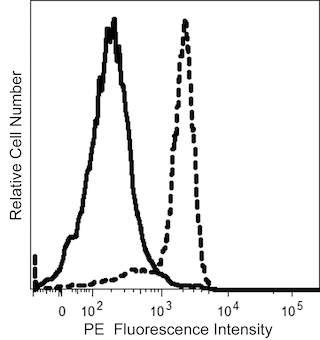
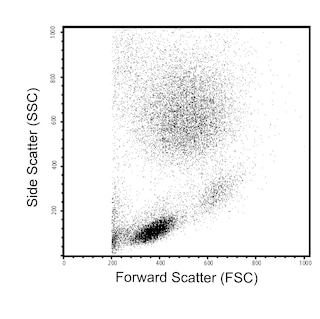
The GIR-208 antibody recognizes the extracellular region of CD119 which is also known as the alpha chain subunit (80-95 kDa glycoprotein) of the human interferon-γ receptor (IFN-γRα). The functionally active-form of the human IFN-γ receptor consists of two (or more) subunits, with IFN-γRα responsible for IFN-γ binding and both the IFN-γRα and β chains required for the transduction of biologic responses. The IFN-γ receptor α chain (CD119) is expressed on the surface of most human cells (except mature erythrocytes) including monocytes, macrophages, T cells, B cells, NK cells, neutrophils, fibroblasts, epithelial cells, and endothelium. Binding of 125I-labeled GIR-208 antibody to IFN-γRα+ cells is reported to be specifically inhibited in the presence of excess IFN-γ. GIR-208 does not cross react with IFN-γ as tested by ELISA. The ability of this antibody to bind to IFN-γ receptors of species other than human has not been determined. The immunogen used to generate this hybridoma was human IFN-γRα purified from human placenta. The GIR- 208 has been reported to block the binding of 125I-human IFN-γ to IFN-γRα+ cells as well as purified, soluble human IFN-γRα. GIR-208 is a neutralizing antibody that has been shown to neutralize the anti-viral activity of IFN-γ on WISH cells in a dose-dependent fashion.
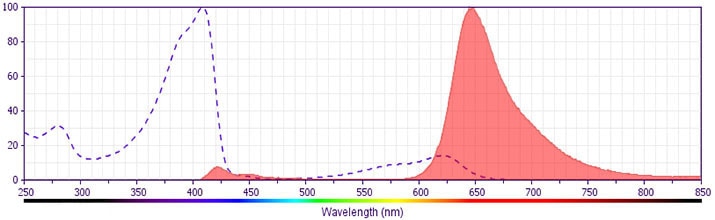
The antibody was conjugated to BD Horizon™ BV650 which is part of the BD Horizon Brilliant™ Violet family of dyes. This dye is a tandem fluorochrome of BD Horizon BV421 with an Ex Max of 405-nm and an acceptor dye with an Em Max at 650-nm. BD Horizon BV650 can be excited by the violet laser and detected in a filter used to detect APC-like dyes (eg, 660/20-nm filter). Due to the excitation and emission characteristics of the acceptor dye, there will be spillover into the APC and Alexa Fluor® 700 detectors. However, the spillover can be corrected through compensation as with any other dye combination.
Development References (6)
-
Bach EA, Aguet M, Schreiber RD. The IFN gamma receptor: a paradigm for cytokine receptor signaling. Annu Rev Immunol. 1997; 15:563-591. (Biology). View Reference
-
Gumina RJ, Freire-Moar J, DeYoung L, Webb DR, Devens BH. Transduction of the IFN-gamma signal for HLA-DR expression in the promonocytic line THP-1 involves a late-acting PKC activity. Cell Immunol. 1991; 138(2):265-279. (Clone-specific: Neutralization). View Reference
-
Kishimoto T. Tadamitsu Kishimoto .. et al., ed. Leucocyte typing VI : white cell differentiation antigens : proceedings of the sixth international workshop and conference held in Kobe, Japan, 10-14 November 1996. New York: Garland Pub.; 1997:818-821.
-
Peyman JA, Hammond GL. Localization of IFN-gamma receptor in first trimester placenta to trophoblasts but lack of stimulation of HLA-DRA, -DRB, or invariant chain mRNA expression by IFN-gamma. J Immunol. 1992; 149(8):2675-2680. (Biology). View Reference
-
Sheehan KC, Calderon J, Schreiber RD. Generation and characterization of monoclonal antibodies specific for the human IFN-gamma receptor. J Immunol. 1988; 140(12):4231-4237. (Immunogen: Neutralization, Western blot). View Reference
-
Valente G, Ozmen L, Novelli F. Distribution of interferon-gamma receptor in human tissues. Eur J Immunol. 1992; 22(9):2403-2412. (Biology). View Reference
Please refer to Support Documents for Quality Certificates
Global - Refer to manufacturer's instructions for use and related User Manuals and Technical data sheets before using this products as described
Comparisons, where applicable, are made against older BD Technology, manual methods or are general performance claims. Comparisons are not made against non-BD technologies, unless otherwise noted.
For Research Use Only. Not for use in diagnostic or therapeutic procedures.
