







Preparation And Storage


Recommended Assay Procedures
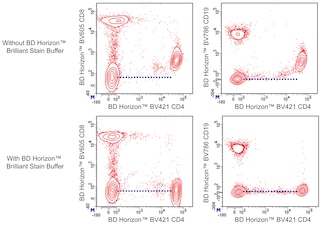
For optimal and reproducible results, BD Horizon Brilliant Stain Buffer should be used anytime two or more BD Horizon Brilliant dyes (including BD OptiBuild Brilliant reagents) are used in the same experiment. Fluorescent dye interactions may cause staining artifacts which may affect data interpretation. The BD Horizon Brilliant Stain Buffer was designed to minimize these interactions. More information can be found in the Technical Data Sheet of the BD Horizon Brilliant Stain Buffer (Cat. No. 563794).
Product Notices
- This antibody was developed for use in flow cytometry.
- The production process underwent stringent testing and validation to assure that it generates a high-quality conjugate with consistent performance and specific binding activity. However, verification testing has not been performed on all conjugate lots.
- Researchers should determine the optimal concentration of this reagent for their individual applications.
- An isotype control should be used at the same concentration as the antibody of interest.
- Caution: Sodium azide yields highly toxic hydrazoic acid under acidic conditions. Dilute azide compounds in running water before discarding to avoid accumulation of potentially explosive deposits in plumbing.
- For fluorochrome spectra and suitable instrument settings, please refer to our Multicolor Flow Cytometry web page at www.bdbiosciences.com/colors.
- Please refer to www.bdbiosciences.com/us/s/resources for technical protocols.
- BD Horizon Brilliant Stain Buffer is covered by one or more of the following US patents: 8,110,673; 8,158,444; 8,575,303; 8,354,239.
- BD Horizon Brilliant Violet 510 is covered by one or more of the following US patents: 8,575,303; 8,354,239.
Companion Products
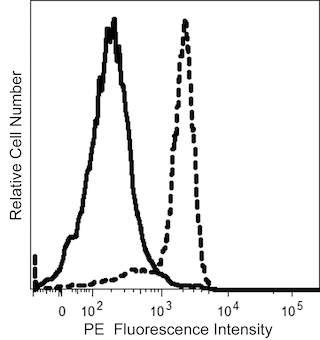
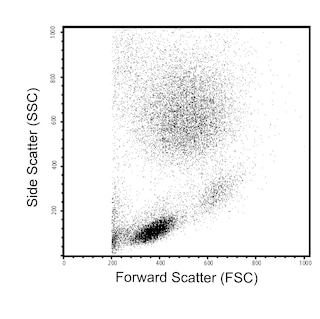
The 3A9 monoclonal antibody recognizes CD195, which is also known as the chemokine receptor, CCR5, a seven transmembrane-spanning G protein-associated molecule. The 3A9 antibody also reportedly cross-reacts with human CCR8. Results of epitope mapping and sequence comparison between CCR5 and CCR8 reveals that the first three amino acid residues for these two receptors are identical: MDY (Met-Asp-Tyr). CCR5 belongs to the β-chemokine receptor family. It is expressed on subsets of T lymphocytes, NK cells, monocytes, macrophages, and dendritic cells. CCR5 regulates lymphocyte chemotaxis activation and transendothelial migration during inflammation. It signals a response to at least three chemokines: RANTES and macrophage inflammatory protein-1 (MIP-1) α and β. Additionally, CCR5 has been found to be a co-receptor for macrophage-tropic HIV-1 on CD4+ cells, a characteristic that is important in viral transmission. Reports indicate that individuals who have partial (heterozygous) or complete (homozygous) deletion of the CCR5 allele, demonstrate resistance to HIV infection. CCR5 has been clustered as CD195 in the VIIth HLDA workshop.
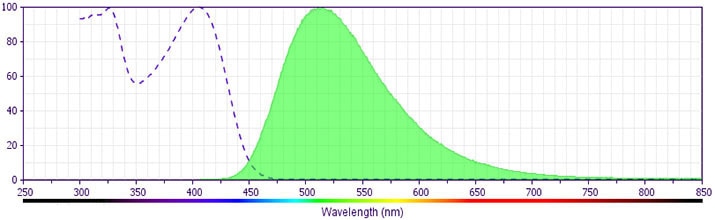
The antibody was conjugated to BD Horizon™ BV510 which is part of the BD Horizon Brilliant™ Violet family of dyes. With an Ex Max of 405-nm and Em Max at 510-nm, BD Horizon BV510 can be excited by the violet laser and detected in the BD Horizon V500 (525/50-nm) filter set. BD Horizon BV510 conjugates are useful for the detection of dim markers off the violet laser.
Development References (10)
-
Campbell JJ, Qin S, Unutmaz D, et al. Unique subpopulations of CD56+ NK and NK-T peripheral blood lymphocytes identified by chemokine receptor expression repertoire. J Immunol. 2001; 166(11):6477-6482. (Biology: Flow cytometry). View Reference
-
Choe H, Farzan M, Sun Y, et al. The beta-chemokine receptors CCR3 and CCR5 facilitate infection by primary HIV-1 isolates. Cell. 1996; 85(7):1135-1148. (Biology). View Reference
-
Dambra PP, Loria MP, D'Oronzio L, et al. The Cytokine Receptor Panel: Flow cytometry analysis on lymphocytes from neonates, young, aged normal donors, and from patients with HIV infection or AIDS. In: Mason D. David Mason .. et al., ed. Leucocyte typing VII : white cell differentiation antigens : proceedings of the Seventh International Workshop and Conference held in Harrogate, United Kingdom. Oxford: Oxford University Press; 2002:269-271.
-
Deng H, Liu R, Ellmeier W, et al. Identification of a major co-receptor for primary isolates of HIV-1. Nature. 1996; 381(6584):661-666. (Biology). View Reference
-
Doranz BJ, Rucker J, Yi Y, et al. A dual-tropic primary HIV-1 isolate that uses fusin and the beta-chemokine receptors CKR-5, CKR-3, and CKR-2b as fusion cofactors. Cell. 1996; 85(7):1149-1158. (Biology). View Reference
-
Hancock WW. Chemokines and the pathogenesis of T cell-dependent immune responses. Am J Pathol. 1996; 148(3):681-684. (Biology). View Reference
-
Karlsson I, Malleret B, Brochard P, et al. FoxP3+ CD25+ CD8+ T-cell induction during primary simian immunodeficiency virus infection in cynomolgus macaques correlates with low CD4+ T-cell activation and high viral load. J Virol. 2007; 81(24):13444-13455. (Clone-specific: Flow cytometry). View Reference
-
Raport CJ, Gosling J, Schweickart VL, Gray PW, Charo IF. Molecular cloning and functional characterization of a novel human CC chemokine receptor (CCR5) for RANTES, MIP-1beta, and MIP-1alpha. J Biol Chem. 1996; 271(29):17161-17166. (Biology). View Reference
-
Rottman JB, Ganley KP, Williams K, Wu L, Mackay CR, Ringler DJ. Cellular localization of the chemokine receptor CCR5. Correlation to cellular targets of HIV-1 infection. Am J Pathol. 1997; 151(5):1341-1351. (Clone-specific: Flow cytometry). View Reference
-
Wu L, Paxton WA, Kassam N, et al. CCR5 levels and expression pattern correlate with infectability by macrophage-tropic HIV-1, in vitro. J Exp Med. 1997; 185(9):1681-1689. (Immunogen: Flow cytometry, Functional assay, Inhibition, Neutralization). View Reference
Please refer to Support Documents for Quality Certificates
Global - Refer to manufacturer's instructions for use and related User Manuals and Technical data sheets before using this products as described
Comparisons, where applicable, are made against older BD Technology, manual methods or are general performance claims. Comparisons are not made against non-BD technologies, unless otherwise noted.
For Research Use Only. Not for use in diagnostic or therapeutic procedures.
