





BD Pharmingen™ Rabbit Anti-Mouse p27
Clone Poly1144 (RUO)


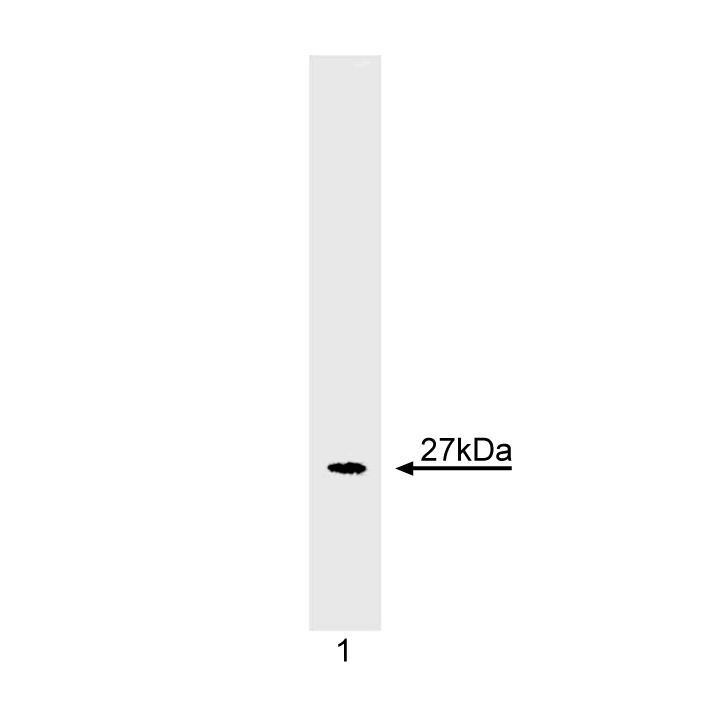
Western blot analysis of p27. Lysates from NIH/3T3 cells were probed with polyclonal rabbit anti-mouse p27 antibody (Cat. No. 558902) at a dilution of 1:1000. p27 is identified as a protein of ~27 kDa.

Western blot analysis of p27. Lysates from NIH/3T3 cells were probed with polyclonal rabbit anti-mouse p27 antibody (Cat. No. 558902) at a dilution of 1:1000. p27 is identified as a protein of ~27 kDa.


Preparation And Storage


Product Notices
- Since applications vary, each investigator should titrate the reagent to obtain optimal results.
- Please refer to www.bdbiosciences.com/us/s/resources for technical protocols.
- Caution: Sodium azide yields highly toxic hydrazoic acid under acidic conditions. Dilute azide compounds in running water before discarding to avoid accumulation of potentially explosive deposits in plumbing.
p27 (Kip1) is a cyclin-dependent kinase inhibitor (cdkI) that associates with cyclin/cdk complexes to inhibit their catalytic activity. p27 was first identified as a result of its role in TGF-β-induced G1 phase arrest and cell-cell contact. In vitro, p27 binds tightly to cyclin D-Cdk4, cyclin E-Cdk2, and cyclin A-Cdk2 complexes to inhibit their activity. In non-dividing cells, the level of p27 is elevated and its activity gradually decreases as cells reach S phase. Mitogenic stimulation causes the cyclin D-CDK complex to bind and sequester p27. An increase in Cdk2 activity during G1 causes the degradation of p27. Phosphorylation of p27 is necessary for its degradation and is mediated by the SCF complex [Skp1,2/Cdc53 (cullins)]/F-box proteins. SCF complexes are involved in targeting phosphorylated proteins for ubiquitin-dependent proteolysis. The antibodies recognize mouse p27. A peptide coupled to KLH and corresponding to amino acids 184-197 at the C-terminus of mouse p27 was used as immunogen.
Development References (4)
-
Johnson DG, Walker CL. Cyclins and cell cycle checkpoints. Annu Rev Pharmacol Toxicol. 1999; 39:295-312. (Biology). View Reference
-
Lee MH, Reynisdottir I, Massague J. Cloning of p57KIP2, a cyclin-dependent kinase inhibitor with unique domain structure and tissue distribution. Genes Dev. 1995; 9(6):639-649. (Biology). View Reference
-
Tsvetkov LM, Yeh KH, Lee SJ, Sun H, Zhang H. p27(Kip1) ubiquitination and degradation is regulated by the SCF(Skp2) complex through phosphorylated Thr187 in p27. Curr Biol. 1999; 9(12):661-664. (Biology). View Reference
-
Vlach J, Hennecke S, Amati B. Phosphorylation-dependent degradation of the cyclin-dependent kinase inhibitor p27. EMBO J. 1997; 16(17):5334-5344. (Biology). View Reference
Please refer to Support Documents for Quality Certificates
Global - Refer to manufacturer's instructions for use and related User Manuals and Technical data sheets before using this products as described
Comparisons, where applicable, are made against older BD Technology, manual methods or are general performance claims. Comparisons are not made against non-BD technologies, unless otherwise noted.
For Research Use Only. Not for use in diagnostic or therapeutic procedures.