





BD Pharmingen™ Serum Rabbit Anti-APC2
Clone Poly1208 (RUO)


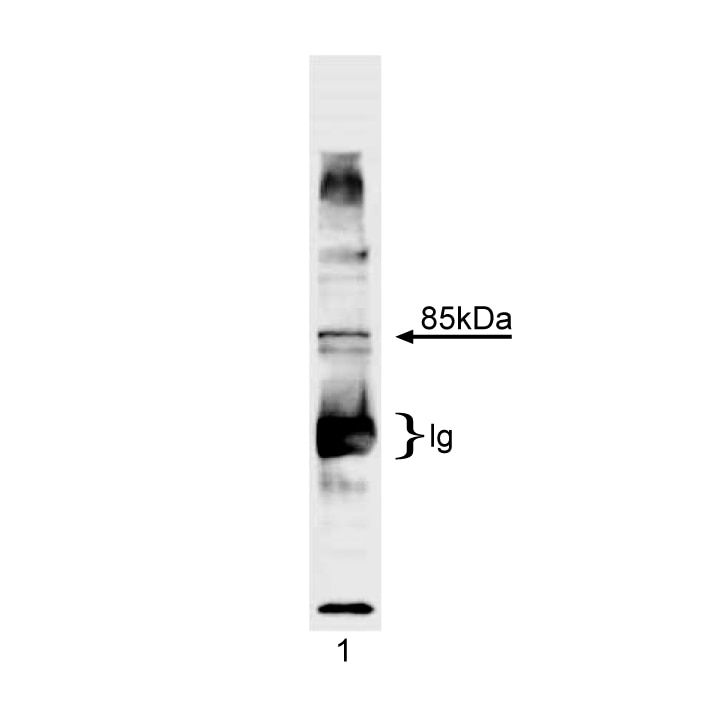
Immunoprecipitation/western blot analysis of APC2. Cell lysates from NIH/3T3 cells were immunoprecipitated with anti-APC2 (Cat. No. 550362) antibody (3 µl/1x10e6 cells) and subjected to SDS/PAGE and blots were
probed at a dilution of 1:2000. APC2 is
detected at ~85 kDa.

Immunoprecipitation/western blot analysis of APC2. Cell lysates from NIH/3T3 cells were immunoprecipitated with anti-APC2 (Cat. No. 550362) antibody (3 µl/1x10e6 cells) and subjected to SDS/PAGE and blots were
probed at a dilution of 1:2000. APC2 is
detected at ~85 kDa.


Preparation And Storage


Recommended Assay Procedures
Applications include immunoprecipitation (1-3 µl/1x10^6 cells) and western blot analysis (1:2000). NIH/3T3 (ATCC CRL-1658) or HeLa (ATCC CCL-2) cells are recommended as a positive control.
Product Notices
- Since applications vary, each investigator should titrate the reagent to obtain optimal results.
- Please refer to www.bdbiosciences.com/us/s/resources for technical protocols.
- Caution: Sodium azide yields highly toxic hydrazoic acid under acidic conditions. Dilute azide compounds in running water before discarding to avoid accumulation of potentially explosive deposits in plumbing.
Cell cycle progression through mitosis is regulated in part by controlling the synthesis and degradation of specific cyclins and kinases. Initiation of mitosis occurs when cyclin B and Cdc2 form a complex, causing the phosphorylation of a number of proteins by Cdc2 to initiate the M phase. Cdc2 activation leads to the degradation of cyclin B via an ubiquitin-mediated proteolysis pathway which leads to the inactivation of Cdc2. The initiation of anaphase and exit from mitosis depend on the activation of the anaphase promoting complex (APC), which is composed of proteins responsible for the ubiquitination of anaphase inhibitors and mitotic cyclins. The vertebrate APC has been shown to consist of at least 12 subunits, and APC-2 is one of these subunits. APC2 contains a 200 amino acid residue region, designated the CH region, which has homology to a region in the cullin family of proteins. Cullin proteins function to ubiquinate many phosphorylated substrate proteins, such as cyclin G1. Thus, both APC2 and cullin proteins may perform similar biochemical roles in their respective proteolytic pathways. Human APC2 has been cloned and has an expected molecular weight of ~85 kDa in SDS/PAGE. The antibodies recognize human and mouse APC2. A peptide coupled to KLH and made against the C-terminus of human APC2 (CYSAGVYRLPKNCS) was used as immunogen.
Development References (3)
-
Kipreos ET, Lander LE, Wing JP, He WW, Hedgecock EM. cul-1 is required for cell cycle exit in C. elegans and identifies a novel gene family. Cell. 1996; 85(6):829-839. (Biology). View Reference
-
Yu H, Peters JM, King RW, Page AM, Hieter P, Kirschner MW. Identification of a cullin homology region in a subunit of the anaphase-promoting complex. Science. 1998; 279(5354):1219-1222. (Biology). View Reference
-
Zachariae W, Shevchenko A, Andrews PD, et al. Mass spectrometric analysis of the anaphase-promoting complex from yeast: identification of a subunit related to cullins. Science. 1998; 279(5354):1216-1219. (Biology). View Reference
Please refer to Support Documents for Quality Certificates
Global - Refer to manufacturer's instructions for use and related User Manuals and Technical data sheets before using this products as described
Comparisons, where applicable, are made against older BD Technology, manual methods or are general performance claims. Comparisons are not made against non-BD technologies, unless otherwise noted.
For Research Use Only. Not for use in diagnostic or therapeutic procedures.