





BD Pharmingen™ Purified Mouse Anti-Human RON (CD136)
Clone Zt/g4 (RUO)


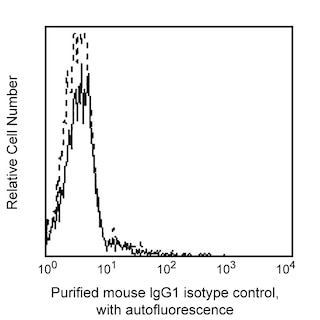
Analysis of human RON (CD136) expression.
Left Panel - Flow cytometric analysis of RON (CD136) expression on human SW480 cells. Cells from the human SW480 (Colorectal adenocarcinoma, ATCC CCL-228) cell line were stained with either Purified Mouse IgG1, κ Isotype Control (Cat. No. 554121; dashed line histogram) or Purified Mouse Anti-Human RON (CD136) antibody (Cat. No. 565691; solid line histogram) followed by staining with PE Goat Anti-Mouse Ig (Cat. No. 550589). The fluorescence histogram showing the expression RON (CD136) [Ig isotype control staining] was derived from gated events with the forward and side light-scatter characteristics of viable SW480 cells. Flow cytometric analysis was performed using a BD™ LSR II Flow Cytometer System.
Right Panel - Immunohistochemical staining of human small intestine. After fixation of small intestine with acetone, sections were stained with either Purified Mouse IgG1, κ Isotype Control (Cat. No.550878; Left Image) or Purified Mouse Anti-Human Ron (CD136) (Cat. No. 565691; Right Image). A three-step staining procedure that employs a Biotin Goat Anti-Mouse Immunoglobulin (Cat. No. 550337), Streptavidin-Horseradish Peroxidase (HRP) (Cat. No.550946), and the DAB Substrate Kit (Cat. No. 550880) was used to develop the primary staining reagents. Original magnification: 40×.
Analysis of human RON (CD136) expression.
Left Panel - Flow cytometric analysis of RON (CD136) expression on human SW480 cells. Cells from the human SW480 (Colorectal adenocarcinoma, ATCC CCL-228) cell line were stained with either Purified Mouse IgG1, κ Isotype Control (Cat. No. 554121; dashed line histogram) or Purified Mouse Anti-Human RON (CD136) antibody (Cat. No. 565691; solid line histogram) followed by staining with PE Goat Anti-Mouse Ig (Cat. No. 550589). The fluorescence histogram showing the expression RON (CD136) [Ig isotype control staining] was derived from gated events with the forward and side light-scatter characteristics of viable SW480 cells. Flow cytometric analysis was performed using a BD™ LSR II Flow Cytometer System.
Right Panel - Immunohistochemical staining of human small intestine. After fixation of small intestine with acetone, sections were stained with either Purified Mouse IgG1, κ Isotype Control (Cat. No.550878; Left Image) or Purified Mouse Anti-Human Ron (CD136) (Cat. No. 565691; Right Image). A three-step staining procedure that employs a Biotin Goat Anti-Mouse Immunoglobulin (Cat. No. 550337), Streptavidin-Horseradish Peroxidase (HRP) (Cat. No.550946), and the DAB Substrate Kit (Cat. No. 550880) was used to develop the primary staining reagents. Original magnification: 40×.


Preparation And Storage


Product Notices
- Since applications vary, each investigator should titrate the reagent to obtain optimal results.
- Please refer to www.bdbiosciences.com/us/s/resources for technical protocols.
- Caution: Sodium azide yields highly toxic hydrazoic acid under acidic conditions. Dilute azide compounds in running water before discarding to avoid accumulation of potentially explosive deposits in plumbing.
- Sodium azide is a reversible inhibitor of oxidative metabolism; therefore, antibody preparations containing this preservative agent must not be used in cell cultures nor injected into animals. Sodium azide may be removed by washing stained cells or plate-bound antibody or dialyzing soluble antibody in sodium azide-free buffer. Since endotoxin may also affect the results of functional studies, we recommend the NA/LE (No Azide/Low Endotoxin) antibody format, if available, for in vitro and in vivo use.
- An isotype control should be used at the same concentration as the antibody of interest.
Companion Products

The Zt/g4 monoclonal antibody specifically binds to RON, which is also known as CD136, Macrophage-stimulating protein receptor (MSP-Receptor, MSP-R), Macrophage stimulating 1 receptor (c-met-related tyrosine kinase) (MST1R), or Protein-tyrosine kinase 8 (PTK8). RON is a type I transmembrane glycoprotein that belongs to the receptor tyrosine kinase family. It is expressed on cells as a disulfide-linked heterodimer. RON is expressed on macrophages, keratinocytes, erythroblasts and epithelial cells from the skin, lung, kidney, liver, intestine, colon, and bone marrow. RON reportedly regulates many physiological processes including the survival, migration, differentiation, and effector functions of a variety of cell types including epithelial cells, and macrophages. RON binds Macrophage stimulating protein (MSP). Overexpression of RON may contribute to the malignant transformation of epithelial cells.
Development References (4)
-
Feng L, Yao HP, Wang W, et al. Efficacy of anti-RON antibody Zt/g4-drug maytansinoid conjugation (Anti-RON ADC) as a novel therapeutics for targeted colorectal cancer therapy. Clin Cancer Res. 2014; 20(23):6045-6058. (Clone-specific: Bioassay, Flow cytometry, Fluorescence microscopy, Functional assay, Immunofluorescence, In vivo exacerbation). View Reference
-
Li Z, Yao H, Guin S, Padhye SS, Zhou YQ, Wang MH. Monoclonal antibody (mAb)-induced down-regulation of RON receptor tyrosine kinase diminishes tumorigenic activities of colon cancer cells. Int J Oncol. 2010; 37(2):473-482. (Clone-specific: Bioassay, Flow cytometry, Fluorescence microscopy, Functional assay, Immunofluorescence). View Reference
-
Ronsin C, Muscatelli F, Mattei MG, Breathnach R. A novel putative receptor protein tyrosine kinase of the met family. Oncogene. 1993; 8(5):1195-11202. (Biology). View Reference
-
Yao HP, Luo YL, Feng L, et al. Agonistic monoclonal antibodies potentiate tumorigenic and invasive activities of splicing variant of the RON receptor tyrosine kinase. Cancer Immunol Immunother. 206; 5(9):179-1186. (Immunogen: Bioassay, ELISA, Flow cytometry, Functional assay, Immunohistochemistry, Immunoprecipitation, Induction, Stimulation). View Reference
Please refer to Support Documents for Quality Certificates
Global - Refer to manufacturer's instructions for use and related User Manuals and Technical data sheets before using this products as described
Comparisons, where applicable, are made against older BD Technology, manual methods or are general performance claims. Comparisons are not made against non-BD technologies, unless otherwise noted.
For Research Use Only. Not for use in diagnostic or therapeutic procedures.