





BD Horizon™ BV421 Streptavidin
(RUO)




Preparation And Storage


Recommended Assay Procedures
BD™ CompBeads can be used as surrogates to assess fluorescence spillover (Compensation). When fluorochrome conjugated antibodies are bound to CompBeads, they have spectral properties very similar to cells. However, for some fluorochromes there can be small differences in spectral emissions compared to cells, resulting in spillover values that differ when compared to biological controls. It is strongly recommended that when using a reagent for the first time, users compare the spillover on cells and CompBead to ensure that BD Comp beads are appropriate for your specific cellular application.
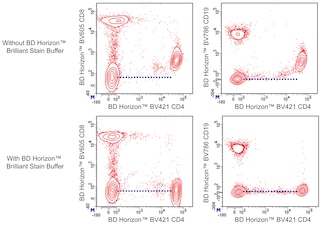
For optimal and reproducible results, BD Horizon Brilliant Stain Buffer should be used anytime two or more BD Horizon Brilliant dyes are used in the same experiment. Fluorescent dye interactions may cause staining artifacts which may affect data interpretation. The BD Horizon Brilliant Stain Buffer was designed to minimize these interactions. More information can be found in the Technical Data Sheet of the BD Horizon Brilliant Stain Buffer (Cat. No. 563794/566349) or the BD Horizon Brilliant Stain Buffer Plus (Cat. No. 566385).
Product Notices
- Since applications vary, each investigator should titrate the reagent to obtain optimal results.
- Caution: Sodium azide yields highly toxic hydrazoic acid under acidic conditions. Dilute azide compounds in running water before discarding to avoid accumulation of potentially explosive deposits in plumbing.
- Source of all serum proteins is from USDA inspected abattoirs located in the United States.
- Pacific Blue™ is a trademark of Molecular Probes, Inc., Eugene, OR.
- For fluorochrome spectra and suitable instrument settings, please refer to our Multicolor Flow Cytometry web page at www.bdbiosciences.com/colors.
- BD Horizon Brilliant Violet 421 is covered by one or more of the following US patents: 8,158,444; 8,362,193; 8,575,303; 8,354,239.
- BD Horizon Brilliant Stain Buffer is covered by one or more of the following US patents: 8,110,673; 8,158,444; 8,575,303; 8,354,239.
- Alexa Fluor® is a registered trademark of Molecular Probes, Inc., Eugene, OR.
- Please refer to http://regdocs.bd.com to access safety data sheets (SDS).
- Please refer to www.bdbiosciences.com/us/s/resources for technical protocols.
Companion Products
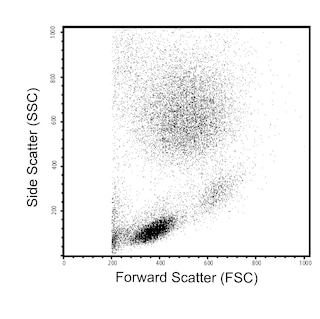
BD Horizon™ BV421 Streptavidin is a useful second-step reagent for the indirect immunofluorescent staining of cells in combination with biotinylated primary antibodies for flow cytometric analysis.
Streptavidin is a non-glycosylated protein that is prepared chromatographically from the bacterium Streptomyces avidinii. Streptavidin homotetramers have a particularly high, non-covalent binding affinity for biotin. When conjugated with fluorochromes, streptavidin has been widely used with biotin-conjugated antibodies and other biotinylated specific-binding molecules (eg, recombinant proteins and lectins) to stain cells and tissues for subsequent multiparameter analysis by flow cytometry, fluorescence microscopy and imaging. Likewise, when conjugated with an enzyme (eg, Horseradish Peroxidase or Alkaline Phosphatase) and coupled with a colorimetric or luminescent substrate development system, streptavidin has found widespread use along with biotinylated antibodies in a number of applications including Western blot, ELISA, ELISPOT, immunocytochemistry and immunohistochemistry.
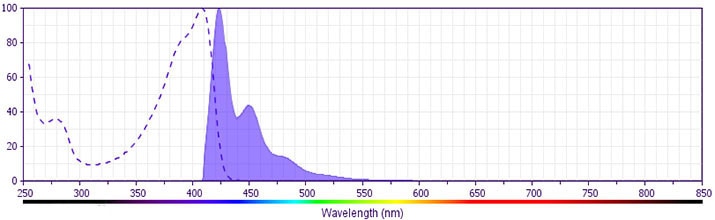
Streptavidin was conjugated to BD Horizon BV421 which is part of the BD Horizon Brilliant™ Violet family of dyes. With an Ex Max near 407 nm and Em Max near 421 nm, BD Horizon BV421 can be excited by the violet laser (405 nm) and detected with a 450/50 nm filter. BD Horizon BV421 conjugates are very bright, often exhibiting a 10 fold improvement in brightness compared to Pacific BlueTM conjugates. Due to nearly identical excitation and emission properties but different spillover characteristics, BD Horizon BV421, Pacific Blue, and BD Horizon V450 cannot be used simultaneously.
Development References (2)
-
Diamandis EP, Christopoulos TK. The biotin-(strept)avidin system: principles and applications in biotechnology. Clin Chem. 1991; 37(5):625-636. (Biology). View Reference
-
Shapiro HM. Practical flow cytometry, 4th ed.. Hoboken, N.J.: Wiley-Liss; 2003:1-681.
Please refer to Support Documents for Quality Certificates
Global - Refer to manufacturer's instructions for use and related User Manuals and Technical data sheets before using this products as described
Comparisons, where applicable, are made against older BD Technology, manual methods or are general performance claims. Comparisons are not made against non-BD technologies, unless otherwise noted.
For Research Use Only. Not for use in diagnostic or therapeutic procedures.
Refer to manufacturer's instructions for use and related User Manuals and Technical Data Sheets before using this product as described.
Comparisons, where applicable, are made against older BD technology, manual methods or are general performance claims. Comparisons are not made against non-BD technologies, unless otherwise noted.
