





The BD Rhapsody™ Sequence Analysis Pipeline is a versatile tool that offers the flexibility to run your bioinformatics analysis on either a Seven Bridges cloud-based platform or on a local installation.
The BD Rhapsody™ Sequence Analysis Pipeline:
- Provides a primary analysis of single-cell multiomics data by leveraging cutting-edge algorithms to deliver fast results and deep insights.
- Utilizes an intuitive user interface via a cloud-based platform and is easy to use, regardless of the computational expertise of the user.
- Offers the ability to choose between cloud-based or local installation options and affords maximum convenience and accessibility for single-cell multiomics data analysis.
- Provides broad compatibility of output data with downstream analysis tools such as Seurat and Scanpy.
The .Cellismo output files from the BD Rhapsody™ Sequence Analysis Pipeline can be imported into the BD Cellismo™ Data Visualization Tool for secondary analysis and visualization.
Pipeline Overview
After sequencing, the pipeline takes input from FASTQ files, a reference (Targeted panel or WTA / WTA+ATAC-Seq reference archive), an AbSeq reference (if required) and a supplemental reference (if required) to generate output files and metrics about the pipeline run.
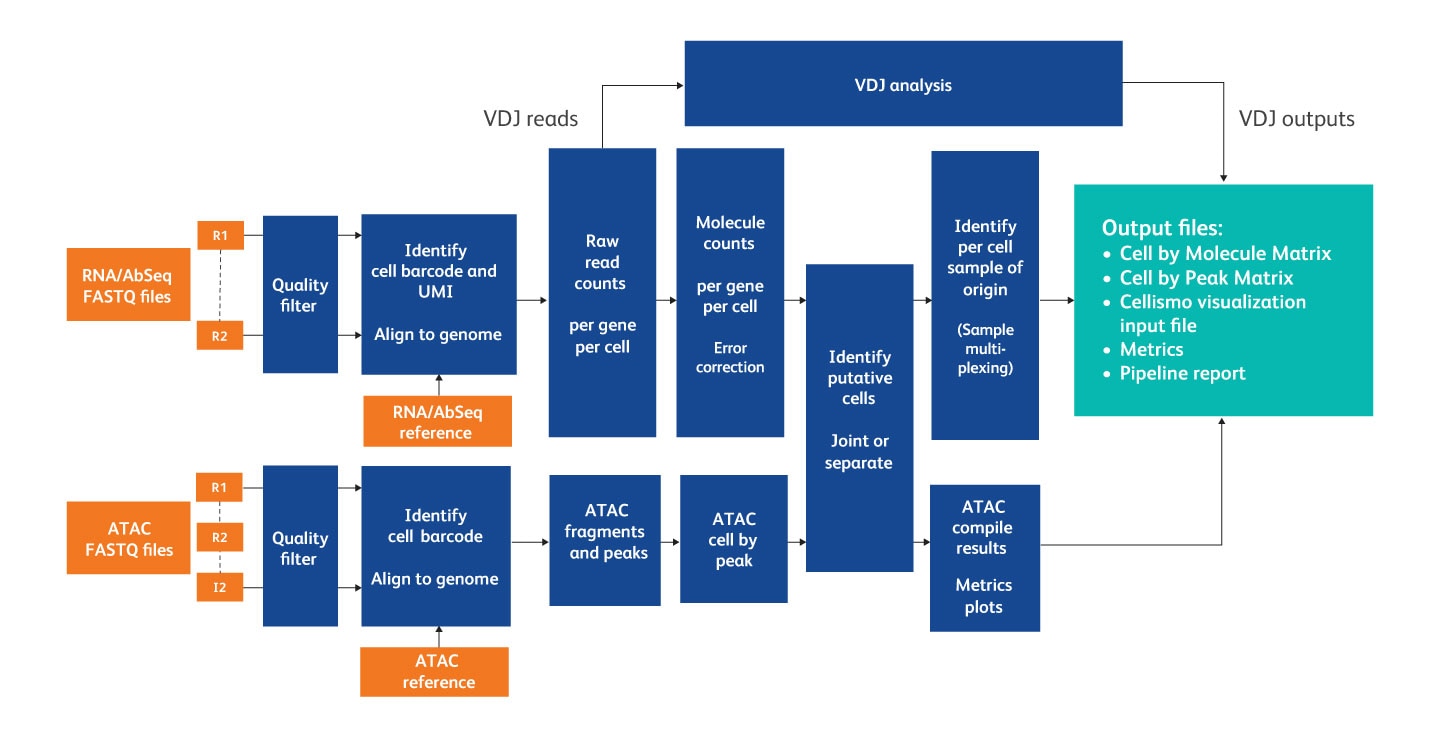
Overview of the steps in the analysis pipeline.
Features
- Free : Upload raw data, run the pipeline and download results from the cloud for free
- Fast: Less than 3 hours to process 1 billion reads
- Simple: One consolidated pipeline for BD Rhapsody™ Whole Transcriptome Analysis Amplification Kit, BD Rhapsody™ Targeted mRNA Kits, BD Rhapsody™ TCR/BCR Next Multiomic Assays and BD Rhapsody™ ATAC-Seq Assays
-
Current Version: v4.0 | Release date: September 2026
Added
- VDJ:
- New ‘airr’ modality in the Cellismo output file containing the contents of the dominant contigs AIRR file, so VDJ results can be imported directly into Cellismo.
- Clonotyping is now performed, adding a new ‘clone_id’ column to the AIRR Dominant Contigs and Unfiltered Contigs files
- Additional constant (C) region alignment columns in the AIRR outputs: ‘c_support’, ‘c_sequence_alignment’, ‘c_sequence_alignment_aa’, ‘c_sequence_start’ and ‘c_sequence_end’
- New pipeline parameter:
- ‘Multiple_Alignment_Handling’ controls how reads that align equally well to more than one gene are treated: ‘Discard’ (default, previous behavior) or ‘Uniform Random’, which assigns the read to one of the candidate genes at random
- ‘Multiple_Alignment_Gene_Selection’ controls which gene is chosen for reads that map to multiple genes, either through multiple genomic alignments or through a single alignment that falls within overlapping genes: ‘Any Overlap’ (default) or ‘Most Base Overlap’.
- Non-pseudogene alignment prioritization. Reads aligning to two or more genes will prefer non-pseudogenes: when a read overlaps both pseudogene and non-pseudogene features, the pseudogenes are removed before the multiple alignment handling strategy is applied
- Pipeline Report:
- New gene body coverage plot for WTA assays
- New bioproduct type count table summarizing counts by gene biotype, with the same information also written to a new ‘_biotypeCounts.csv’ output file
- TCR/BCR - top 10 clonotypes listed for each receptor type
- Make Rhapsody Reference tool:
- GTF and FASTA validation. GTFs are checked for missing or empty ‘gene_id’, ‘gene_name’ and transcript_id’ attributes and for structural problems such as transcripts and exons that reference a gene with no corresponding gene feature. FASTA files are checked to confirm they contain the contigs referenced in the GTF annotation
- New optional input ‘Repair_GTF’, which attempts to automatically repair common fixable GTF problems and uses the repaired annotation for downstream processing
- New optional input ‘GTF_Validation_Complete_Mode’, which reports every error and warning found in the GTF instead of stopping at the first fatal error
- New optional input ‘Disable_FASTA_Validation’, to bypass the contig compatibility check between the FASTA and GTF files in rare cases where this is intended
- New optional input ‘Combine_Same_Gene_Names’, which merges genes that share a gene name but have different gene IDs. When it is off (default), chromosome, start and strand information is appended to duplicated gene names to keep them distinct
Updated- VDJ:
- UMI error correction up to 4x faster with substantially reduced memory use
- In the Cellismo output file, the VDJ per-cell columns are now attached to the ‘airr’ modality instead of ‘rna’
- ATAC: ‘Mean_Reads_per_Cell’ and ‘Pct_Reads_from_Putative_Cells’ are now calculated from useful reads rather than all FASTQ reads, matching how the equivalent RNA metrics are calculated
- Improved library name and read type determination from FASTQ file names and improved handling of the read identifier when pairing FASTQ files
- Make Rhapsody Reference tool:
- Underscores and colons are now removed from contig names, since Seurat rejects underscores in feature names and colons cause problems with the IGV browser in the Cellismo viewer
- ‘Filter_PARs’ is now an optional input
- Cellismo file generation no longer requires UTR annotations to be present
Fixed- VDJ:
- Read trimming now fails immediately on a non-zero exit code and logs the failing command. Also limited to 8 threads to avoid exceeding the open file handle limit
- Possible corruption of the single read contigs file, which multiple writer threads could write to at the same time
- Invalid ‘contig_id’ error in ‘VDJ_Compile_Results’ when a downsampled FASTQ produced no assembly results and the input reads were used as contigs
- Failure in ‘VDJ_Compile_Results’ caused by missing values during deserialization
- Pipeline failure when a FASTQ file contained very long reads.
- Failure in ‘AlignmentAnalysis’ caused by an incorrect VDJ-only check, which could leave the mRNA valid read files ungenerated and crash ‘GetDataTables’
- Cell calling failure when the last point of the curve was the only minimum.
- Incorrect false positive cell count reported in the pipeline report and ‘_CellLabelAlgorithmStats.csv’ when the refined cell calling second step was skipped because too many cells were flagged as noise
- Divide-by-zero errors in the Sample Tag logs and metrics when no putative cells were called
- Failure to generate Seurat and Cellismo objects when bioproduct names in ‘_Bioproduct_Stats.csv’ did not match the feature names in the object, which occurred for references whose GTF has no gene names
- Targeted pipeline failure caused by bioproduct names that look like integers
- Pipeline failure when gene biotype filtering was turned off during reference generation
- Pipeline Report:
- The read flow Sankey diagram is now displayed when no cells are called
- The mRNA cell calling plot, joint cell calling plot, and gene body coverage plot are now displayed when no cells are jointly called
- Sankey diagram nodes could be connected incorrectly when a library name matched one of the diagram node names
- ATAC: pipeline failure when the reference GTF contained features with a missing gene biotype
- VDJ:
-
Previous Version: v3.0 | Release date: October 2025
Added
- ATAC:
- Gene Activity output—new modality in the .Cellismo output file and also a separate MEX output file. Gene activity is a Gene-by-Cell matrix, where counts are number of transposase cut sites in the gene body or 2,000 bases upstream of the gene start position
- Transcription factor motif output—new modality in the .Cellismo output file and also a separate MEX output file. This is a TFmotif-by-cell matrix, where values are z-scores of the enrichment of each TF motif
- VDJ
- New assembly algorithm improves speed of this step by up to 23 fold (range 7x-23x), enabling the processing of billions of TCR/BCR reads. Metrics are generally equivalent or slightly better.
- VDJ only pipeline—able to provide only TCR and/or BCR FASTQs and get a cell call and VDJ results. Sample multiplexing with VDJ only is also supported. VDJ in combination with a mRNA assay is still recommended for better cell calling and identification.
- New pipeline node to downsample data to calculate a sequencing saturation curve and median genes per cell curve, which are output on the pipeline report
- Make Rhapsody Reference tool:
- Added an optional input for Transcription Factor Motif PFM file
- Will now filter out readthrough transcripts and genes with only readthrough transcripts. Added optional parameter to turn off this filtering
- Added optional parameter to filter out Y chromosome Pseudo-Autosomal Regions from Human reference build 38
- Pipeline Report:
- New Read Flow diagram, showing a sankey diagram of read filtering steps for each library and for each of the RNA and/or ATAC modalities
- New Sequencing Saturation calculator to enable calculation of required total reads to achieve a target saturation value
Updated
- VDJ
- _VDJ_perCell.csv file CDR3 columns are updated to use CDR3 junction instead of CDR3 alone, resulting in the inclusion of canonical amino acids
- _VDJ_perCell.csv file added full length pairing columns
- New column in AIRR outputs "junction_anchored_aa"—a direct translation of only the CDR3 nucleotide sequence, not influenced by upstream frameshifts
- Update constant region gene identification to prevent mismatched chain types
- Removed PyIR wrapper and call IgBlast directly
- Basic putative cell calling algorithm updated to fix several edge cases and get more precise cell calls. Increase in putative cell number of ~1% is typical. Use of the Expected Cell Count parameter is highly encouraged
- Pipeline Report:
- Various metric alert updates
- Mean bioproducts per cell added to summary section
- Gene expression _MolsPerCell MEX output now contains Ensembl IDs as well as Gene symbols
- Improved library name determination from FASTQ file names
- More aggressive cleanup of polyA sequence in reads to prevent spurious alignments
- Make Rhapsody Reference tool: Extra Sequence input is now included in the BWA-Mem index
- Seven Bridges CWL: Instance types updated to be more performant, and increase size of instances for ATAC related nodes
- ATAC peak annotation now uses transcript features rather than gene features, which better classifies peaks when a gene has multiple transcription start sites
- .Cellismo output file now contains GTF data for genes
- Dimensionality reduction threshold updates: Below 100,000 cells, both t-SNE and UMAP coordinates are generated. Between 100,000 and 300,000 cells, only UMAP coordinates. Above 300,000 cells, a sub-sample of 300,000 cells will be selected and UMAP coordinates generated.
Fixed
- AlignmentAnalysis node was not getting an early cell count estimate, which could cause downstream node scaling issues
- TCR/BCR node failure when the number of valid TCR or BCR reads exceeded 2,147,483,647 reads
- Pipeline Report error when exact cell count parameter specified
- Pipeline Report error when CITE-seq/AbSeq only datasets are run
- Targeted RNA pipeline did not output a DBEC MEX file
- ATAC pipeline could get stuck in QualCLAlign_ATAC for some reference genomes with large numbers of contigs
- Rare issue where an ATAC peak could exceed the length of the contig on which it resides
- Improved handling chromosome names with unexpected characters
- Failure in GenerateSeurat node when there is only 1 AbSeq input
- Rare failure cause by poor quality read 1 data creating a race condition
- Rare failure in ATAC node caused by incorrect BWA-MEM2 binary selection
- ATAC pipeline failure when more than one ATAC library was present in the pipeline inputs
- ATAC pipeline failure when using sample tags or an "Extra seqs" input
- ATAC pipeline discrepancy in putative cell numbers in different output files.
- ATAC:
Get Free Access to the Pipeline
Cloud-Based Version
- Go to Velsera.com
- Click Request Access. In the request access window, enter your email address to receive an email invitation to the Seven Bridges Genomics platform within 24 hours.
- Click the link in the email invitation and complete the registration. Seven Bridges Genomics displays the dashboard with the demo projects.
Local Version
- Go to bitbucket.org/CRSwDev/cwl. If necessary, create a Bitbucket account.
- In the left pane, click Downloads > Download Repository. The CWL and YML files will download.
- Unzip the archive. Each folder within the archive is named after the pipeline version to which it corresponds.
-
User's Guide
(1)


For Research Use Only. Not for use in diagnostic or therapeutic procedures.