







Preparation And Storage


Recommended Assay Procedures
Sodium azide is a reversible inhibitor of oxidative metabolism; therefore, antibody preparations containing this preservative agent must not be used in cell cultures nor injected into animals. Sodium azide may be removed by washing stained cells or plate-bound antibody or dialyzing soluble antibody in sodium azide-free buffer. Since endotoxin may also affect the results of functional studies, we recommend the NA/LE™ antibody format for in vitro and in vivo use.
For IHC, we recommend the use of purified RA3-6B2 mAb in our special formulation for immunohistochemistry, Cat. No. 550286.
Product Notices
- Since applications vary, each investigator should titrate the reagent to obtain optimal results.
- Please refer to www.bdbiosciences.com/us/s/resources for technical protocols.
- Caution: Sodium azide yields highly toxic hydrazoic acid under acidic conditions. Dilute azide compounds in running water before discarding to avoid accumulation of potentially explosive deposits in plumbing.
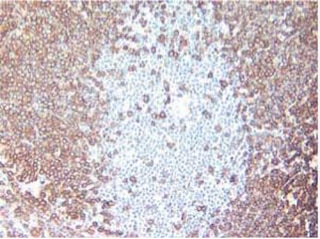
The RA3-6B2 monoclonal antibody specifically binds to an epitope on the extracellular domain of the transmembrane CD45 glycoprotein which is dependent upon the expression of exon A and specific carbohydrate residues. It is expressed on B lymphocytes at all stages from pro-B through mature and activated B cell, but it is decreased on plasma cells and a subset of memory B cells. The levels of CD45R expression on the B-cell lineage appear to be developmentally regulated. It is also reportedly found on the abnormal T cells involved in the lymphadenopathy of lpr/lpr and gld/gld mutant mice, on lytically active subsets of lymphokine-activated killer cells (NK cells and non-MHC-restricted CTL), on apoptotic T lymphocytes of mice injected with bacterial superantigen, on a population of NK-cell precursors in the bone marrow, and on B-lymphocyte, T-lymphocyte, and macrophage progenitors in fetal liver. The CD45R antigen has been reported not to be on hematopoietic stem cells, naive T lymphocytes, or MHC-restricted CTL. CD45 is a member of the Protein Tyrosine Phosphatase (PTP) family: Its intracellular (COOH-terminal) region contains two PTP catalytic domains, and the extracellular region is highly variable due to alternative splicing of exons 4, 5, and 6 (designated A, B, and C, respectively), plus differing levels of glycosylation. The CD45 isoforms detected in the mouse are cell type-, maturation, and activation state-specific. The CD45 isoforms play complex roles in T-cell and B-cell antigen receptor signal transduction. CD45R is commonly used as a pan B-cell marker; however, CD19 expression, detectable by the rat anti-mouse CD19 antibody (clone 1D3), is reported to be more restricted to the B-cell lineage. The rat anti-mouse CD45R antibody (clone RA3-6B2) has been reported to enhance isotype switching during in vitro B-cell responses and to inhibit in vivo B-cell responses. Cross-reaction of the RA3-6B2 clone with activated human T lymphocytes has also been reportedly observed.
This antibody is routinely tested by flow cytometric analysis. Other applications were tested at BD Biosciences Pharmingen during antibody development only or reported in the literature.
Development References (18)
-
Allman DM, Ferguson SE, Cancro MP. Peripheral B cell maturation. I. Immature peripheral B cells in adults are heat-stable antigenhi and exhibit unique signaling characteristics. J Immunol. 1992; 149(8):2533-2540. (Biology). View Reference
-
Asensi V, Kimeno K, Kawamura I, Sakumoto M, Nomoto K. Treatment of autoimmune MRL/lpr mice with anti-B220 monoclonal antibody reduces the level of anti-DNA antibodies and lymphadenopathies. Immunology. 1989; 68(2):204-208. (Biology). View Reference
-
Ballas ZK, Rasmussen W. Lymphokine-activated killer cells. VII. IL-4 induces an NK1.1+CD8 alpha+beta- TCR-alpha beta B220+ lymphokine-activated killer subset. J Immunol. 1993; 150(1):17-30. (Biology). View Reference
-
Bleesing JJ, Morrow MR, Uzel G, Fleisher TA. Human T cell activation induces the expression of a novel CD45 isoform that is analogous to murine B220 and is associated with altered O-glycan synthesis and onset of apoptosis. Cell Immunol. 2001; 213(1):72-81. (Biology). View Reference
-
Coffman RL. Surface antigen expression and immunoglobulin gene rearrangement during mouse pre-B cell development. Immunol Rev. 1982; 69:5-23. (Biology). View Reference
-
Domiati-Saad R, Ogle EW, Justement LB. Administration of anti-CD45 mAb specific for a B cell-restricted epitope abrogates the B cell response to a T-dependent antigen in vivo. J Immunol. 1993; 151(11):5936-5947. (Biology). View Reference
-
Driver DJ, McHeyzer-Williams LJ, Cool M, Stetson DB, McHeyzer-Williams MG. Development and maintenance of a B220- memory B cell compartment. J Immunol. 2001; 167(3):1393-1405. (Biology). View Reference
-
George A, Rath S, Shroff KE, Wang M, Durdik JM. Ligation of CD45 on B cells can facilitate production of secondary Ig isotypes. J Immunol. 1994; 152(3):1014-1021. (Biology). View Reference
-
Hardy RR, Carmack CE, Shinton SA, Kemp JD, Hayakawa K. Resolution and characterization of pro-B and pre-pro-B cell stages in normal mouse bone marrow. J Exp Med. 1991; 173(5):1213-1225. (Biology). View Reference
-
Hathcock KS, Hirano H, Murakami S, Hodes RJ. CD45 expression by B cells. Expression of different CD45 isoforms by subpopulations of activated B cells. J Immunol. 1992; 149(7):2286-2294. (Biology). View Reference
-
Johnson P, Maiti A, Ng DHW. CD45: A family of leukocyte-specific cell surface glycoproteins. In: Herzenberg LA, Weir DM, Herzenberg LA, Blackwell C , ed. Weir's Handbook of Experimental Immunology, Vol 2. Cambridge: Blackwell Science; 1997:62.1-62.16.
-
Kobata T, Takasaki K, Asahara H, et al. Apoptosis with FasL+ cell infiltration in the periphery and thymus of corrected autoimmune mice. Immunology. 1997; 92(2):206-213. (Biology). View Reference
-
Krop I, de Fougerolles AR, Hardy RR, Allison M, Schlissel MS, Fearon DT. Self-renewal of B-1 lymphocytes is dependent on CD19. Eur J Immunol. 1996; 26(1):238-242. (Biology). View Reference
-
Laouar Y, Ezine S. In vivo CD4+ lymph node T cells from lpr mice generate CD4-CD8-B220+TCR-beta low cells. J Immunol. 1994; 153(9):3948-3955. (Biology). View Reference
-
Puzanov IJ, Bennett M, Kumar V. IL-15 can substitute for the marrow microenvironment in the differentiation of natural killer cells. J Immunol. 1996; 157(10):4282-4285. (Biology). View Reference
-
Renno T, Hahne M, Tschopp J, MacDonald HR. Peripheral T cells undergoing superantigen-induced apoptosis in vivo express B220 and upregulate Fas and Fas ligand. J Exp Med. 1996; 183(2):431-437. (Biology). View Reference
-
Rolink A, ten Boekel E, Melchers F, Fearon DT, Krop I, Andersson J. A subpopulation of B220+ cells in murine bone marrow does not express CD19 and contains natural killer cell progenitors. J Exp Med. 1996; 183(1):187-194. (Biology). View Reference
-
Sagara S, Sugaya K, Tokoro Y, et al. B220 expression by T lymphoid progenitor cells in mouse fetal liver. J Immunol. 1997; 158(2):666-676. (Biology). View Reference
Please refer to Support Documents for Quality Certificates
Global - Refer to manufacturer's instructions for use and related User Manuals and Technical data sheets before using this products as described
Comparisons, where applicable, are made against older BD Technology, manual methods or are general performance claims. Comparisons are not made against non-BD technologies, unless otherwise noted.
For Research Use Only. Not for use in diagnostic or therapeutic procedures.
