







Preparation And Storage


Recommended Assay Procedures
BD® CompBeads can be used as surrogates to assess fluorescence spillover (compensation). When fluorochrome conjugated antibodies are bound to BD® CompBeads, they have spectral properties very similar to cells. However, for some fluorochromes there can be small differences in spectral emissions compared to cells, resulting in spillover values that differ when compared to biological controls. It is strongly recommended that when using a reagent for the first time, users compare the spillover on cells and BD® CompBeads to ensure that BD® CompBeads are appropriate for your specific cellular application.
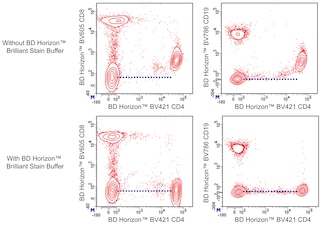
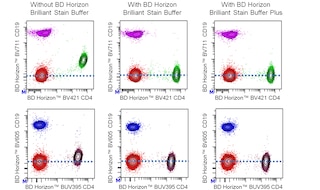
For optimal and reproducible results, BD Horizon Brilliant Stain Buffer should be used anytime BD Horizon Brilliant dyes are used in a multicolor flow cytometry panel. Fluorescent dye interactions may cause staining artifacts which may affect data interpretation. The BD Horizon Brilliant Stain Buffer was designed to minimize these interactions. When BD Horizon Brilliant Stain Buffer is used in in the multicolor panel, it should also be used in the corresponding compensation controls for all dyes to achieve the most accurate compensation. For the most accurate compensation, compensation controls created with either cells or beads should be exposed to BD Horizon Brilliant Stain Buffer for the same length of time as the corresponding multicolor panel. More information can be found in the Technical Data Sheet of the BD Horizon Brilliant Stain Buffer (Cat. No. 563794/566349) or the BD Horizon Brilliant Stain Buffer Plus (Cat. No. 566385).
Product Notices
- Please refer to www.bdbiosciences.com/us/s/resources for technical protocols.
- Since applications vary, each investigator should titrate the reagent to obtain optimal results.
- An isotype control should be used at the same concentration as the antibody of interest.
- Caution: Sodium azide yields highly toxic hydrazoic acid under acidic conditions. Dilute azide compounds in running water before discarding to avoid accumulation of potentially explosive deposits in plumbing.
- For fluorochrome spectra and suitable instrument settings, please refer to our Multicolor Flow Cytometry web page at www.bdbiosciences.com/colors.
- The production process underwent stringent testing and validation to assure that it generates a high-quality conjugate with consistent performance and specific binding activity. However, verification testing has not been performed on all conjugate lots.
- Researchers should determine the optimal concentration of this reagent for their individual applications.
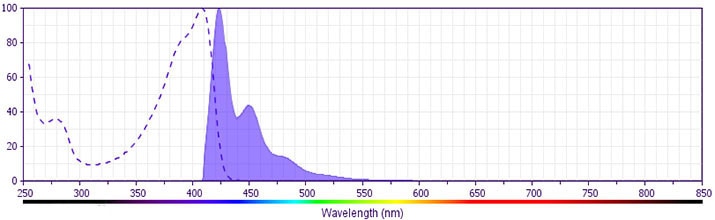
- BD Horizon Brilliant Violet 421 is covered by one or more of the following US patents: 8,158,444; 8,362,193; 8,575,303; 8,354,239.
- BD Horizon Brilliant Stain Buffer is covered by one or more of the following US patents: 8,110,673; 8,158,444; 8,575,303; 8,354,239.
- Human donor specific background has been observed in relation to the presence of anti-polyethylene glycol (PEG) antibodies, developed as a result of certain vaccines containing PEG, including some COVID-19 vaccines. We recommend use of BD Horizon Brilliant™ Stain Buffer in your experiments to help mitigate potential background. For more information visit https://www.bdbiosciences.com/en-us/support/product-notices.
- Please refer to http://regdocs.bd.com to access safety data sheets (SDS).
- Pacific Blue™ is a trademark of Life Technologies Corporation.
Companion Products
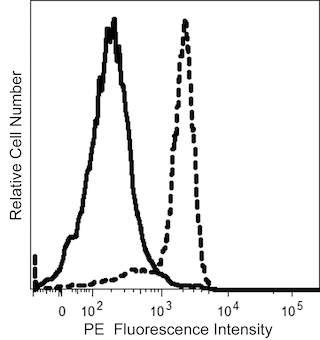
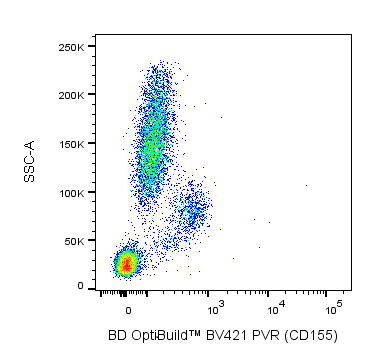
The TX24 monoclonal antibody specifically binds to the Poliovirus Receptor (PVR) which is also known as CD155, Nectin-like protein 5 (NECL5). PVR is a ~70 kDa nectin-like type I transmembrane glycoprotein that belongs to the PVR-related (PRR) family within the Ig superfamily. In addition to two cell surface PVR isoforms (alpha and delta), two secreted PVR isoforms (beta and gamma) have been reported that share the same three Ig domains but differ in their C-termini. PVR is expressed on monocytes, macrophages, endothelial cells, epithelia cells, CD34+ thymocytes, and neurons. In addition to serving as a receptor for poliovirus and cytomegalovirus, PVR functions as an adhesion molecule involved in cell-cell and cell-matrix adhesion through interaction with CD96 (TACTILE), Nectin 1-3 (CD111, CD112, CD113), CD226, and vitronectin. PVR promotes natural killer (NK) cell adhesion to and lysis of target cells.
Development References (5)
-
Freistadt MS, Eberle KE. CD155 (poliovirus receptor) Workshop Panel Report. In: Knapp W. W. Knapp .. et al., ed. Leucocyte typing IV : white cell differentiation antigens. Oxford New York: Oxford University Press; 1989:1075-1078.
-
Freistadt MS, Fleit HB, Wimmer E.. Poliovirus receptor on human blood cells: a possible extraneural site of poliovirus replication. Virology. 1993; 195(2):798-803. (Biology). View Reference
-
Fuchs A, Cella M, Giurisato E, Shaw AS, Colonna M. Cutting edge: CD96 (tactile) promotes NK cell-target cell adhesion by interacting with the poliovirus receptor (CD155).. J Immunol. 2004; 172(7):3994-8. (Biology). View Reference
-
Pende D, Bottino C, Castriconi R, et al. PVR (CD155) and Nectin-2 (CD112) as ligands of the human DNAM-1 (CD226) activating receptor: involvement in tumor cell lysis.. Mol Immunol. 2005; 42(4):463-9. (Biology). View Reference
-
Tahara-Hanaoka S, Shibuya K, Onoda Y et al. Functional characterization of DNAM-1 (CD226) interaction with its ligands PVR (CD155) and nectin-2 (PRR-2/CD112). Int Immunol. 2006; 16(4):533-538. (Clone-specific: Flow cytometry, Functional assay, Inhibition). View Reference
Please refer to Support Documents for Quality Certificates
Global - Refer to manufacturer's instructions for use and related User Manuals and Technical data sheets before using this products as described
Comparisons, where applicable, are made against older BD Technology, manual methods or are general performance claims. Comparisons are not made against non-BD technologies, unless otherwise noted.
For Research Use Only. Not for use in diagnostic or therapeutic procedures.
