







Preparation And Storage


Product Notices
- This reagent has been pre-diluted for use at the recommended Volume per Test. We typically use 1 × 10^6 cells in a 100-µl experimental sample (a test).
- An isotype control should be used at the same concentration as the antibody of interest.
- Source of all serum proteins is from USDA inspected abattoirs located in the United States.
- Caution: Sodium azide yields highly toxic hydrazoic acid under acidic conditions. Dilute azide compounds in running water before discarding to avoid accumulation of potentially explosive deposits in plumbing.
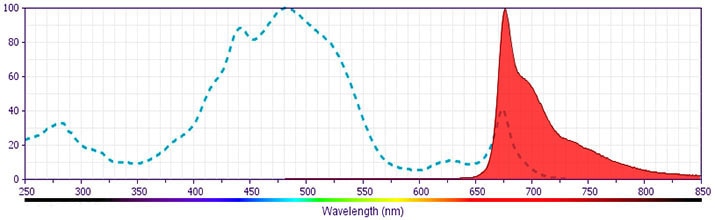
- PerCP-Cy5.5–labelled antibodies can be used with FITC- and R-PE–labelled reagents in single-laser flow cytometers with no significant spectral overlap of PerCP-Cy5.5, FITC, and R-PE fluorescence.
- PerCP-Cy5.5 is optimized for use with a single argon ion laser emitting 488-nm light. Because of the broad absorption spectrum of the tandem fluorochrome, extra care must be taken when using dual-laser cytometers, which may directly excite both PerCP and Cy5.5™. We recommend the use of cross-beam compensation during data acquisition or software compensation during data analysis.
- Please observe the following precautions: Absorption of visible light can significantly alter the energy transfer occurring in any tandem fluorochrome conjugate; therefore, we recommend that special precautions be taken (such as wrapping vials, tubes, or racks in aluminum foil) to prevent exposure of conjugated reagents, including cells stained with those reagents, to room illumination.
- For fluorochrome spectra and suitable instrument settings, please refer to our Multicolor Flow Cytometry web page at www.bdbiosciences.com/colors.
- Cy is a trademark of GE Healthcare.
- Please refer to www.bdbiosciences.com/us/s/resources for technical protocols.
Companion Products

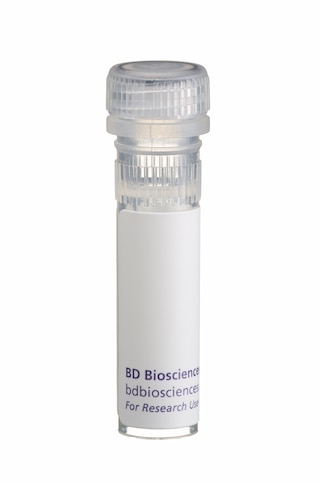
The DCN46 antibody specifically binds to dendritic cell-specific ICAM-3 grabbing nonintegrin (DC-SIGN or CD209), a type-II membrane protein of approximately 44 kDa with a mannose-binding C-type lectin domain. It is highly expressed on dendritic cells in mucosal tissues. Its sequence is identical to the HIV-1 envelope gp120-binding C-type lectin, and reports suggest that DC-SIGN binds to HIV-1 gp120 and effectively transmits infectious HIV-1 to resting T lymphocytes expressing CD4 and chemokine receptors. The C-type lectin domain of DC-SIGN is also capable of binding other pathogenic viruses, bacteria, and parasites. Reports also suggest that DC-SIGN enables the highly efficient migration of dendritic cells from blood into the tissues. It can interact with ICAM-2, which has a similar sequence as ICAM-3, and is abundantly expressed on vascular and lymphoid endothelium. Thus, DC-SIGN mediates dendritic cells rolling and transendothelial migration, and its interaction with ICAM-2 is essential to specific migratory functions of dendritic cells.
Development References (5)
-
Appelmelk BJ, van Die I, van Vliet SJ, et al. Carbohydrate profiling identifies new pathogens that interact with dendritic cell-specific ICAM-3-grabbing nonintegrin on dendritic cells. J Immunol. 2003; 170(4):1635-1639. (Biology). View Reference
-
Gruber A, Chalmers AS, Popov S, Ruprecht RM. Functional aspects of binding of monoclonal antibody DCN46 to DC-SIGN on dendritic cells.. Immunol Lett. 2002; 84(2):103-8. (Clone-specific). View Reference
-
Sallusto F, Cella M, Danieli C, Lanzavecchia A. Dendritic cells use macropinocytosis and the mannose receptor to concentrate macromolecules in the major histocompatibility complex class II compartment: downregulation by cytokines and bacterial products. J Exp Med. 1995; 182(2):389-400. (Immunogen). View Reference
-
Steinman RM, Granelli-Piperno A, Pope M, et al. The interaction of immunodeficiency viruses with dendritic cells. Curr Top Microbiol Immunol. 2003; 276:1-30. (Biology). View Reference
-
Steinman RM. DC-SIGN: a guide to some mysteries to dendritic cells. Cell. 2000; 100(5):491-494. (Biology). View Reference
Please refer to Support Documents for Quality Certificates
Global - Refer to manufacturer's instructions for use and related User Manuals and Technical data sheets before using this products as described
Comparisons, where applicable, are made against older BD Technology, manual methods or are general performance claims. Comparisons are not made against non-BD technologies, unless otherwise noted.
For Research Use Only. Not for use in diagnostic or therapeutic procedures.
