Dear Customer, If you experience any text readability or display issues on our website, please update your web browser to the latest version
.
See More
Dear Customer, If you experience any text readability or display issues on our website, please update your web browser to the latest version
.
See MoreDear Customer, If you experience any text readability or display issues on our website, please update your web browser to the latest version
.
This page has been recently translated and is available in French now.
Looks like you're visiting us from {countryName}.
Would you like to stay on the current location site or be switched to your location?
Any use of products other than the permitted use without the express written authorization of Becton, Dickinson and Company is strictly prohibited.
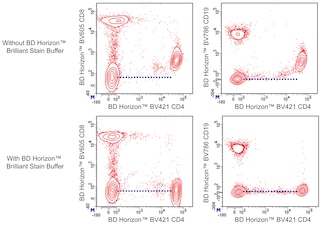
For optimal and reproducible results, BD Horizon Brilliant Stain Buffer should be used anytime two or more BD Horizon Brilliant dyes (including BD OptiBuild Brilliant reagents) are used in the same experiment. Fluorescent dye interactions may cause staining artifacts which may affect data interpretation. The BD Horizon Brilliant Stain Buffer was designed to minimize these interactions. More information can be found in the Technical Data Sheet of the BD Horizon Brilliant Stain Buffer (Cat. No. 563794).
The 1G9 monoclonal antibody specifically binds to T cell immunoreceptor with Ig and ITIM domains (TIGIT) which is also known as, V-set and transmembrane domain-containing protein 3 (Vstm3). TIGIT is a 26 kDa, type I transmembrane glycoprotein that belongs to the poliovirus receptor (PVR) family. TIGIT is expressed on activated and memory CD4+ T cells and CD8+ T cells, follicular T helper cells, regulatory T cells, and NK cells. Its ligands include the poliovirus receptor (PVR, aka, CD155), poliovirus receptor-related protein 2 (PVRL2, aka, CD112), and poliovirus receptor-related protein 3 (PVRL3, CD113). TIGIT functions as a negative regulator of T cell and NK cell responses including proliferation, cytotoxicity, and the production of proinflammatory cytokines. TIGIT-deficient mice are reportedly more susceptible to developing autoimmune diseases in certain model systems.
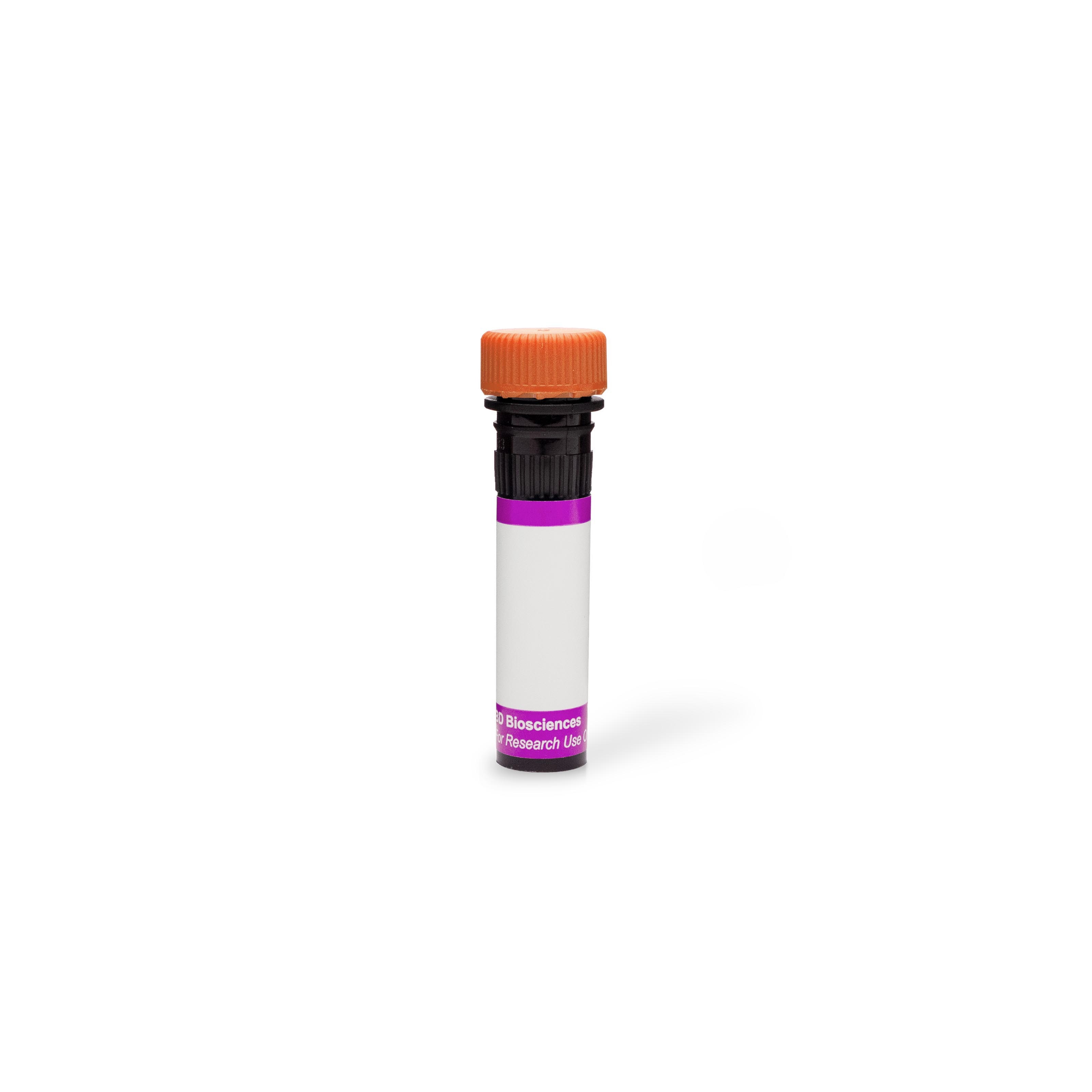
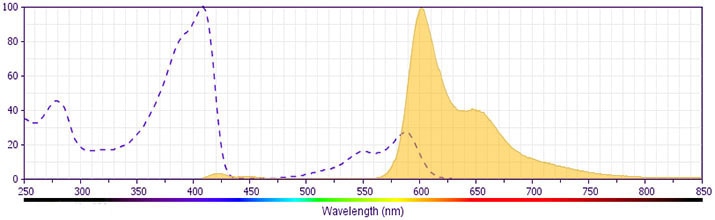
This antibody is conjugated to BD Horizon™ BV605 which is part of the BD Horizon Brilliant™ Violet family of dyes. With an Ex Max of 407-nm and Em Max of 602-nm, BD Horizon BV605 can be excited by a violet laser and detected with a standard 610/20-nm filter set. BD Horizon BV605 is a tandem fluorochrome of BD Horizon BV421 and an acceptor dye with an Em max at 605-nm. Due to the excitation of the acceptor dye by the green (532 nm) and yellow-green (561 nm) lasers, there will be significant spillover into the PE and BD Horizon PE-CF594 detectors off the green or yellow-green lasers. BD Horizon BV605 conjugates are very bright, often exhibiting brightness equivalent to PE conjugates and can be used as a third color off of the violet laser.
Please refer to Support Documents for Quality Certificates
Global - Refer to manufacturer's instructions for use and related User Manuals and Technical data sheets before using this products as described
Comparisons, where applicable, are made against older BD Technology, manual methods or are general performance claims. Comparisons are not made against non-BD technologies, unless otherwise noted.
Please refer to Support Documents for Quality Certificates
Global - Refer to manufacturer's instructions for use and related User Manuals and Technical data sheets before using this products as described
Comparisons, where applicable, are made against older BD Technology, manual methods or are general performance claims. Comparisons are not made against non-BD technologies, unless otherwise noted.
For Research Use Only. Not for use in diagnostic or therapeutic procedures.