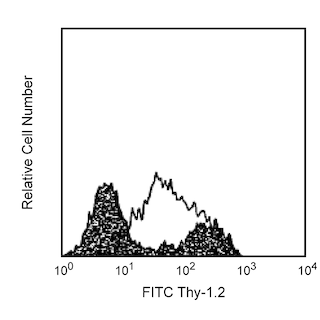
The CXCR3-173 monoclonal antibody specifically binds to mouse CD183, also known as CXCR3. CD183 is a seven transmembrane spanning, G protein-coupled chemokine receptor for CXC chemokines including CXCL9 (Mig), CXCL10 (IP-10) and CXCL11 (I-TAC). These chemokines are induced by inflammatory cytokines including IFN-γ, IFN-α/β, and TNF. CXCR3 is primarily expressed on activated/memory CD4+ and CD8+ T lymphocytes, Foxp+ regulatory T cells, natural killer T (NKT) cells and mature NK cells. Binding of chemokines to CXCR3 induces integrin activation, cytoskeletal changes, and chemotactic migration of activated lymphocytes. CD183 has been reported to play important roles in T cell recruitment and immune responses in a number of inflammatory and autoimmune diseases. The CXCR3-173 antibody reportedly inhibited in vitro chemotactic responses to CXCL10 or CXCL11 significantly but not to CXCL9. When administered systemically to mouse hosts, the CXCR3-173 antibody reportedly prolonged cardiac and pancreatic islet cell allograft survival. In the presence of CXCR3 ligands, especially, CXCL10 and CXCL11, staining with the antibody can be significantly blocked.
The antibody was conjugated to BD Horizon™ BUV661 which is part of the BD Horizon Brilliant™ Ultraviolet family of dyes. This dye is a tandem fluorochrome of BD Horizon BUV395 with an Ex Max of 348-nm and an acceptor dye with an Em Max at 661-nm. BD Horizon Brilliant BUV661 can be excited by the ultraviolet laser (355 nm) and detected with a 670/25 filter and a 630 nm LP. Due to cross laser excitation of this dye, there may be significant spillover into channels detecting APC-like emissions (eg, 670/25-nm filter).
Due to spectral differences between labeled cells and beads, using BD™ CompBeads can result in incorrect spillover values when used with BD Horizon BUV661 reagents. Therefore, the use of BD CompBeads or BD CompBeads Plus to determine spillover values for these reagents is not recommended. Different BUV661 reagents (eg, CD4 vs. CD45) can have slightly different fluorescence spillover therefore, it may also be necessary to use clone-specific compensation controls when using these reagents.