





BD Pharmingen™ Purified Mouse Anti-Human MLH1
Clone G168-728 (RUO)


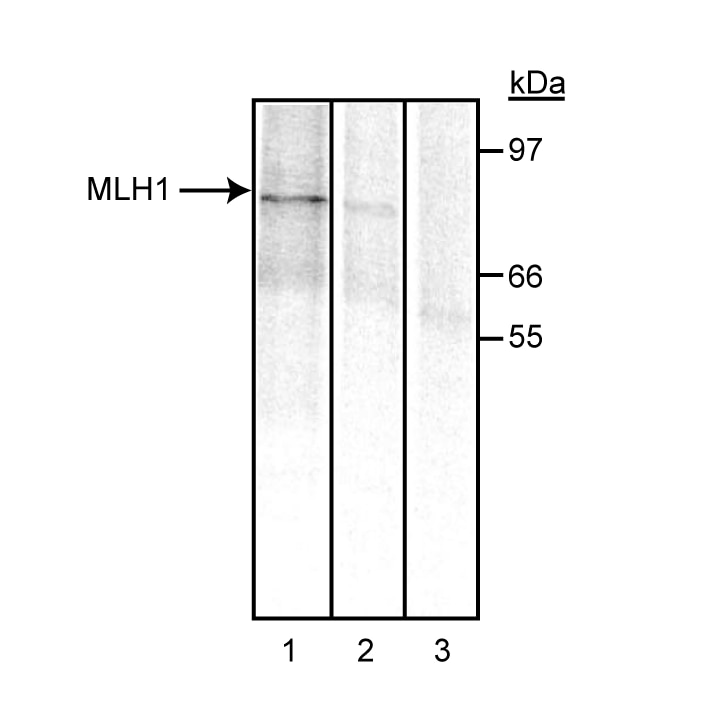
Immunoprecipitation of MLH1. Two different monoclonal antibodies were used to immunoprecipitate MLH1 from equal amounts of whole cell extracts of NIH/3T3 mouse cells. Lane 1, a strong MLH1 band was seen with clone G168-728. Lane 2, only a faint band was seen using clone G168-15. Lane 3, an IgG2a isotype control.
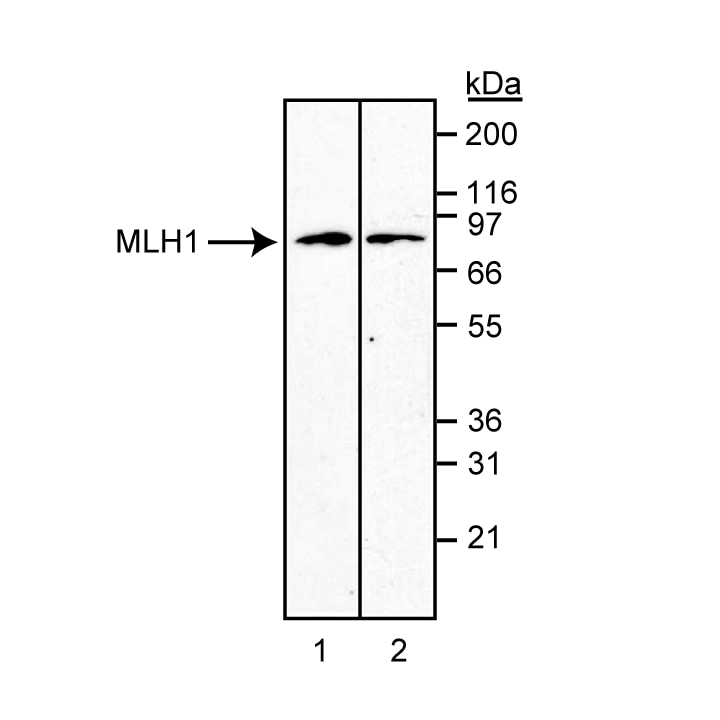
Western blot analysis of MLH1. 30 µg of 293 cell lysate per lane was probed with 3 µg/ml (lane 1) or 1 µg/ml (lane 2) of anti- MLH1 antibody (clone G168-728).
Immunoprecipitation of MLH1. Two different monoclonal antibodies were used to immunoprecipitate MLH1 from equal amounts of whole cell extracts of NIH/3T3 mouse cells. Lane 1, a strong MLH1 band was seen with clone G168-728. Lane 2, only a faint band was seen using clone G168-15. Lane 3, an IgG2a isotype control.
Western blot analysis of MLH1. 30 µg of 293 cell lysate per lane was probed with 3 µg/ml (lane 1) or 1 µg/ml (lane 2) of anti- MLH1 antibody (clone G168-728).


Preparation And Storage


Recommended Assay Procedures
Applications include immunoprecipitation (2 µg/1x106 cells) and western blot analysis (1-3 µg/ml). MCF-7 human breast carcinoma (ATCC HTB-22), 293 adenovirustransformed human kidney (ATCC CRL-1673), and NIH/3T3 mouse fibroblast (ATCC CRL-1658) cells are suggested as positive controls. Clone G168-15 (Cat. No. 13271A) is suggested for immunohistochemical analysis of MLH1; clone G168-15 may also be stronger for western blot analysis than clone G168-728 in some assay systems.
Product Notices
- Since applications vary, each investigator should titrate the reagent to obtain optimal results.
- Please refer to www.bdbiosciences.com/us/s/resources for technical protocols.
- Caution: Sodium azide yields highly toxic hydrazoic acid under acidic conditions. Dilute azide compounds in running water before discarding to avoid accumulation of potentially explosive deposits in plumbing.
The repair of mismatched DNA is essential to maintaining the integrity of genetic information over time. Loss of function of DNA repair enzymes can lead to an accumulation of replication errors, resulting in a mutated phenotype. DNA repair enzymes are highly conserved from bacteria to yeast to mammals. In yeast the proteins are called MutS homolog 2 (MSH2), MutL homolog (MLH1), and PMS1 which is also a homolog of MutL. MSH2 is involved in the initial recognition of mismatched nucleotides during the replication mismatch repair process. It is thought that after MSH2 binds to a mismatched DNA duplex, it is joined by a heterodimer of MLH1 and PMS1 which together help facilitate the later steps in mismatch repair. The G168-728 antibody recognizes human and mouse MLH1 (80-85 kDa). Full-length human recombinant MLH was expressed as a maltose binding-MLH fusion protein, affinity purified, and used as immunogen.
Development References (3)
-
Baker SM, Plug AW, Prolla TA. Involvement of mouse Mlh1 in DNA mismatch repair and meiotic crossing over. Nat Genet. 1996; 13(3):336-342. (Clone-specific: Immunoprecipitation). View Reference
-
Prolla TA, Christie DM, Liskay RM. Dual requirement in yeast DNA mismatch repair for MLH1 and PMS1, two homologs of the bacterial mutL gene. Mol Cell Biol. 1994; 14(1):407-415. (Biology). View Reference
-
Prolla TA, Pang Q, Alani E, Kolodner RD, Liskay RM. MLH1, PMS1, and MSH2 interactions during the initiation of DNA mismatch repair in yeast. Science. 1994; 265(5175):1091-1093. (Biology). View Reference
Please refer to Support Documents for Quality Certificates
Global - Refer to manufacturer's instructions for use and related User Manuals and Technical data sheets before using this products as described
Comparisons, where applicable, are made against older BD Technology, manual methods or are general performance claims. Comparisons are not made against non-BD technologies, unless otherwise noted.
For Research Use Only. Not for use in diagnostic or therapeutic procedures.