





BD Pharmingen™ Alexa Fluor® 647 Mouse anti-β-Tubulin, Class III
Clone TUJ1 (RUO)


Analysis of Alexa Fluor® 647 Anti-Human Class III tubulin on Neurons. H9 human embryonic stem (ES) cells (WiCell, Madison, WI) were differentiated into Neural Precursor cells (NPCs) and grown for 4 passages before differentiating into neurons and glia for 12 days. The cells were fixed with BD Cytofix™ Fixation Buffer (Cat. No. 554655) for 20 minutes at room temperature, permeabilized with BD Phosflow™ Perm/Wash Buffer I (Cat. No. 557885), and then stained with either Alexa Fluor® 647 Mouse nti-β-Tubulin, Class III (Cat. No 560394; Right Histogram) or Alexa Fluor® 647 Mouse IgG2a Isotype Control (Cat. No. 558053; Left Histogram). This antibody also works with BD Phosflow™ Perm Buffer II and III. Flow cytometry was performed on a BD FACSCanto™ II flow cytometry system.
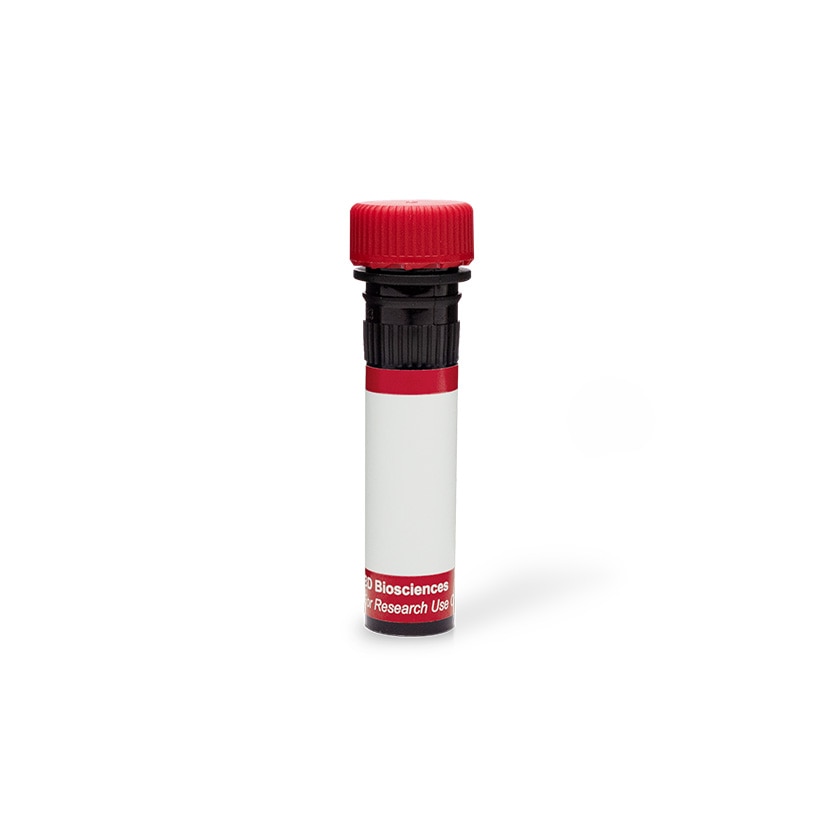
Analysis of Alexa Fluor® 647 Anti-Human Class III tubulin on Neurons. H9 human embryonic stem (ES) cells (WiCell, Madison, WI) were differentiated into Neural Precursor cells (NPCs) and grown for 4 passages before differentiating into neurons and glia for 12 days. The cells were fixed with BD Cytofix™ Fixation Buffer (Cat. No. 554655) for 20 minutes at room temperature, permeabilized with BD Phosflow™ Perm/Wash Buffer I (Cat. No. 557885), and then stained with either Alexa Fluor® 647 Mouse nti-β-Tubulin, Class III (Cat. No 560394; Right Histogram) or Alexa Fluor® 647 Mouse IgG2a Isotype Control (Cat. No. 558053; Left Histogram). This antibody also works with BD Phosflow™ Perm Buffer II and III. Flow cytometry was performed on a BD FACSCanto™ II flow cytometry system.


Preparation And Storage


Product Notices
- Please refer to www.bdbiosciences.com/us/s/resources for technical protocols.
- This reagent has been pre-diluted for use at the recommended Volume per Test. We typically use 1 × 10^6 cells in a 100-µl experimental sample (a test).
- Alexa Fluor® 647 fluorochrome emission is collected at the same instrument settings as for allophycocyanin (APC).
- Alexa Fluor® is a registered trademark of Molecular Probes, Inc., Eugene, OR.
- The Alexa Fluor®, Pacific Blue™, and Cascade Blue® dye antibody conjugates in this product are sold under license from Molecular Probes, Inc. for research use only, excluding use in combination with microarrays, or as analyte specific reagents. The Alexa Fluor® dyes (except for Alexa Fluor® 430), Pacific Blue™ dye, and Cascade Blue® dye are covered by pending and issued patents.
- For fluorochrome spectra and suitable instrument settings, please refer to our Multicolor Flow Cytometry web page at www.bdbiosciences.com/colors.
- Source of all serum proteins is from USDA inspected abattoirs located in the United States.
- Caution: Sodium azide yields highly toxic hydrazoic acid under acidic conditions. Dilute azide compounds in running water before discarding to avoid accumulation of potentially explosive deposits in plumbing.
- An isotype control should be used at the same concentration as the antibody of interest.
- This reagent has been pre-diluted for use at the recommended Volume per Test when following the Recommended Assay Procedure. A Test is typically ~10,000 cells cultured in a well of a 96-well imaging plate.
Companion Products


Microtubules are formed by the self assembly of tubulin and are one of the major components of the eukaryotic cytoskeleton. The two main tubulin isoforms, α - and ß-tubulin, are usually products of separate genes. The ß-tubulin family includes six expressed genes that produce the polypeptide isoforms known as Classes I through VI, each of which have a distinct pattern of expression. Class III ß-tubulin is found in neurons and mammalian testis cells and is widely used as a neuronal marker in developmental neurobiology, neoplasia, and stem cell research. Class III ß-tubulin expression in neuronal and neuroblastic tumors is differentiation dependent, and its expression in certain non-neuronal neoplasms has been associated with poor prognosis and/or resistance to chemotherapy.

Development References (3)
-
Geisert EE Jr, Frankfurter A. The neuronal response to injury as visualized by immunostaining of class III beta-tubulin in the rat. Neurosci Lett. 1989; 102(2-3):137-141. (Clone-specific: Immunohistochemistry). View Reference
-
Katsetos CD, Del Valle L, Geddes JF et al. Aberrant localization of the neuronal class III beta-tubulin in astrocytomas. Arch Pathol Lab Med. 2001; 125(5):613-624. (Clone-specific: Immunocytochemistry (cytospins)). View Reference
-
Mozzetti S, Ferlini C, Concolino P et al. Class III beta-tubulin overexpression is a prominent mechanism of paclitaxel resistance in ovarian cancer patients. Clin Cancer Res. 2005; 11(1):298-305. (Clone-specific: Immunohistochemistry). View Reference
Please refer to Support Documents for Quality Certificates
Global - Refer to manufacturer's instructions for use and related User Manuals and Technical data sheets before using this products as described
Comparisons, where applicable, are made against older BD Technology, manual methods or are general performance claims. Comparisons are not made against non-BD technologies, unless otherwise noted.
For Research Use Only. Not for use in diagnostic or therapeutic procedures.