Dear Customer, If you experience any text readability or display issues on our website, please update your web browser to the latest version
.
See More
Dear Customer, If you experience any text readability or display issues on our website, please update your web browser to the latest version
.
See MoreDear Customer, If you experience any text readability or display issues on our website, please update your web browser to the latest version
.
This page has been recently translated and is available in French now.
Looks like you're visiting us from {countryName}.
Would you like to stay on the current location site or be switched to your location?
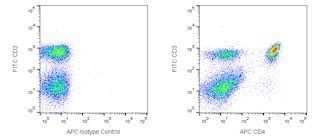
Multicolor flow cytometric analysis of mouse CD184 (CXCR4) expression on BALB/c thymocytes. BALB/c thymocytes were stained with APC Rat Anti-Mouse CD4 antibody (Cat. No. 553051) and with either BD Horizon™ BV421 Rat IgG2b Isotype Control (Cat. No. 562603, Left Panel) or BD Horizon™ BV421 Rat Anti-Mouse CD184 antibody (Cat. No. 562738, Right Panel). The two color fluorescent dot plots were derived from gated events based on the light scattering characteristics for viable thymocytes. Flow cytometry was performed using a BD™ LSR II Flow Cytometry System.
Any use of products other than the permitted use without the express written authorization of Becton, Dickinson and Company is strictly prohibited.
The 2B11/CXCR4 monoclonal antibody specifically binds to mouse CD184, which is also known as the C-X-C Chemokine Receptor type 4 , CXCR4. CXCR4 (previously known as Fusin and LESTR), is a seven-transmembrane, G-protein-coupled receptor. It is the specific receptor for the CXC chemokine, SDF-1/CXCL12. Mouse CXCR4 shows 91% homology at the amino acid level with human CXCR4. CXCR4 is widely expressed by hematopoietic and non-hematopoietic cell types including neutrophils, monocytes, T cells, B cells, CD34-positive progenitor cells, endothelial cells, neurons and astrocytes. Human CXCR4 is used by T-tropic HIV-1 as a co-receptor for viral entry. The mouse Cxcr4 gene has been mapped to chromosome 1.
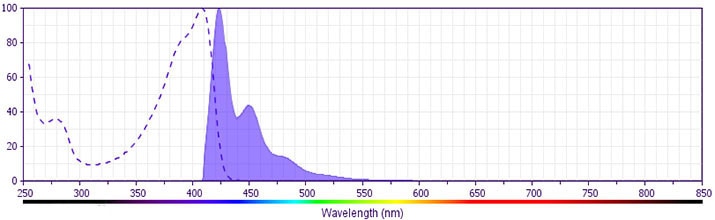
The antibody was conjugated to BD Horizon™ BV421 which is part of the BD Horizon™ Brilliant Violet™ family of dyes. With an Ex Max of 407-nm and Em Max at 421-nm, BD Horizon™ BV421 can be excited by the violet laser and detected in the standard Pacific Blue™ filter set (eg, 450/50-nm filter). BD Horizon™ BV421 conjugates are very bright, often exhibiting a 10 fold improvement in brightness compared to Pacific Blue™ conjugates.
Please refer to Support Documents for Quality Certificates
Global - Refer to manufacturer's instructions for use and related User Manuals and Technical data sheets before using this products as described
Comparisons, where applicable, are made against older BD Technology, manual methods or are general performance claims. Comparisons are not made against non-BD technologies, unless otherwise noted.
For Research Use Only. Not for use in diagnostic or therapeutic procedures.