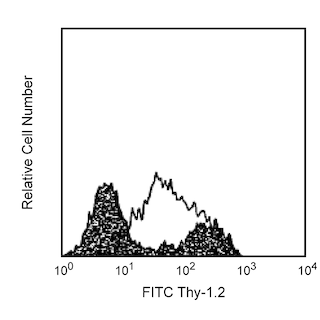
The M290 antibody specificaly binds to CD103, the α chain of αIELβ7 integrin. CD103 has a unique and fairly restricted tissue distribution. It is expressed on almost all intestinal intraepithelial lymphocytes (IEL), dendritic epidermal T cells (DEC), subpopulations of peripheral T cells, and distinct subsets of fetal, neonatal, and adult thymocytes. E-cadherin is the epithelial cell ligand for αIELβ7 integrin. The ordered expression of αIEL during thymocyte development (which occurs under the influence of the thymic epithelium), high level of αIEL expression on peripheral T cells in epithelial tissues (IEL and DEC), and expression of CD103 on a subset of CD8+ lymphocytes responding to allogeneic epithelial cells, suggest that αIELβ7 integrin may have a common role in the interactions of T lymphocytes with epithelia during T-cell maturation and effector functions. CD103 is thought to play a role in allograft rejection. The M290 antibody is reported to efficiently inhibit αIELβ7-mediated adhesion in in vitro assays.
The antibody was conjugated to BD Horizon™ BUV661 which is part of the BD Horizon Brilliant™ Ultraviolet family of dyes. This dye is a tandem fluorochrome of BD Horizon BUV395 with an Ex Max of 348-nm and an acceptor dye with an Em Max at 661-nm. BD Horizon Brilliant BUV661 can be excited by the ultraviolet laser (355 nm) and detected with a 670/25 filter and a 630 nm LP. Due to cross laser excitation of this dye, there may be significant spillover into channels detecting APC-like emissions (eg, 670/25-nm filter).
Due to spectral differences between labeled cells and beads, using BD™ CompBeads can result in incorrect spillover values when used with BD Horizon BUV661 reagents. Therefore, the use of BD CompBeads or BD CompBeads Plus to determine spillover values for these reagents is not recommended. Different BUV661 reagents (eg, CD4 vs. CD45) can have slightly different fluorescence spillover therefore, it may also be necessary to use clone-specific compensation controls when using these reagents.