Dear Customer, If you experience any text readability or display issues on our website, please update your web browser to the latest version
.
See More
Dear Customer, If you experience any text readability or display issues on our website, please update your web browser to the latest version
.
See MoreDear Customer, If you experience any text readability or display issues on our website, please update your web browser to the latest version
.
This page has been recently translated and is available in French now.
Looks like you're visiting us from {countryName}.
Would you like to stay on the current location site or be switched to your location?
Any use of products other than the permitted use without the express written authorization of Becton, Dickinson and Company is strictly prohibited.
For optimal results, it is recommended to perform 2 washes after staining with antibodies. Cells may be prepared, stained with antibodies and washed twice with wash buffer per established protocols for immunofluorescence staining, prior to acquisition on a flow cytometer. Performing fewer than the recommended wash steps may lead to increased spread of the negative population.
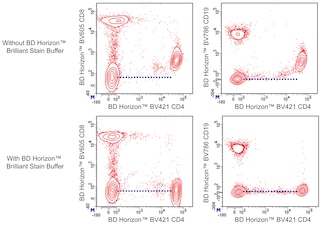
For optimal and reproducible results, BD Horizon Brilliant Stain Buffer should be used anytime two or more BD Horizon Brilliant dyes are used in the same experiment. Fluorescent dye interactions may cause staining artifacts which may affect data interpretation. The BD Horizon Brilliant Stain Buffer was designed to minimize these interactions. More information can be found in the Technical Data Sheet of the BD Horizon Brilliant Stain Buffer (Cat. No. 563794/566349).
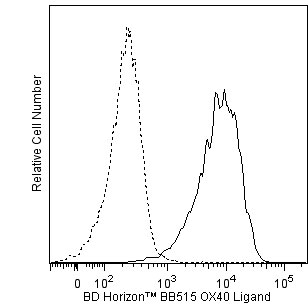
The RM134L antibody reacts with CD252 (OX-40 Ligand, OX-40L), a member of the NGF/TNF superfamily which is present on antigen-presenting cells and activated B lymphocytes. OX-40L interacts with OX-40 Antigen (CD134) found predominantly on activated T cells. This ligand-receptor pair is grouped with pairs such as CD40-CD40L and CD80- or CD86-CD28, which contribute significantly to B-cell/T-cell interaction during the immune response. The OX-40L-OX-40 interaction is reciprocally costimulatory in that both T cells and B cells are activated in cross-linking. Stimulation via OX-40 Antigen increases the proliferative and IL-2 production responses of activated T cells, while stimulation via OX-40L enhances proliferation and Ig secretion by activated B cells. The RM134L mAb stains B cells activated for four days with anti-IgM plus anti-CD40 (Clone HM40-3) antibodies. An increased binding of OX-40-Ig fusion protein to mouse splenic B cells was observed when B cells were treated with lipopolysaccharide (LPS), suggesting that OX-40L expression is augmented in LPS-activated splenic B cells when compared to resting cells, but this observation could not be confirmed with the RM134L mAb. In addition, other studies with OX-40-Ig fusion protein detected OX-40L on CD4+ and CD8+ activated splenic T cells, but OX-40L was not detected on T cells with the RM134L mAb. Similar results have been reported by others. The RM134L mAb inhibits the binding of OX-40-Ig fusion protein to OX-40L transfectants and blocks the costimulatory activity of OX-40L.
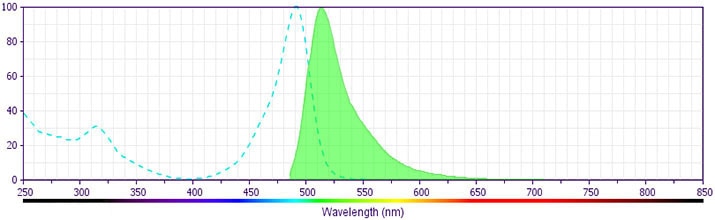
The antibody was conjugated to BD Horizon BB515 which was developed exclusively by BD Biosciences. With an excitation max of 490 nm and an emission max of 515 nm, BD Horizon BB515 can be excited by the 488 nm laser and detected in a standard FITC set (e.g. 530/30-nm filter). This dye provides a much brighter alternative to FITC with less spillover into the PE detector.
Please refer to Support Documents for Quality Certificates
Global - Refer to manufacturer's instructions for use and related User Manuals and Technical data sheets before using this products as described
Comparisons, where applicable, are made against older BD Technology, manual methods or are general performance claims. Comparisons are not made against non-BD technologies, unless otherwise noted.
For Research Use Only. Not for use in diagnostic or therapeutic procedures.