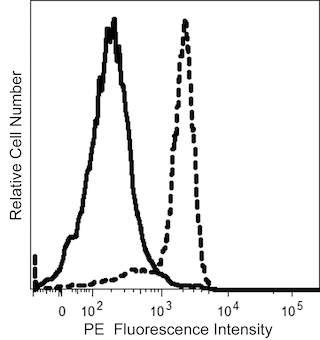
The NOK-1 monoclonal antibody specifically recognizes CD178. Fas (CD95; APO-1) is a 45 kDa cell surface protein that mediates apoptosis when cross-linked with agonistic anti-Fas antibodies or by Fas ligand (FasL; CD178). Fas belongs to the TNF (Tumor Necrosis Factor)/NGF (Nerve Growth Factor) receptor family, and is expressed in various tissues and cells including the thymus, liver, ovary and lung. CD178 (FasL), a member of the TNF cytokine family, induces apoptosis by binding to Fas, its cell-surface receptor. FasL may exist as either membrane bound or soluble forms and is expressed by activated T and NK cells. FasL may also be constitutively expressed in some immunologically privileged sites, e.g., eye and testis. Fas and FasL play an important role in the induction of apoptosis, and thus regulate a variety of immunological responses.
The NOK-1 antibody clone has been reported to recognize human FasL, recognizing both the membrane bound (FasL) and soluble (sFasL) forms. It is reported that the epitope for NOK-1 has been mapped to the COOH-terminus of FasL, at the region implicated in Fas binding. FasL and sFasL have been reported to migrate at reduced molecular weights of 40 and 26 kDa, respectively. However, the molecular weights observed in a particular sample may vary according to FasL and sFasL glycosylation and breakdown patterns as described in the literature. The NOK-1 antibody clone is not recommended for the Western blot application.
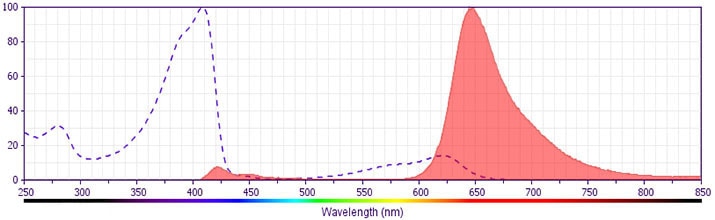
The antibody was conjugated to BD Horizon™ BV650 which is part of the BD Horizon Brilliant™ Violet family of dyes. This dye is a tandem fluorochrome of BD Horizon BV421 with an Ex Max of 405-nm and an acceptor dye with an Em Max at 650-nm. BD Horizon BV650 can be excited by the violet laser and detected in a filter used to detect APC-like dyes (eg, 660/20-nm filter). Due to the excitation and emission characteristics of the acceptor dye, there will be spillover into the APC and Alexa Fluor® 700 detectors. However, the spillover can be corrected through compensation as with any other dye combination.