





.png)


Preparation And Storage


Product Notices
- Since applications vary, each investigator should titrate the reagent to obtain optimal results.
- Please refer to www.bdbiosciences.com/us/s/resources for technical protocols.
- Caution: Sodium azide yields highly toxic hydrazoic acid under acidic conditions. Dilute azide compounds in running water before discarding to avoid accumulation of potentially explosive deposits in plumbing.
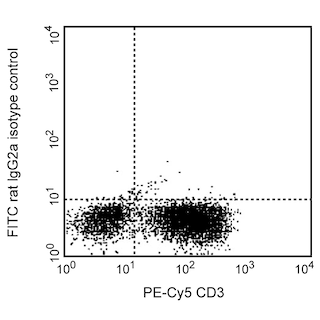
The H129.19 monoclonal antibody specifically binds to the CD4 (L3T4) differentiation antigen expressed on thymocytes, a subpopulation of mature T lymphocytes (i.e., MHC class II-restricted T cells, including most T helper cells), and a subset of NK-T cells of all mouse strains tested. CD4 has also been detected on pluirpotent hematopoietic stem cells, bone marrow myeloid precursors, intrathymic lymphoid precursors, and a subset of splenic dendritic cells. CD4 is expressed on the plasma membrane of mouse egg cells and is involved in adhesion of the egg to MHC class II-bearing sperm. CD4 is an antigen coreceptor on the T-cell surface which interacts with MHC class II molecules on antigen-presenting cells. It participates in T-cell activation through its association with the T-cell receptor complex and protein tyrosine Lck. The H129.19 antibody blocks binding of the anti-mouse CD4 antibodies GK1.5 and RM4-5, but not RM4-4 antibody. mAb H129.19 inhibits various responses of T helper cells to antigenic or mitogenic stimuli.
This antibody is routinely tested by flow cytometric analysis. Other applications were tested at BD Biosciences Pharmingen during antibody development only or reported in the literature.
Development References (16)
-
BD Biosciences Pharmingen. Unpublished results. .
-
Bendelac A. Mouse NK1+ T cells. Curr Opin Immunol. 1995; 7(3):367-374. (Biology). View Reference
-
Bierer BE, Sleckman BP, Ratnofsky SE, Burakoff SJ. The biologic roles of CD2, CD4, and CD8 in T-cell activation. Annu Rev Immunol. 1989; 7:579-599. (Biology). View Reference
-
Frederickson GG, Basch RS. L3T4 antigen expression by hemopoietic precursor cells. J Exp Med. 1989; 169(4):1473-1478. (Biology). View Reference
-
Ghobrial RR, Boublik M, Winn HJ, Auchincloss H Jr. In vivo use of monoclonal antibodies against murine T cell antigens. Clin Immunol Immunopathol. 1989; 52(3):486-506. (Clone-specific: Depletion). View Reference
-
Godfrey DI, Kennedy J, Mombaerts P, Tonegawa S, Zlotnik A. Onset of TCR-β gene rearrangement and role of TCR-β expression during CD3-CD4-CD8- thymocyte differentiation. J Immunol. 1994; 152(10):4783-4792. (Biology). View Reference
-
Guo MW, Watanabe T, Mori E, Mori T. Molecular structure and function of CD4 on murine egg plasma membrane. Zygote. 1995; 3(1):65-73. (Clone-specific: Blocking). View Reference
-
Janeway CA Jr. The T cell receptor as a multicomponent signalling machine: CD4/CD8 coreceptors and CD45 in T cell activation. Annu Rev Immunol. 1992; 10:645-674. (Biology). View Reference
-
Martin P, del Hoyo GM, Anjuere F, et al. Concept of lymphoid versus myeloid dendritic cell lineages revisited: both CD8alpha(-) and CD8alpha(+) dendritic cells are generated from CD4(low) lymphoid-committed precursors. Blood. 2000; 96(7):2511-2519. (Biology). View Reference
-
Naquet P, Malissen B, Bekkhoucha F, et al. L3T4 but not LFA-1 participates in antigen presentation by Ak-positive L-cell transformants. Immunogenetics. 1985; 22(3):247-256. (Clone-specific: Blocking). View Reference
-
Pierres A, Naquet P, Van Agthoven A, et al. A rat anti-mouse T4 monoclonal antibody (H129.19) inhibits the proliferation of Ia-reactive T cell clones and delineates two phenotypically distinct (T4+, Lyt-2,3-, and T4-, Lyt-2,3+) subsets among anti-Ia cytolytic T cell clones. J Immunol. 1984; 132(6):2775-2782. (Immunogen: Blocking, Immunoprecipitation). View Reference
-
Pont S, Regnier-Vigouroux A, Marchetto S, Pierres M. Accessory molecules and T cell activation. II. Antibody binding to L3T4a inhibits Ia-independent mouse T cell proliferation. Eur J Immunol. 1987; 17(3):429-432. (Clone-specific: Blocking). View Reference
-
Regnier-Vigouroux A, Blanc D, Pont S, Marchetto S, Pierres M. Accessory molecules and T cell activation. I. Antigen receptor avidity differentially influences T cell sensitivity to inhibition by monoclonal antibodies to LFA-1 and L3T4. J Immunol. 1986; 16(11):1385-1390. (Clone-specific: Blocking). View Reference
-
Wineman JP, Gilmore GL, Gritzmacher C, Torbett BE, Muller-Sieburg CE. CD4 is expressed on murine pluripotent hematopoietic stem cells. Blood. 1992; 180(7):1717-1724. (Biology). View Reference
-
Wu L, Antica M, Johnson GR, Scollay R, Shortman K. Developmental potential of the earliest precursor cells from the adult mouse thymus. J Exp Med. 1991; 174(6):1617-1627. (Biology). View Reference
-
Wu L, Scollay R, Egerton M, Pearse M, Spangrude GJ, Shortman K. CD4 expressed on earliest T-lineage precursor cells in the adult murine thymus. Nature. 1991; 349(6304):71-74. (Biology). View Reference
Please refer to Support Documents for Quality Certificates
Global - Refer to manufacturer's instructions for use and related User Manuals and Technical data sheets before using this products as described
Comparisons, where applicable, are made against older BD Technology, manual methods or are general performance claims. Comparisons are not made against non-BD technologies, unless otherwise noted.
For Research Use Only. Not for use in diagnostic or therapeutic procedures.
