


BD™ SpectraComp™ Unmixing and Compensation Particles are the brightest among leading competitor beads, delivering uniform signals for accurate compensation and spectral unmixing. Designed to simplify workflow setup, they combine positive and negative particles with κ/λ light chain binding and multi-species reactivity against up to 5 species (mouse, rat, hamster, rabbit, and human) in a single vial.
Why Choose BD™ SpectraComp™ Beads?
Simplify compensation and spectral unmixing with a single control designed for flexibility and performance. BD™ SpectraComp™ Unmixing and Compensation Particles combine bright, uniform signals, broad species and antibody compatibility, and workflow-friendly buffer support to help deliver reliable results across a wide range of flow cytometry research applications.
- Provide bright and uniform signals for accurate compensation and spectral unmixing.
- Eliminate species-specific controls with reactivity against up to 5 species (mouse, rat, hamster, human and rabbit) in a single vial.
- Expand antibody compatibility by binding both κ- and λ-light-chain-bearing immunoglobulins.
- Support compensation and spectral unmixing with proven performance.
- Work with your preferred fluorochromes and staining protocols, with compatibility across BD fluorochromes, BD Horizon™ Brilliant Stain Buffer and other commonly used lysis and fix/perm buffers.
- Cell-like scatter characteristics and autofluorescence.
- Compatible with analyzers and cell sorters.
Competitor Comparison
Brighter Signal and Well-Resolved Positive Population Enable Accurate Compensation and Unmixing
Brighter signal of the positive compensation beads ensures improved separation between positive and negative populations, enabling more precise determination of spillover and spectral signatures. The resulting increase in signal-to-noise resolution helps improve the accuracy and robustness of compensation and spectral unmixing calculations, particularly in multi-parameter and spectral flow cytometry workflows.
See how BD™ SpectraComp™ Beads compare to other beads
We compared BD™ SpectraComp™ XT Unmixing and Compensation Particles with human PBMCs and other commercially available beads (Thermo Fisher UltraComp eBeads™ Spectral Unmixing Beads and UltraComp eBeads™ Plus Compensation Beads, and BioLegend Compensation Beads) across twenty different fluorochromes. As shown below, BD™ SpectraComp™ XT Particles exhibited the highest median fluorescence intensity (MFI) compared with PBMCs and other commercially available compensation controls, for all dye formats tested.
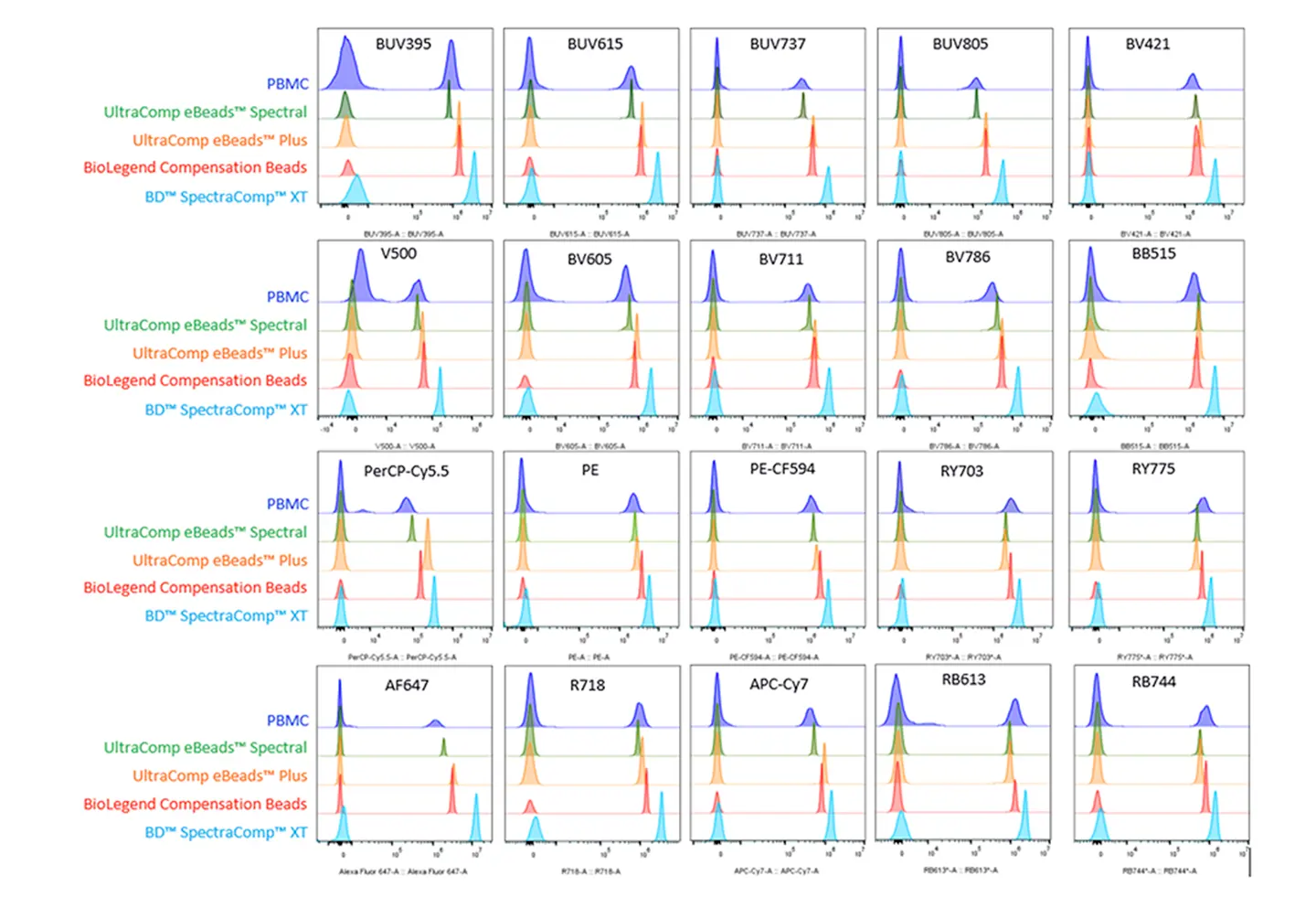
Brightness comparison of BD™ SpectraComp™ XT Particles with competitor beads.
Human PBMC were stained with twenty CD4 (SK3) fluorochromes ranging across five lasers, and over the emission spectrum. The same fluorochromes were used to stain, per manufacturers protocol, different compensation particles. All beads were stained with the same concentration of antibody (0.125 μg for all but RY703 and RY775 which were stained with 0.25 μg). Cells were stained with optimal concentration for CD4 (0.06 μg). Samples were run on a BD FACSDiscover™ A8 Cell Analyzer and analyzed with FlowJo™ Software. Results are plotted in overlayed histograms demonstrating relative brightness of all samples.
BD™ SpectraComp™ Unmixing and Compensation Particles were evaluated for fluorescence brightness with other commercially available beads (Thermo Fisher UltraComp eBeads™ Spectral Unmixing Beads and UltraComp eBeads™ Plus Compensation Beads, and BioLegend Compensation Beads) using FITC-conjugated antibodies from mouse, rat and hamster species. Data below demonstrates that BD™ SpectraComp™ Particles exhibited the highest MFI.
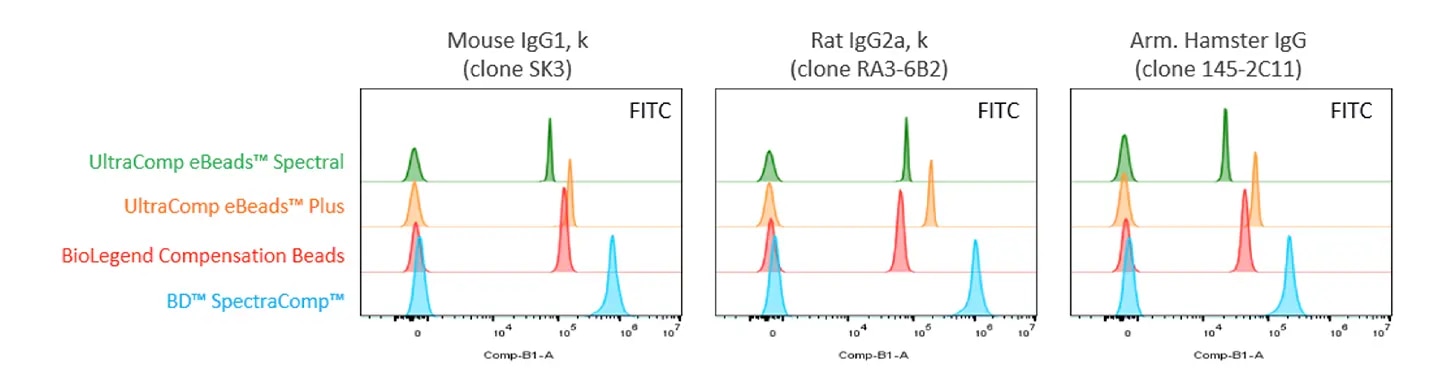
Brightness comparison of BD™ SpectraComp™ Particles with competitor beads.
BD™ SpectraComp™ Unmixing and Compensation Particles, Thermo Fisher UltraComp eBeads™ Spectral Unmixing Beads and Plus Compensation Beads, and BioLegend Compensation Beads were stained, per manufacturers’ protocol, with FITC-conjugated antibodies from mouse, rat and hamster species. All beads were stained with the same concentration of antibody (0.125 μg). Samples were run on a Cytek® Aurora and analyzed with FlowJo™ Software. Results are plotted in overlayed histograms demonstrating relative brightness of all samples.
Product Catalog
BD™ SpectraComp™ Unmixing and Compensation Particles Selection Guide
BD™ SpectraComp™ Beads are multi-species particles that support mouse, rat and hamster antibodies. If your panel also includes human- or rabbit-derived antibodies, choose BD™ SpectraComp™ XT Particles for expanded reactivity. BD™ SpectraComp™ Beads support both conventional compensation and spectral unmixing workflows, delivering reliable performance across traditional and spectral flow cytometry platforms.
| Product | Reactivity | Format | Light chain recognized |
|---|---|---|---|
| BD™ SpectraComp™ Unmixing and Compensation Particles | Mouse, Rat, Hamster (Armenian, Syrian) | Single vial with both positive and negative beads | Kappa & lambda |
| BD™ SpectraComp™ XT Unmixing and Compensation Particles | Human, Rabbit, Mouse, Rat, Hamster (Armenian, Syrian) | Single vial with both positive and negative beads | Kappa & lambda |
Ready to Order? Choose from 3 and 5-species beads
Product Usage
How to Use BD™ SpectraComp™ Unmixing and Compensation Particles?
Getting started with BD™ SpectraComp™ Unmixing and Compensation Particles is straightforward. They are designed to integrate into existing workflows and have been validated with a broad range of products. Find the recommended protocol and compatibility information below.
BD™ SpectraComp™ Beads Protocol
Before you begin: For accurate compensation or spectral unmixing, process BD™ SpectraComp™ Unmixing and Compensation Particles exactly like your cell samples, including all fixation, lysis, permeabilization and BD Horizon™ Brilliant Stain Buffer steps (where applicable).
- Prepare bead controls. Prepare one single-color control for each fluorochrome-conjugated reagent, plus an unstained or negative control as appropriate. Add the selected compensation or spectral unmixing beads to each tube or well.
- Add the fluorochrome-conjugated reagent. Add the matching antibody or reagent using an amount predetermined by an optimization test to provide clear positive-negative separation, with a positive bead signal that is equal to or brighter than the biological sample but remains on scale.
- Match the sample workflow. Process stained bead controls using the same relevant buffers and preparation steps as the experimental samples, such as staining buffer, lysis, fixation or permeabilization.
- Wash, resuspend and acquire. Wash and resuspend the bead controls, then acquire each control using the same instrument settings planned for the experimental samples. Gate on the appropriate bead population by scatter parameters and confirm that fluorescence signals remain on scale before generating the matrix.
- Generate and verify the matrix. Gate on the appropriate positive and negative bead populations to generate the matrix. If the in-tube negative population does not support accurate matrix generation, a universal negative bead population may be used as an alternative. Check accuracy with an NxN matrix to confirm appropriate fluorescence correction for all fluorochromes in the panel.
For a more detailed protocol, please refer to the BD™ SpectraComp™ Particles and BD™ SpectraComp™ XT Particles Technical Data Sheets.
Compatible with Multiple Instruments, Buffers and Fluorochromes
BD™ SpectraComp™ Beads can be easily integrated into existing workflows, as they have been tested on a wide range of flow cytometers, fluorochromes, and staining and preparation buffers.
Review BD™ SpectraComp™ Beads performance data
Instrument compatibility
BD™ SpectraComp™ Beads are compatible with most analyzers and sorters, including the BD LSRFortessa™ Cell Analyzer, BD FACSymphony™ A5 SE Cell Analyzer, BD FACSLyric™ Clinical Flow Cytometry System, BD FACSDiscover™ A8 Cell Analyzer, BD FACSDiscover™ S8 Cell Sorter, BD FACSAria™ Fusion Flow Cytometer and also Cytek® Aurora Flow Cytometer.
Buffer compatibility
- BD Horizon™ Brilliant Stain Buffer
- BD FACS™ Lysing Solution
- BD Pharm Lyse™ Lysing Buffer
- BD Cytofix/Cytoperm™ Fixation/Permeabilization Kit
- BD Cytofix™ Fixation Buffer
- BD Pharmingen™ Transcription Factor Buffer Set
- BD Phosflow™ Perm Buffer III
Fluorochrome compatibility
BD™ SpectraComp™ Beads have been tested with most legacy fluorochromes, BD Horizon™ Brilliant Dyes and BD Horizon Real Dyes (RealViolet™, RealYellow™, RealBlue™, RealRed™). As with any compensation control, each individual antibody conjugate should be tested to confirm compatibility before use.
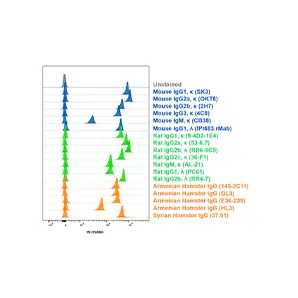
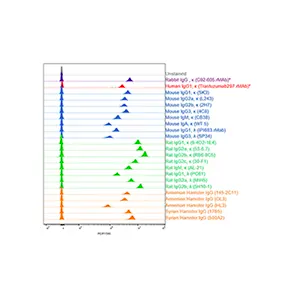
Autofluorescence
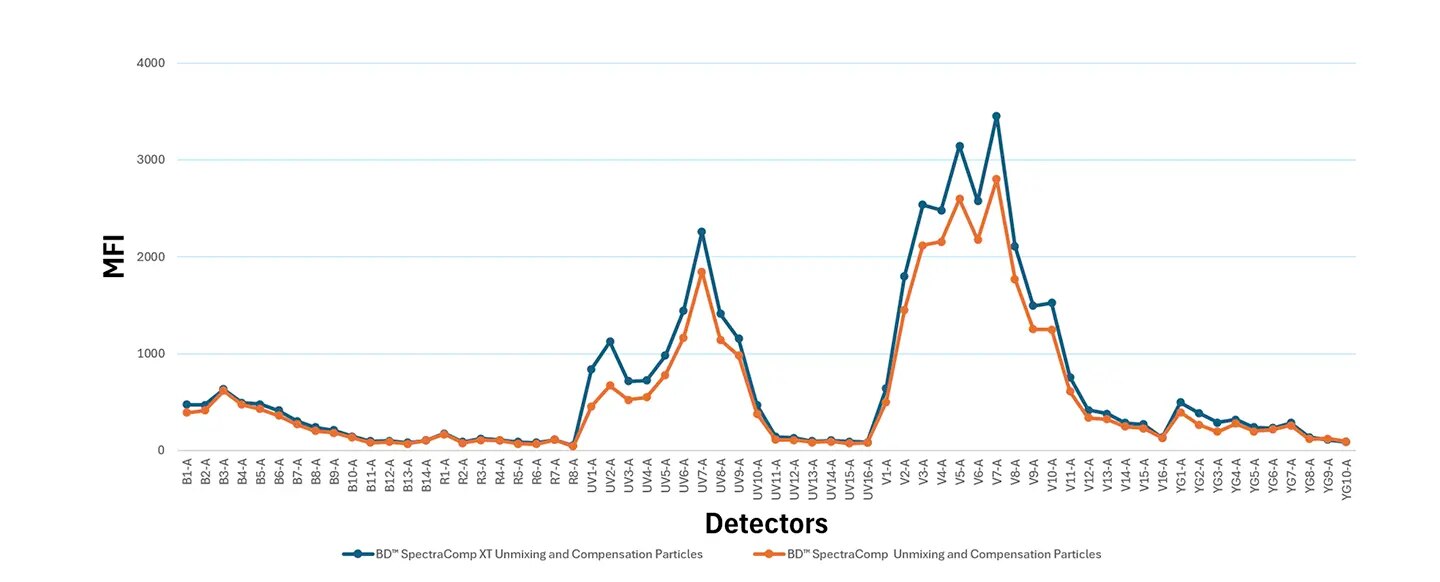

Panels using BD™ SpectraComp™ Unmixing and Compensation Particles
T cell backbone Panel
Human whole blood was stained with the BD Horizon™ T Cell Backbone Panel along with four additional drop-in markers to identify and interrogate T cell subsets. Single-color controls were prepared using BD™ SpectraComp™ Unmixing and Compensation Particles and used to generate the compensation matrix. Single-color stained cells were analyzed in a NxN matrix to evaluate the compensation accuracy of the compensation matrix. The T cell subsets were then analyzed based on differential expression of CD45RA and CD197 and showed proper resolution of populations.
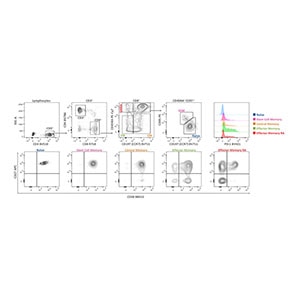
Identification of differentiated human T cell subsets
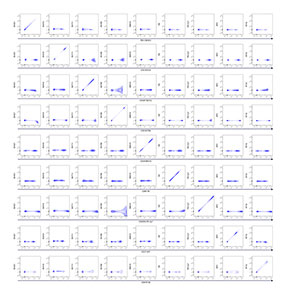
N×N matrix for single-color cell samples compensated using BD™ SpectraComp™ Unmixing and Compensation Particles.
List of Reagents in a 9-color T cell Panel
| Marker | Clone | Fluorochrome | Cat No. | ||
|---|---|---|---|---|---|
| CD3 | UCHT1 | BV510 | 568263 | BD Horizon™ Human T Cell Backbone Panel | |
| CD4 | SK3 | BV786 | |||
| CD8 | RRPA-T8 | R718 | |||
| CD45RA | HI100 | PE-Cy7 | |||
| CD197(CCR7) | 2-L1-A | BV711 | |||
| CD95 | DX2 | PE | 555647 | ||
| PD-1 | EH12.1 | BV421 | 562516 | ||
| CD27 | M-T271 | APC | 558664 | ||
| CD28 | CD28.2 | BB515 | 564492 |
Human whole blood from a normal donor was stained with the BD Horizon™ Human T Cell Backbone Panel and four drop-in markers to generate the data shown below.
32-color immunophenotyping panel
A 32-color broad immunophenotyping panel was used to stain human PBMCs from a healthy donor. BD™ SpectraComp™ Unmixing and Compensation Particles were used as single-color controls instead of cells for BV605, BV786, BV711 and RY568 due to low cell frequency and variable expression of those markers. Assessment of these fluorochromes in NxN matrices revealed insignificant unmixing errors that did not affect the analysis of the target populations of B cells, NK cells and dendritic cells.
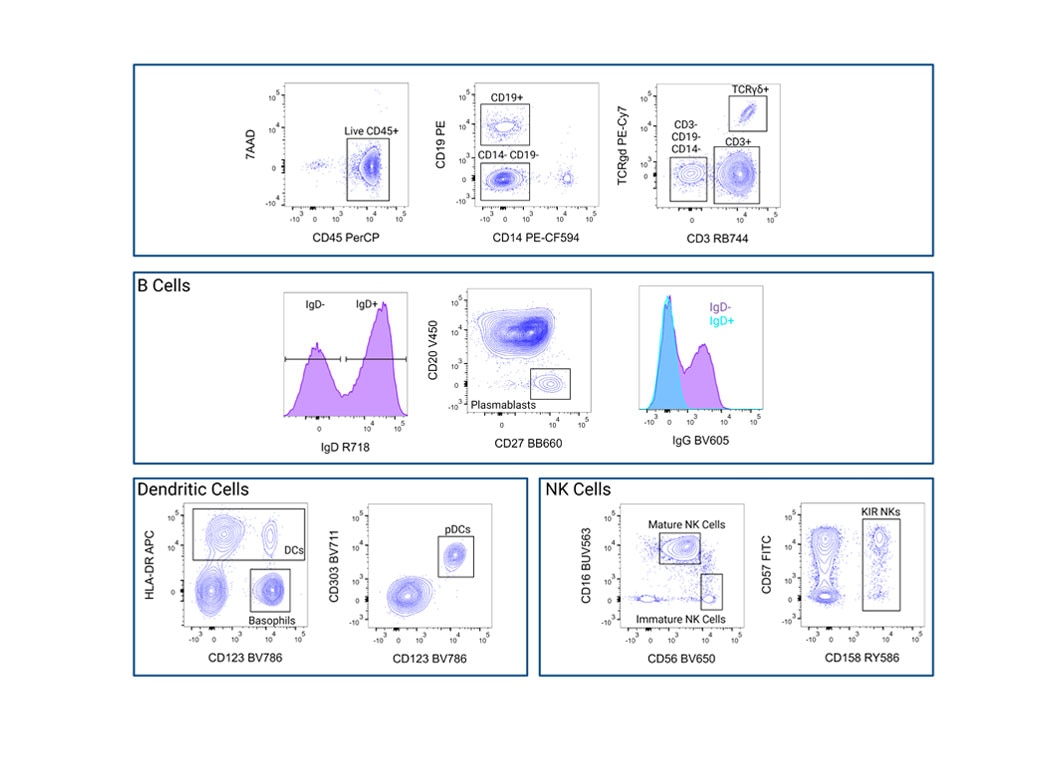
Representative analysis of freshly isolated human PBMCs obtained from healthy volunteer donors stained with a 32-color broad immunophenotyping panel
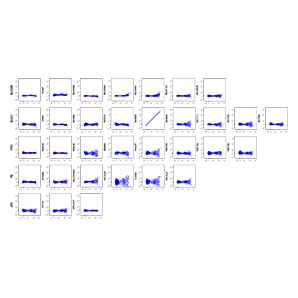
IgG BV605 matrix for single-color cells sample unmixed using BD™ SpectraComp™ Unmixing and Compensation Particles.
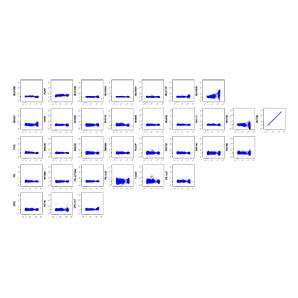
CD123 BV786 matrix for single-color samples unmixed using BD™ SpectraComp™ Unmixing and Compensation Particles.
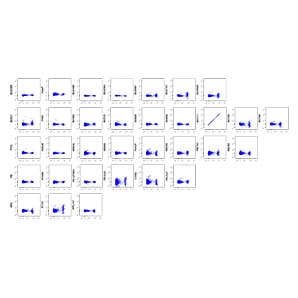
CD303 BV711 matrix for single-color samples unmixed using BD™ SpectraComp™ Unmixing and Compensation Particles.
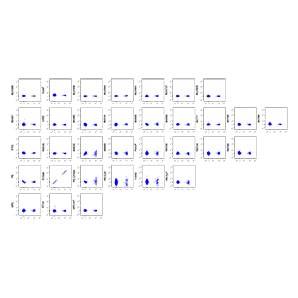
CD158 RY586 matrix for single-color samples unmixed using BD™ SpectraComp™ Unmixing and Compensation Particles.
List of Reagents in a 32-color Panel
| Marker | Clone | Dye | Cat. No. |
|---|---|---|---|
| CD45RA | 5H9 | BUV395 | 740315 |
| Auto F | — | Cells | |
| CD45RO | UCHL1 | BUV496 | 749888 |
| CD16 | 3G8 | BUV563 | 748851 |
| CD185/CXCR5 | RF8B2 | BUV661 | 741559 |
| CD28 | CD28.2 | BUV737 | 612815 |
| CD127 | HIL-7R-M21 | BUV805 | 748486 |
| CD25 | BC96 | BV421 | 567485 |
| CD20 | L27 | V450 | 561164 |
| CD62L | DREG-56 | BV480 | 566174 |
| CD39 | A1 | BV510 | 567526 |
| IgG* | G18-145 | BV605 | 563246 |
| CD56 | NCAM16.2 | BV650 | 564057 |
| CD303* | V24-785 | BV711 | 748002 |
| KLRG1 | Z7-205.rMAb | BV750 | 753692 |
| CD123* | 7G3 | BV786 | 564196 |
| CD57 | NK-1 | FITC | 555619 |
| CD4 | SK3 | RB545 | 569184 |
| CD11c | B-LY6 | BB630 | Custom |
| CD27 | M-T271 | BB660 | Custom |
| CD45 | 2D1 | PerCP | 340665 |
| CD279/PD-1 | EH12.1 | RB705 | 570245 |
| CD3 | UCHT1 | RB744 | 570470 |
| CCR7/CD197 | 2-L1-A | RB780 | 568749 |
| CD19 | HIB19 | PE | 555413 |
| CD158* | HP-MA4 | RY586 | 753232 |
| CD14 | MφP9 | PE-CF594 | 562335 |
| CD95 | DX2 | PE-Cy5 | 559773 |
| 7-AAD | — | — | — |
| TCRγδ | 11F2 | PE-Cy7 | 655434 |
| HLA-DR | TU36 | APC | 559868 |
| IgD | IA6-2 | R718 | 567993 |
| CD8 | SK1 | APC-H7 | 641409 |
This table contains all markers used to stain human PBMCs in all the data shown above.
* BD™ SpectraComp™ Unmixing and Compensation Particles used as single-color controls
Panels using BD™ SpectraComp™ XT Unmixing and Compensation Particles
Immunophenotyping of Human Monocyte and Lymphocyte Subsets
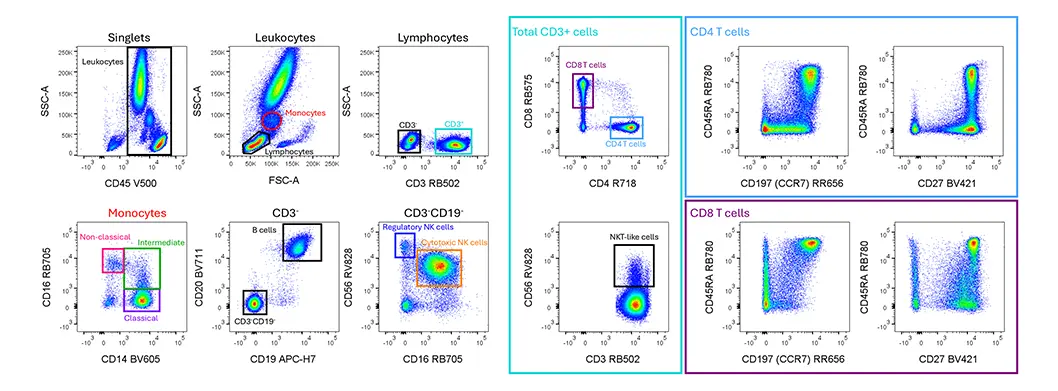
Identification of human monocyte and lymphocyte subsets
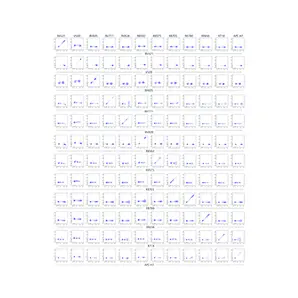
N×N matrix for single-color cell samples compensated using BD™ SpectraComp™ XT Unmixing and Compensation Particles
Marker | Clone | Fluorochrome | Cat # |
CD45 | HI30 | V500 | 560777 |
CD3 | UCHT1 | RB502 | 574470 |
CD4 | SK3 | R718 | 566930 |
CD8 | RPA-T8 | RB575 | 573344 |
CD45RA | HI100 | RB780 | 569081 |
CD197 | 2-L1-A | RR656 | 574479 |
CD27 | M-T271 | BV421 | 562513 |
CD19 | HIB19 | APC-H7 | 560727 |
CD20 | Obinutuzumab297.rmab | BV711 | 758007 |
CD56 | NCAM16.2 | RV828 | 572642 |
CD16 | 3G8 | RB705 | 570243 |
CD14 | 63D3.rMab | BV605 | 752931 |
Table of reagents to immunophenotype human monocyte and lymphocyte subsets.
Immunophenotyping of Human Regulatory T Cells (Tregs)
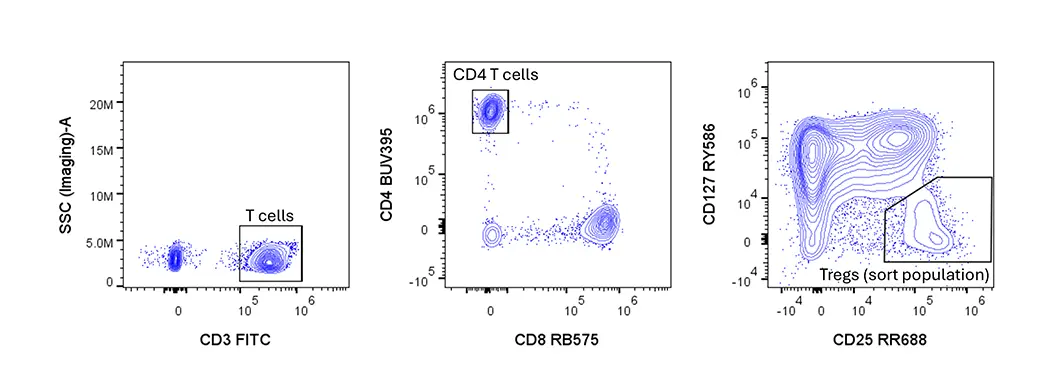
Gating strategy for identification of human regulatory T cells (Tregs) for downstream sorting using the BD FACSDiscover™ S8 Cell Sorter
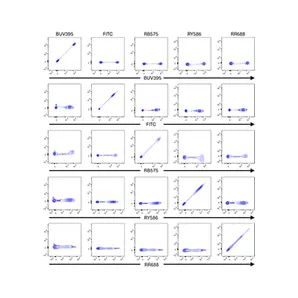
N×N matrix for single-color cell samples unmixed using BD™ SpectraComp™ XT Unmixing and Compensation Particles
Table of reagents to immunophenotype human regulatory T cells
Marker | Clone | Fluorochrome | Cat # |
CD3 | UCHT1 | FITC | 555332 |
CD4 | M-T477 | BUV395 | 742738 |
CD8 | RPA-T8 | RB575 | 573344 |
CD25 | 2A3 | RR688 | 572390 |
CD127 | HIL-7R-M21 | RY586 | 568140 |
FAQs
- What is the difference between BD™ SpectraComp™ and BD™ SpectraComp™ XT?
The main difference is multi-species reactivity. BD™ SpectraComp™ Unmixing and Compensation Particles support antibodies from mouse, rat, and hamster, whereas BD™ SpectraComp™ XT Particles add compatibility with human- and rabbit-derived antibodies. Both products provide positive and negative particle populations in a single vial and support both kappa and lambda light chains.
Can I use BD™ SpectraComp™ Beads for conventional and spectral flow cytometry?
Yes, BD™ SpectraComp™ Beads have been designed for use in both compensation and spectral unmixing. These unmixing and compensation beads provide a versatile control solution for both conventional and spectral multi-parameter flow cytometry assays.
These particles have been tested on both conventional and spectral flow cytometry cell analyzers and sorters, including the BD LSRFortessa™ Cell Analyzer, BD FACSymphony™ A5 SE Cell Analyzer, BD FACSLyric™ Clinical Flow Cytometry System, BD FACSDiscover™ A8 Cell Analyzer, BD FACSDiscover™ S8 Cell Sorter, BD FACSAria™ Fusion Flow Cytometer and also Cytek® Aurora Flow Cytometer.
- Why are my BD™ SpectraComp™ Beads not brighter than my stained cells?
If BD™ SpectraComp™ Beads are not brighter than your stained cells, the antibody reagent may need to be optimized. Compensation and spectral unmixing controls perform best when the particle MFI exceeds that of the cell population, so optimizing antibody concentration can help achieve an appropriate signal.
- What buffers are compatible with BD™ SpectraComp™ Beads?
BD™ SpectraComp™ Beads have been tested with several commonly used BD staining and sample preparation buffers. These include BD Horizon™ Brilliant Stain Buffer, BD FACS™ Lysing Solution, BD Pharm Lyse™ Lysing Buffer, BD Cytofix/Cytoperm™ Fixation/Permeabilization Kit, BD Cytofix™ Fixation Buffer, BD Pharmingen™ Transcription Factor Buffer Set and BD Phosflow™ Perm Buffer III.
- How do I use BD™ SpectraComp™ particles for compensation and spectral unmixing?
BD™ SpectraComp™ particles should be processed exactly like your cell samples. Use the same staining workflow, including any fixation, lysis, permeabilization and BD Horizon™ Brilliant Stain Buffer steps where applicable. Matching the particle and sample workflows helps minimize variability and improves the accuracy of spillover correction.


For Research Use Only. Not for use in diagnostic or therapeutic procedures.